Xhanti Payi and Busisiwe R: South Africa’s Mining Future Needs Light, Not Just Minerals


This article has been supplied.
By: Payi - Director and Radebe international consultant at Inani Strategies
It is undisputed that South African geology peers above many geographies in the world. The country sits on over fifty different minerals, from PGMs, precious metals to energy and industrial minerals - some which are the largest deposits in the world. This mineral diversity is something international investors are well aware of. The actual rocks are not the problem.
The problem, in our view, is the fog that surrounds real-time capital flow and investments in the country’s mining sector. The rocks are there, and there are parties’ intent on ensuring that they are taken out of the ground. But how can one tell where those parties are in their investment decisions, and what motivates the decisions and timing regarding the sector.
In our view, the problem, increasingly, is the fog that surrounds real-time capital flow and investment intentions.
Modern global finance works on a system where capital flows to places where risks can not only be measured, priced and modelled, but also done so in a timeframe as close to real time as possible. To model risk in this way requires data that are reliable, granular and high frequency. South Africa is thus yet to catch up to peers in this modern mining investment information landscape. Where our peers, like Australia, can perhaps let the delivery of this information slip for a quarter or so, South Africa cannot afford to do so, given the reindustrialisation the country so desperately needs.
This informational void is no more clearly illustrated than in where market analysts and investors go to look for information on how the country deploys capital.
Premier mining jurisdictions like Australia, Canada and Chile have state departments that maintain dynamic and detailed databases that plot out planned capital expenditure across the resources pipeline. In some cases, even categorising expenditure by commodity, stage of development and region. An investor, interested in future capital commitments in, say Western Australia, would only need to logon to a government database where that information would be transparently presented.
Australia publishes a regular Resources and Energy Major Projects review of investment projects which seek to extend, increase, or improve the quality of mineral commodity output in Australia. These include greenfield projects, expansions, reactivations, processing facilities, and related infrastructure. Previously released as a chapter in Australia’s Resources and Energy Quarterly, it reports the value of current and potential investment in the mining sector and provides commentary on key development trends.
In South Africa, that same investor would not have access to a government database and would have to rely on commercial banking research, such as the Nedbank Capital Expenditure Project Listing.
In the absence of a government backed and supported mining investment tracker, Nedbank’s project listing goes a long way in filling the informational void. The listing is a commendable piece of research, aggregating announced, pending and active capital expenditure projects in the whole country and across sectors. However, that an investor would have to rely on macro-aggregated research to understand capital investment pipeline of the mining sector exposes a serious flaw in the country’s public data architecture.
Not to mention that by its nature, a listing such a listing only reports on publicly announced project commitments. This can in no way be a substitute for timeous registry of sector drivers, operational inputs, and structural capital expenditure pipelines. When the Department of Mineral and Petroleum Resources or Statistics South Africa only provides lagged, backward-looking macroeconomic figures, the market is forced to piece together the future of our mining sector using proxy data and media releases.
This data opacity creates a profound bottleneck for forward investment. When capital expenditure is opaque, global markets price in a risk premium.
Boardrooms evaluating multi-billion-rand shaft sinkings, processing upgrades, or greenfield projects need line-of-sight on granular, high-frequency metrics. They need real-time data on route-specific freight bottlenecks along Transnet corridors, localised labor unit adjustments, deep-level versus open-cast cost drivers, and clear visibility on surrounding capital commitments.
Instead, when rail throughput drops or power allocations shift, local and international markets are left calculating the fallout through lagged estimates rather than transparent operational metrics.
The consequences are self-evident, and without clear, centralised tracking of capital deployment and operational drivers, investment becomes overly cautious and defensive. Capital stays parked in short-term sustaining maintenance or brownfield bailouts rather than committing to transformative, long-term expansion projects. We end up relying on external surveys - whether from commercial banks or international institutions - to tell us how healthy our own policy and investment environment actually is.
This is not merely a technical or administrative inconvenience, but it is a fundamental economic drag. When data is scarce or delayed, uncertainty increases. When uncertainty increases, the cost of capital rises. High capital costs choke off the very investments that build new infrastructure, replace aging assets, and secure future employment.
South Africa does not lack talent, engineering prowess, or mineral wealth, but a modern, transparent data architecture for our primary industry.
If we are serious about turning the mining sector into a growth engine for the next decade, fixing physical infrastructure – rail, ports, and power sources is only half the battle. We must also fix the information infrastructure. We need an open, real-time digital cadastre, integrated state-backed investment tracking, and high-frequency reporting on sector drivers.
It is time to bring South Africa’s mining sector into the light. Because in today’s global market, if investors cannot see the data, they simply will not see the opportunity.
Article Enquiry
Email Article
Save Article
Feedback
To advertise email advertising@creamermedia.co.za or click here
Research Reports
Projects
Latest Multimedia

Showroom
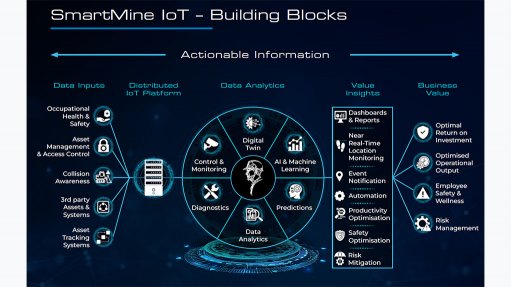
SmartMine IoT has been developed with the mining industry in mind, to provides our customers with powerful business intelligence and data modelling...
VISIT SHOWROOM
ESAB South Arica, the leading supplier of high-end welding and cutting products to the Southern African industrial market is based in...
VISIT SHOWROOM

Press Office
Announcements
What's On
Subscribe to improve your user experience...
Option 1 (equivalent of R125 a month):
Receive a weekly copy of Creamer Media's Engineering News & Mining Weekly magazine
(print copy for those in South Africa and e-magazine for those outside of South Africa)
Receive daily email newsletters
Access to full search results
Access archive of magazine back copies
Access to Projects in Progress
Access to ONE Research Report of your choice in PDF format
Option 2 (equivalent of R375 a month):
All benefits from Option 1
PLUS
Access to Creamer Media's Research Channel Africa for ALL Research Reports, in PDF format, on various industrial and mining sectors
including Electricity; Water; Energy Transition; Hydrogen; Roads, Rail and Ports; Coal; Gold; Platinum; Battery Metals; etc.
Already a subscriber?
Forgotten your password?
Receive weekly copy of Creamer Media's Engineering News & Mining Weekly magazine (print copy for those in South Africa and e-magazine for those outside of South Africa)
➕
Recieve daily email newsletters
➕
Access to full search results
➕
Access archive of magazine back copies
➕
Access to Projects in Progress
➕
Access to ONE Research Report of your choice in PDF format
RESEARCH CHANNEL AFRICA
R4500 (equivalent of R375 a month)
SUBSCRIBEAll benefits from Option 1
➕
Access to Creamer Media's Research Channel Africa for ALL Research Reports on various industrial and mining sectors, in PDF format, including on:
Electricity
➕
Water
➕
Energy Transition
➕
Hydrogen
➕
Roads, Rail and Ports
➕
Coal
➕
Gold
➕
Platinum
➕
Battery Metals
➕
etc.
Receive all benefits from Option 1 or Option 2 delivered to numerous people at your company
➕
Multiple User names and Passwords for simultaneous log-ins
➕
Intranet integration access to all in your organisation