Partnership sees introduction of advanced drones

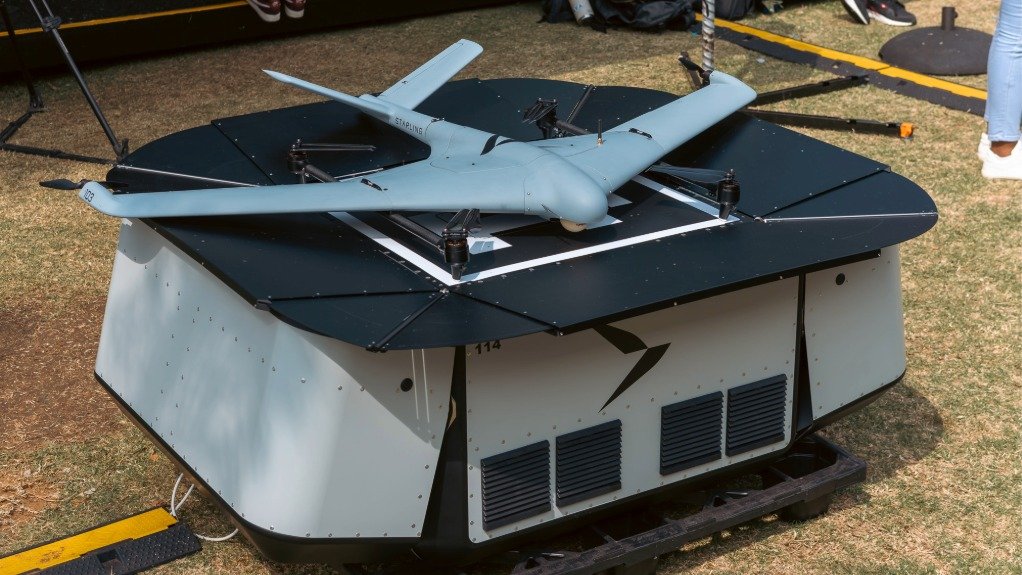
EYES IN THE SKY The Pathfinder-X launches autonomously from powered and connected hubs, providing repeatable, regular aerial intelligence


Mining technology integrator Dwyka Mining Services has entered a reseller partnership with US-based aerospace and robotics company Starling Systems as a means to introduce Starling’s advanced aerial intelligence and autonomous capabilities to the African mining industry.
Among various solutions, Starling’s Pathfinder-X ‘drone-in-a-box’ solution combines endurance on long missions with vertical take-off and landing capabilities, enabling rapid intervention.
“When an incident or threat occurs, the aircraft is on scene fast, securing the area and putting eyes on the ground,” says Dwyka CEO and Mining Indaba Steering Committee member Jamie van Schoor.
The Mining Indaba is a yearly mining conference and expo, with the 2027 edition set to take place at the Cape Town International Convention Centre over February 8 to 11. Dwyka Labs – the innovation, training, and social impact unit of Dwyka Mining Services – will take part in a panel discussion during the 2027 Mining Indaba.
The Pathfinder-X drones launch autonomously from powered and connected hubs, controlled by remote operators that plan, upload and execute missions, explains Van Schoor.
The drone-in-a-box model centralises pilot skills and flight frequency, enabling repeatable, regular aerial intelligence operations. As a result, he says remote operations can be deployed and managed from a single point, enabling greater control over resource costs and operating expenses, while removing personnel from hazardous environments.
Alongside drones, other replaceable robots offer significant advantages in hazardous environments and confined spaces where “getting in, capturing mission-critical data and getting out safely carries real risk”, such as in underground blast-clearance window applications, outlines Van Schoor.
He explains that these post-blast applications involve mining operations having to wait until blast gasses have exited underground workings before personnel and machines can re-enter the area for the next shift, with some deep-level mines having to wait up to three hours for this process to take place.
Robots can reclaim this wasted time by measuring gas levels to confirm the exact times in which safe re-entry can be made.
Further, as gas readings are position-referenced, operations know which underground districts are clear, enabling personnel to prioritise these for early re-entry, thereby improving interval control, says Van Schoor.
For surface applications, drone-in-a-box solutions enable clients to schedule repeatable surveys and inspections across mission-critical infrastructure and volumetrically important areas such as conveyor belts, ore tips and stockpiles, supporting inventory and mineral accounting.
In underground applications, fully autonomous drones use laser navigation to capture high-resolution 3D data, helping operations manage blasting precisely to reduce dilution, improve grade and boost recovery.
Fit-for-Purpose Robots
Autonomous robot systems – separated into fully autonomous which requires no human intervention and semi-autonomous which requires human involvement to guide the system – use onboard sensors to assist and augment human operation. However, the appropriate system for a specific application depends on the application.
“Cobot relationships”, where humans and robots work together, are now a central conversation among pioneering users and operations preparing their workforce and commodity base to stay globally competitive, says Van Schoor.
Meanwhile, in water applications, autonomous multibeam sonar platforms have the ability to “dramatically accelerate” the mapping of tailings storage facilities and water bodies, notes Van Schoor.
The use of ground robots is also accelerating, anchored in what Van Schoor says is their ability to cover greater distances using a single battery charge, as well as their ability to be used in hazardous, confined and uninhabitable areas.
In Africa, this extends to outdoor applications where exposure to harsh weather conditions and chemicals can present adverse and even hazardous working environments for humans.
Across all areas, he says, mining operations are increasingly adopting robotics through robotics-as-a-service models, which shift expenditure from capital investment to ongoing operating costs.
Connected Security
To improve operational efficiency, drones and ground robots are increasingly sharing a single inspection and monitoring workflow, says Van Schoor. For example, the Pathfinder-X and its Starling Hub can work alongside robotics developer Boston Dynamics’ four-legged mobile inspection robot, Spot.
Van Schoor explains that ground and aerial robots can collaborate on various datasets such as position, location and coverage, including handing off tasks and responsibilities to each other to ensure objectives are met.
One such application is perimeter inspections. To ensure mine security, mines must conduct regular, unpredictable and quick-to-deploy inspections after a trigger event. In this application, he says Pathfinder-X launches automatically from a central hub and provides a near-real-time aerial view of the location to gather evidence and provide an aerial perspective of the situation, day or night.
Spot and similar quadruped platforms can then patrol long perimeters with thermal and high optical zoom cameras to capture detailed data and provide early warnings.
By recharging at a series of docks along the route, the drones and ground robots can inspect and secure long linear assets across an extensive area and throughout an almost 24/7 window, explains Van Schoor.
Article Enquiry
Email Article
Save Article
Feedback
To advertise email advertising@creamermedia.co.za or click here
Research Reports


Projects
Latest Multimedia
Latest News
Showroom
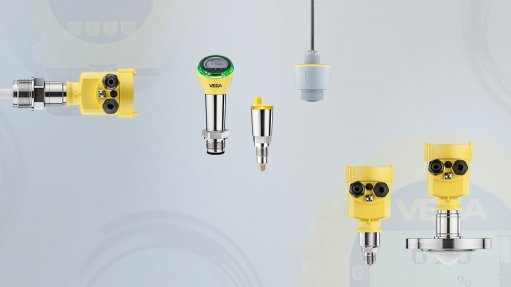
For over 60 years, VEGA has provided industry-leading products for the measurement of level, density, weight and pressure. As the inventor of the...
VISIT SHOWROOM
The SAIMM started as a learned society in 1894 after the invention of the cyanide process that saved the South African gold mining industry of the...
VISIT SHOWROOM



Press Office
Announcements
What's On
Subscribe to improve your user experience...
Option 1 (equivalent of R125 a month):
Receive a weekly copy of Creamer Media's Engineering News & Mining Weekly magazine
(print copy for those in South Africa and e-magazine for those outside of South Africa)
Receive daily email newsletters
Access to full search results
Access archive of magazine back copies
Access to Projects in Progress
Access to ONE Research Report of your choice in PDF format
Option 2 (equivalent of R375 a month):
All benefits from Option 1
PLUS
Access to Creamer Media's Research Channel Africa for ALL Research Reports, in PDF format, on various industrial and mining sectors
including Electricity; Water; Energy Transition; Hydrogen; Roads, Rail and Ports; Coal; Gold; Platinum; Battery Metals; etc.
Already a subscriber?
Forgotten your password?
Receive weekly copy of Creamer Media's Engineering News & Mining Weekly magazine (print copy for those in South Africa and e-magazine for those outside of South Africa)
➕
Recieve daily email newsletters
➕
Access to full search results
➕
Access archive of magazine back copies
➕
Access to Projects in Progress
➕
Access to ONE Research Report of your choice in PDF format
RESEARCH CHANNEL AFRICA
R4500 (equivalent of R375 a month)
SUBSCRIBEAll benefits from Option 1
➕
Access to Creamer Media's Research Channel Africa for ALL Research Reports on various industrial and mining sectors, in PDF format, including on:
Electricity
➕
Water
➕
Energy Transition
➕
Hydrogen
➕
Roads, Rail and Ports
➕
Coal
➕
Gold
➕
Platinum
➕
Battery Metals
➕
etc.
Receive all benefits from Option 1 or Option 2 delivered to numerous people at your company
➕
Multiple User names and Passwords for simultaneous log-ins
➕
Intranet integration access to all in your organisation