Designing for women means designing better places for everyone

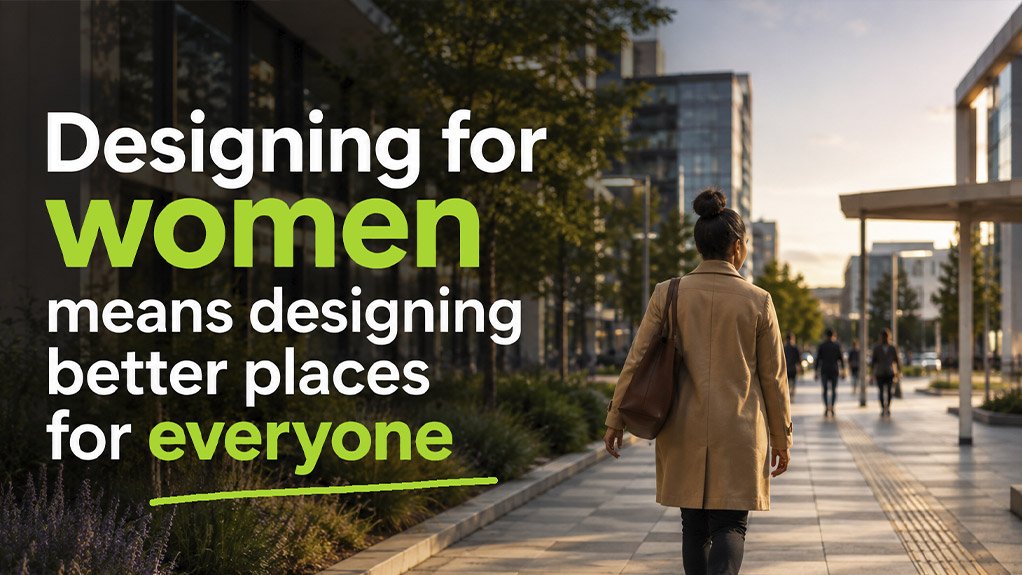



We tend to judge a development by what happens within its boundaries. But that is not necessarily how the people using it experience it.
A route that feels perfectly ordinary at lunchtime can feel very different after dark if the lighting is poor, visibility is limited, or the walk to public transport is isolated. A parking area, pedestrian crossing, or transport stop might seem like a relatively small part of a development, but for someone using that development every day, it can make an enormous difference.
Women’s Month gives us an opportunity to think about this more closely. Women often experience the safety and mobility weaknesses in our built environment particularly sharply. Statistics South Africa has previously highlighted women’s greater reliance on public transport and the role that safe transport plays in accessing employment, especially where journeys involve walking to and waiting at transport stops.
But there is a broader point for the construction industry. Looking at the built environment through women’s experiences can tell us a great deal about how well our developments work for everyone.
Safety starts before the entrance
Lighting is an obvious place to start, although simply adding more lights does not necessarily make a place feel safe.
A brightly lit entrance is of limited value if the route leading to it passes behind dense landscaping or through an inactive stretch of public space with poor visibility. The different elements have to work together.
The 2026 UN-Habitat World Cities Report identifies clear sightlines and adequate lighting among the urban design elements that support women’s security and freedom of movement. Importantly, these are not problems that should be fixed once a development is occupied. They are decisions that can be considered much earlier, during planning and design.
“We sometimes think about accessibility mainly in terms of whether people can enter and use a building, when their experience of that development starts much earlier,” says Morag Evans, CEO of Databuild. “How someone reaches it, moves around it, and gets home again should form part of our understanding of whether that place genuinely works.”
That means looking beyond the building itself.
The journey matters too
Think about a woman leaving work after dark. Her experience of that workplace does not end when she walks out of the front door. There is still the route to the parking area, the walk to public transport, the time spent waiting for a taxi or bus and, in many cases, another walk at the other end.
The same applies elsewhere. A clinic is connected to the pavement outside it. A workplace is connected to the transport people use to reach it. A public facility is affected by what people encounter between the building and the surrounding community.
Of course, developers and project teams cannot control every part of an urban journey. But developments do not exist independently of their surroundings either.
The position of entrances, pedestrian access, transport connections, public amenities, and how a site meets the street can make the journey easier or create another obstacle.
This matters particularly for women because of their greater reliance on public transport, but it is certainly not only women who benefit from getting these connections right.
Designing around real life
Perhaps the more useful question is: how will people actually use this place?
Someone collecting a child after work experiences a transport interchange differently from someone arriving by car during daylight hours. A person with limited mobility notices a broken pavement or badly positioned crossing that others may barely register. A public space that feels welcoming when it is busy can feel very different after the surrounding businesses have closed.
There is no single “typical” user, just as there is no single way in which a development will be experienced.
This is why UN Women’s Safe Cities and Safe Public Spaces programme places such emphasis on understanding women’s lived experience when cities plan and invest in public spaces and services. Its work over the past 15 years has shown the value of looking at places through the eyes of the people who actually use them.
For developers and project teams, this does not mean creating a separate category of places designed for women. It means asking better questions early enough for the answers to matter.
Who will use this development? How will they get there? What happens when they leave after dark? Where might someone feel exposed or struggle to move around easily?
Often, the answers point to relatively ordinary design decisions. But ordinary decisions can have a considerable effect on how a place works.
Good design has to survive occupation
There is another part of the conversation that is easy to overlook. Even a well-designed place can stop working as intended.
Lights break. Vegetation grows and begins to obscure sightlines. Pavements deteriorate. Access points are changed or poorly managed. A pedestrian route that worked well when a development opened may feel quite different several years later.
So inclusive design cannot live only in the original drawings and specifications. How a development is operated and maintained matters too.
“We need to look at familiar places through a different lens,” says Evans. “When we understand where people feel excluded, unsafe, or simply inconvenienced by the way a place has been designed, we gain information that can help us build better.”
Women’s Month is a useful opportunity to do exactly that.
Building places that work for everyone
Designing with women in mind does not ultimately benefit women alone.
A safer walk to public transport benefits the person working late. Better lighting helps someone crossing a parking area at night. Clearer pedestrian routes help older people, children and people with limited mobility. Better connections between a development and its surroundings make places easier for everyone to use.
Perhaps that is the real value of looking at the built environment through women’s experiences. It gives us another way to notice the things we might otherwise overlook.
A successful development should not only work on a drawing but also within the boundaries of the site. It should work for the people who have to use it in real life.
Article Enquiry
Email Article
Save Article
Feedback
To advertise email advertising@creamermedia.co.za or click here
Research Reports

Projects
Latest Multimedia


Latest News

Showroom

Your global lifecycle technology & service partner for materials & minerals processing equipment for coal, iron ore, copper, manganese & other...
VISIT SHOWROOM
Electrifying the world in a safe, smart, and sustainable way, ABB Electrification is a global technology leader in electrical distribution and...
VISIT SHOWROOM


Announcements
What's On
Subscribe to improve your user experience...
Option 1 (equivalent of R125 a month):
Receive a weekly copy of Creamer Media's Engineering News & Mining Weekly magazine
(print copy for those in South Africa and e-magazine for those outside of South Africa)
Receive daily email newsletters
Access to full search results
Access archive of magazine back copies
Access to Projects in Progress
Access to ONE Research Report of your choice in PDF format
Option 2 (equivalent of R375 a month):
All benefits from Option 1
PLUS
Access to Creamer Media's Research Channel Africa for ALL Research Reports, in PDF format, on various industrial and mining sectors
including Electricity; Water; Energy Transition; Hydrogen; Roads, Rail and Ports; Coal; Gold; Platinum; Battery Metals; etc.
Already a subscriber?
Forgotten your password?
Receive weekly copy of Creamer Media's Engineering News & Mining Weekly magazine (print copy for those in South Africa and e-magazine for those outside of South Africa)
➕
Recieve daily email newsletters
➕
Access to full search results
➕
Access archive of magazine back copies
➕
Access to Projects in Progress
➕
Access to ONE Research Report of your choice in PDF format
RESEARCH CHANNEL AFRICA
R4500 (equivalent of R375 a month)
SUBSCRIBEAll benefits from Option 1
➕
Access to Creamer Media's Research Channel Africa for ALL Research Reports on various industrial and mining sectors, in PDF format, including on:
Electricity
➕
Water
➕
Energy Transition
➕
Hydrogen
➕
Roads, Rail and Ports
➕
Coal
➕
Gold
➕
Platinum
➕
Battery Metals
➕
etc.
Receive all benefits from Option 1 or Option 2 delivered to numerous people at your company
➕
Multiple User names and Passwords for simultaneous log-ins
➕
Intranet integration access to all in your organisation