
Could Southern Africa’s next wave of green industrialisation come from the ocean?


Gaylor Montmasson-Clair is a director of Southern Transitions, a Global South just transition ‘think-and-do tank’



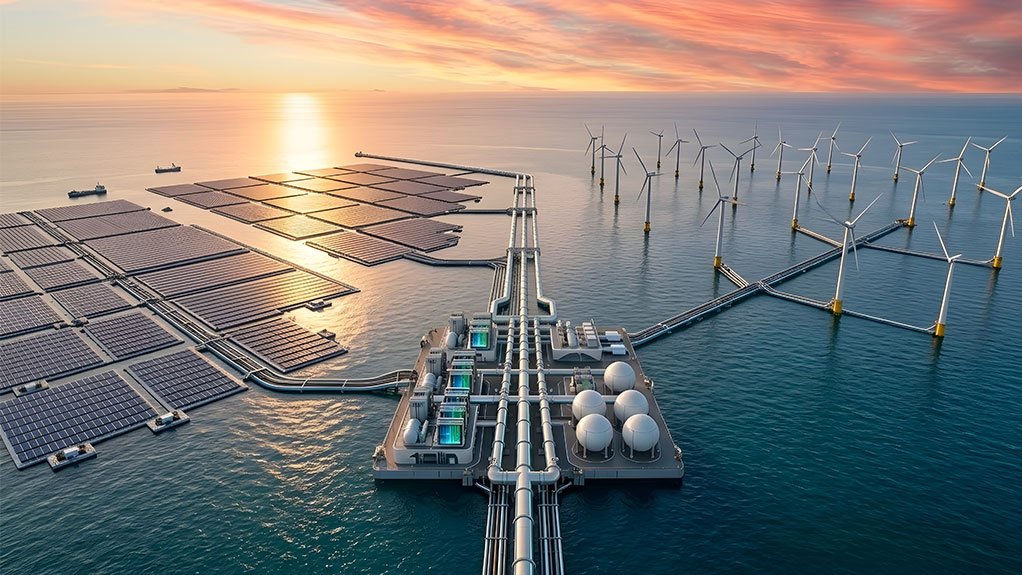
It is 2040. You are strolling along the west coast of South Africa. In the sunset, offshore wind turbines pepper the horizon. On the quayside at Saldanha Bay, a floating platform the size of a city block is fitted with a turbine before it is towed out into the Atlantic. Its tower was rolled from local steel, and its cables made in the region. A few kilometres inland, a green steel plant and an ammonia facility run on steady, low-carbon electricity. Further up the coast, Walvis Bay services the wind farms off Namibia and supplies the green hydrogen cluster of the !Nara Namib Industrial Zone, while Angola’s Atlantic ports and Mozambique’s Indian Ocean coast extend the corridor north and east. Through the Southern African Power Pool (SAPP), renewable energy produced offshore flows inland to mines, factories and plants, creating thousands of local, decent jobs across the region.
This picture may feel distant, but it is not a utopia. It is what Southern Africa’s next wave of green industrialisation could look like if the region actively prepared for it.
Already, the development of renewable energy, although nascent, is gathering pace. Solar and wind energy generation capacity in Southern African Development Community (SADC) countries stood at 17.6 GW in 2025, compared with a mere 15 MW in 2010. And much potential remains to be unlocked. Solar and onshore wind energy, supported by battery storage, are set to comprise a growing share of the region’s generation capacity – up to 53% by 2040, including hydropower. Accelerating this wave is fundamental to powering the region’s development ambitions, achieving universal energy access and greening existing industries. And so is planning for the next wave. This is where offshore wind could come in, not as a substitute but as a complement to onshore technologies.
Southern Africa’s offshore wind resource is indeed exceptional. Along the Benguela coast, offshore wind can achieve capacity factors above 50%, comparable to the best North Sea sites. South Africa alone has around 95 GW of technical potential in suitable areas, mostly for floating turbines, and Namibia, Angola and Mozambique hold significant potential too.
Currently, offshore wind costs more than onshore technologies, but its costs are declining steadily. Moreover, the case for offshore wind does not only rest on cost: the real value lies in the industrial ecosystem it can underpin. Offshore wind is as much a regional industrial project as a national energy one. Direct employment is concentrated in construction, manufacturing, and operation and maintenance: installing a gigawatt a year mobilises around 25 000 full-time-equivalent jobs during construction, and each operating gigawatt sustains about 600 more. In the value chain, offshore wind generation could power green industrialisation at scale, such as green iron and steel. It could also anchor a range of connected activities, such as surveys, marine services, port logistics and, over time, the manufacturing of towers, foundations and cables.
The region has more to build on than is often assumed. The existing oil, gas and heavy marine capabilities of Angola, Namibia and Mozambique, and South Africa’s steel and heavy engineering base, along with its onshore wind experience, can be leveraged to roll out both fixed-bottom and floating platforms. Walvis Bay, Saldanha Bay, Ngqura, Durban and Richards Bay could serve as fabrication and marshalling bases, or as logistics and maintenance hubs.
Yet the path ahead remains long. Offshore wind projects typically take nine to twelve years from site identification to operation, and the enabling environment takes as long to establish. No SADC country has set offshore wind targets in its electricity or industrial plans yet. None has begun the multi-year, on-site measurement of wind, waves and currents. No port in the region meets floating wind’s requirements for depth, load-bearing capacity and space, and reinforcing coastal grids will take about a decade. Then, an added challenge is whether communities can collectively imagine offshore wind as part of a compelling development story.
Encouragingly, the landscape has started to shift. In September 2026, South Africa published a strategic framework for offshore wind. And the first offshore wind farm in the region, off the coast of Richards Bay, is in development.
Looking ahead, the good news is that what needs to happen now is low- or no-regret, because it would strengthen the region’s energy and industrial position under any scenario. Coastal states should pool resources to build shared marine, metocean and biodiversity data. Ports, coastal grids and industrial zones should be planned together, with offshore wind in the mix. Regional bodies (SADC and the SAPP) should be given a mandate to coordinate, along with national lead authorities. Value chains should be mapped to guide localisation, and skills built on the region’s oil and gas, marine, port and renewable-energy capabilities. Above all, the region should agree on a common value proposition and finance strategy. Negotiating as a region, rather than country by country, is the best way to secure good terms from leading global players.
Moreover, starting now would give the region a rare chance to shape the industry from the outset, designing cost- and benefit-sharing arrangements so that offshore wind contributes to a just transition, with gains well beyond energy for workers, and for coastal and fishing communities.
The 2040 vision is within reach, but it will not build itself. And the work starts now. Whether those platforms are towed out of Saldanha Bay, and whether the jobs and industries they anchor are shared across the region, depends on decisions taken today.
Gaylor Montmasson-Clair is a director of Southern Transitions, a Global South just transition ‘think-and-do tank’
Article Enquiry
Email Article
Save Article
Feedback
To advertise email advertising@creamermedia.co.za or click here
Research Reports
Projects

Latest Multimedia

Latest News
Showroom
The Aluminium Federation of South Africa (AFSA), is the voice of the South African aluminium industry.
VISIT SHOWROOM
Willard Batteries is one of the leading brands in automotive battery power products. With a rich history spanning over 70 years, Willard batteries...
VISIT SHOWROOM

Announcements
What's On
Subscribe to improve your user experience...
Option 1 (equivalent of R125 a month):
Receive a weekly copy of Creamer Media's Engineering News & Mining Weekly magazine
(print copy for those in South Africa and e-magazine for those outside of South Africa)
Receive daily email newsletters
Access to full search results
Access archive of magazine back copies
Access to Projects in Progress
Access to ONE Research Report of your choice in PDF format
Option 2 (equivalent of R375 a month):
All benefits from Option 1
PLUS
Access to Creamer Media's Research Channel Africa for ALL Research Reports, in PDF format, on various industrial and mining sectors
including Electricity; Water; Energy Transition; Hydrogen; Roads, Rail and Ports; Coal; Gold; Platinum; Battery Metals; etc.
Already a subscriber?
Forgotten your password?
Receive weekly copy of Creamer Media's Engineering News & Mining Weekly magazine (print copy for those in South Africa and e-magazine for those outside of South Africa)
➕
Recieve daily email newsletters
➕
Access to full search results
➕
Access archive of magazine back copies
➕
Access to Projects in Progress
➕
Access to ONE Research Report of your choice in PDF format
RESEARCH CHANNEL AFRICA
R4500 (equivalent of R375 a month)
SUBSCRIBEAll benefits from Option 1
➕
Access to Creamer Media's Research Channel Africa for ALL Research Reports on various industrial and mining sectors, in PDF format, including on:
Electricity
➕
Water
➕
Energy Transition
➕
Hydrogen
➕
Roads, Rail and Ports
➕
Coal
➕
Gold
➕
Platinum
➕
Battery Metals
➕
etc.
Receive all benefits from Option 1 or Option 2 delivered to numerous people at your company
➕
Multiple User names and Passwords for simultaneous log-ins
➕
Intranet integration access to all in your organisation