Water Is Production Infrastructure



This article has been supplied.
(Virtual Showroom) Water rarely announces a shutdown.
Production losses often begin quietly. A sump fills faster than expected. A haul road softens. A pump runs beyond its intended duty. Maintenance teams respond under pressure while access narrows and water levels continue to rise.
By the time flooding becomes visible, cost has already entered the operation through lost time, reduced mobility, delayed development and greater pressure on equipment.
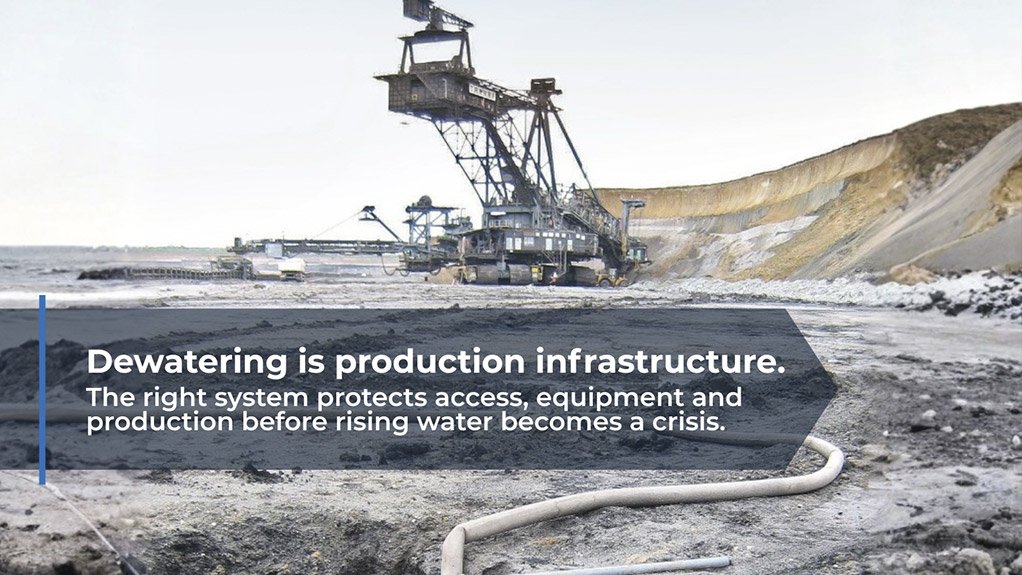
Dewatering is production infrastructure.
The real cost sits beyond the pump
The purchase price of a pump appears on a quotation.
The cost of poor selection appears later through repeated failures, higher energy use, damaged infrastructure, lost shifts and delayed mine development.
A unit selected according to discharge size or motor output alone might move water under ideal conditions. Mine water seldom presents ideal conditions.
Flow rate, total dynamic head, fluid temperature, pH, solids concentration, particle size, abrasiveness, specific gravity, voltage, pipe diameter, transfer distance and operating hours all shape performance.
Specific gravity deserves particular attention. Water carrying suspended mineral solids places greater load on a motor than clean water. A selection based on clean-water performance risks reduced delivery once density increases.
The duty point also matters. Oversized equipment often operates outside its preferred range or cycles too frequently. Undersized equipment runs continuously without lowering water levels fast enough.
Both outcomes raise operating cost and shorten service life.
Head changes the entire duty
Depth and distance place added demands on a mine-water system.
High-volume drainage and high-head transfer serve different purposes. Moving large volumes from a shallow sump requires a different hydraulic approach from lifting water through deep workings or transferring water across long pipelines.
As mines deepen, the required pumping head increases. Each additional stage introduces friction losses, pressure requirements, controls and further points of risk.
Tsurumi’s LH and LHW ranges address medium-to-high flow at higher heads, including deep mine dewatering, staged pumping and long-distance transfer. These duties require more than motor capacity. Seal protection, impeller design, discharge configuration and system planning all influence reliability.
Abrasive water changes the equipment requirement
Mine drainage rarely contains clean water alone.
Sand, silt, clay, fines and fragmented mineral matter pass through the hydraulic components. Each particle contributes to wear across the impeller, suction plate, casing and sealing arrangement.
High-chromium cast iron resists abrasive wear. Slower-speed motors reduce impeller tip velocity in high-volume duties. Agitator-equipped slurry pumps suspend settled material before transfer, supporting sump cleaning and sediment removal.
Tsurumi’s KTZ range supports demanding dewatering applications through cast-iron construction, high-chromium impellers and protective features suited to abrasive conditions. KRS models address high-volume drainage through low-speed, heavy-duty construction. GPN slurry pumps use high-chromium wear components and an agitator to move settled solids.
Mechanical-seal design also influences operating life. Seals isolated inside an oil chamber remain separated from abrasive fluid. Anti-wicking cable entry helps prevent moisture movement along damaged conductors. Thermal protection guards the motor against excess heat and unsuitable running conditions.
African scale requires African application thinking
Mine-water systems must reflect the scale of the operation and the consequences of interrupted transfer.
At a diamond mining operation in Angola, four Tsurumi LH8110 pumps were installed on a modular pontoon system. Each 110 kW unit delivers approximately 26,000 litres per minute.
The installation demonstrates a clear principle. Water-transfer capacity must match the hydraulic duty, site infrastructure and level of production risk.
Large mining operations require more than equipment delivery. They require a clear understanding of inflow, discharge location, future depth, standby capacity, available power and maintenance access.
A pump forms one part of the solution. The full system protects production.
Power and redundancy form part of resilience
Many African mines operate in remote areas or depend on constrained electrical infrastructure, generators and long cable runs.
Correct motor sizing affects energy demand, cable selection, control equipment and the ability to respond during peak inflow.
Automatic level control limits unnecessary dry running and reduces manual intervention. Electrode-based controls suit narrow sumps where traditional float arrangements create movement or space constraints.
Critical duties also require redundancy.
A duty, assist and standby arrangement provides added protection during sudden inflow, maintenance or equipment failure. Standby equipment still requires adequate power, correctly sized discharge lines, suitable valves, lifting arrangements and tested controls.
Emergency planning should take place before seasonal rainfall, pit expansion or deeper development changes the hydraulic duty.
Water responsibility extends beyond the mine
Mine-water management does not end at the sump or discharge point.
Abstraction, reuse, treatment and discharge decisions affect surrounding communities, downstream users and the wider catchment.
Poor water management creates operational, environmental and reputational risk. Responsible planning must protect production while recognising water as a shared resource.
This wider responsibility gives mine-water engineering greater meaning. Reliable systems protect access and machinery. Responsible systems also support environmental performance, regulatory confidence and long-term operating stability.
Technical resilience depends on people
Women in Mining and Engineering Day places attention on leadership, skills development and technical responsibility.
Mine-water control draws on mechanical engineering, electrical knowledge, hydrology, environmental management, maintenance planning and operational experience.
Stronger pathways for women across these disciplines expand the available skills base and support succession planning.
Progress requires meaningful site exposure, technical responsibility, structured mentorship and access to decision-making roles. Development should extend across system design, pump selection, commissioning, control systems, maintenance planning, environmental oversight and project leadership.
Reliable infrastructure depends on skilled people with the authority and experience to make informed decisions under changing operating conditions.
From equipment supply to production protection
Tsurumi Pumps Africa approaches mine dewatering as a complete operating requirement.
Flow, head, fluid composition, solids loading, specific gravity, pH, available power, site layout and future development guide the selection process.
The final solution might involve one submersible unit, staged pumping across several levels, high-head transfer, automated control, high-volume drainage, abrasive slurry handling or standby capacity.
The objective stays consistent.
Keep working areas accessible. Protect critical infrastructure. Control operating costs. Reduce disruption.
Mine-water systems should be judged by the production they protect, the access they preserve and the operational risk they remove.
Tsurumi Pumps Africa will exhibit at Electra Mining Africa 2026 from 7 to 11 September at the Johannesburg Expo Centre, Nasrec.
Mining companies, engineers, contractors and project teams are invited to discuss dewatering duties, high-head transfer and mine-water planning at Hall 6, Stand D21.
Article Enquiry
Email Article
Save Article
Feedback
To advertise email advertising@creamermedia.co.za or click here
Research Reports


Projects
Latest Multimedia

Latest News
Showroom

We partner growth of our select clients through our comprehensive and competitive integrated international logistics, trade finance and information...
VISIT SHOWROOM
Sika South Africa is a trusted partner for the nation’s infrastructure, commercial, residential, and industrial sectors.
VISIT SHOWROOM
Announcements
What's On
Subscribe to improve your user experience...
Option 1 (equivalent of R125 a month):
Receive a weekly copy of Creamer Media's Engineering News & Mining Weekly magazine
(print copy for those in South Africa and e-magazine for those outside of South Africa)
Receive daily email newsletters
Access to full search results
Access archive of magazine back copies
Access to Projects in Progress
Access to ONE Research Report of your choice in PDF format
Option 2 (equivalent of R375 a month):
All benefits from Option 1
PLUS
Access to Creamer Media's Research Channel Africa for ALL Research Reports, in PDF format, on various industrial and mining sectors
including Electricity; Water; Energy Transition; Hydrogen; Roads, Rail and Ports; Coal; Gold; Platinum; Battery Metals; etc.
Already a subscriber?
Forgotten your password?
Receive weekly copy of Creamer Media's Engineering News & Mining Weekly magazine (print copy for those in South Africa and e-magazine for those outside of South Africa)
➕
Recieve daily email newsletters
➕
Access to full search results
➕
Access archive of magazine back copies
➕
Access to Projects in Progress
➕
Access to ONE Research Report of your choice in PDF format
RESEARCH CHANNEL AFRICA
R4500 (equivalent of R375 a month)
SUBSCRIBEAll benefits from Option 1
➕
Access to Creamer Media's Research Channel Africa for ALL Research Reports on various industrial and mining sectors, in PDF format, including on:
Electricity
➕
Water
➕
Energy Transition
➕
Hydrogen
➕
Roads, Rail and Ports
➕
Coal
➕
Gold
➕
Platinum
➕
Battery Metals
➕
etc.
Receive all benefits from Option 1 or Option 2 delivered to numerous people at your company
➕
Multiple User names and Passwords for simultaneous log-ins
➕
Intranet integration access to all in your organisation