Mining’s shift from automation to intelligent operations

AVEVA’s Glenn Kerkhoff and Metlen Energy & Metals’ Grigorios Paschalis discuss how companies can move beyond isolated automation projects towards more connected and increasingly intelligent operations.
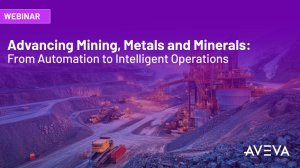


The mining, metals and minerals industries are under increasing pressure to extract greater value from existing assets, with data, AI and connected operations emerging as important tools for improving productivity, asset performance and resource efficiency.
Speaking during an AVEVA webinar titled Advancing Mining, Metals and Minerals: From Automation to Intelligent Operations, AVEVA Global Industry Principal for Mining, Metals & Minerals Glenn Kerkhoff and Metlen Energy & Metals metallurgy technical director Grigorios Paschalis discussed how companies can move beyond isolated automation projects towards more connected and increasingly intelligent operations.
Kerkhoff identified productivity, capital allocation and asset performance, and energy and water as three major forces shaping the industry.
Growing demand for metals and minerals, driven partly by electrification, the energy transition and the expansion of data centres, is increasing pressure on producers to get more from existing operations, he said.
At the same time, companies are becoming more disciplined about capital allocation and are seeking measurable returns from investments, while energy and water are increasingly becoming production-critical inputs rather than simply sustainability considerations.
“Companies need to create more value from the assets and resources they already have,” Kerkhoff said.
He outlined a progression towards intelligent operations based on three digital enablers: connected operations, an industrial data foundation and industrial AI. Connecting people, assets and processes across the value chain provides the basis for bringing together trusted and contextualised data, which can then be used to apply AI to operational challenges.
However, Kerkhoff stressed that the objective should not be to introduce AI for its own sake.
The progression towards autonomy should instead move from connected data and contextual awareness to predictive capabilities, coordinated decision-making and, ultimately, adaptive operations that can respond to changing conditions within defined parameters.
“Autonomy is bigger than just autonomous equipment,” he said, adding that the objective was not to remove people, but “to make the operation more intelligent and more responsive”.
From an operational problem to an AI solution
Paschalis provided a practical example from Metlen’s Aluminium of Greece refinery, where the company has used AI, computer vision, cameras and data systems to improve the management of bauxite feedstock.
The challenge was relatively straightforward: daily instructions specified which types of bauxite should enter the production process, but the company did not have sufficient visibility to determine whether those instructions were being followed accurately.
Metlen therefore developed a pilot project using cameras installed at the bauxite stockpile and on loaders, together with GPS, onboard equipment and cloud-based data processing. The system tracks dumping events and provides information on when, where and what type of bauxite is being fed into the process.
The resulting data is fed into the company’s PI system, creating a basis for further process optimisation and the development of machine-learning and advanced process-control applications.
The results included better process monitoring, reduced bauxite consumption and improved feedstock management. Metlen reported a 10% reduction in the consumption of bauxite directed to a specific part of the process, together with a 0.5% improvement in process efficiency.
Paschalis said the project had also improved working conditions by reducing the need for employees to be physically present at the bauxite stockpile to verify whether material was being handled according to instructions.
Importantly, the technology was developed in response to an operational need rather than as an exercise in adopting new technology.
“The whole digital transformation and the whole technological innovation starts with the business,” Paschalis said. “There is a business need behind what we are doing.”
He said companies should first identify the problem they want to solve, assess the data already available and then determine what additional data or technology is required.
Data is the foundation
Both speakers emphasised that AI is only as effective as the data underpinning it.
“Being AI ready means being data ready,” Paschalis said, stressing the importance of reliable, cleansed data and a “single source of truth”.
At Aluminium of Greece, data from different sources, including databases, enterprise systems and Excel files, had to be brought together and cleaned. This required collaboration between data engineers and operational specialists, with the latter needing to verify whether the data and resulting algorithms were producing meaningful results.
The challenge is particularly significant for established industrial facilities, where legacy systems often coexist with newer technologies.
Aluminium of Greece is a 60-year-old plant, meaning that modernisation of programmable logic controllers and supervisory control and data acquisition systems formed part of the company's digital transformation journey.
Kerkhoff said this highlighted why digital transformation should be viewed as a roadmap rather than a one-off technology deployment.
“It’s not about flicking a switch,” he said. “It’s about what is your roadmap?”
Scaling beyond individual use cases
For Metlen, the bauxite project is one element of a broader pipeline of digital initiatives. The company began its digital journey with a digital twin at its smelter and has subsequently expanded its focus to the refinery, with further projects planned for cast-house and carbon-plant operations.
Paschalis said the company prioritises projects according to the value they can create, rather than pursuing technology for its own sake.
Kerkhoff similarly advised companies operating older facilities to identify high-value use cases where the required data is already available or can be made available relatively easily.
“What we tend to look at is what are the high-value use cases that are, if you like, the lowest amount of effort,” he said, describing these as “quick wins” that can demonstrate value and help build a longer-term roadmap.
The ultimate objective, however, is to connect these individual improvements across the value chain, from raw-material supply and processing through to smelting, logistics and downstream operations.
Kerkhoff summarised the approach as: “Think big, but start small.”
People remain central
Despite the focus on AI and increasing autonomy, the speakers stressed that people remain central to the transformation.
Paschalis said Metlen is not yet at the point where autonomous operations can be widely deployed in its heavy industrial environment, particularly because of safety considerations.
Instead, the company is seeking to change how employees approach operational problems by encouraging them to ask whether technology can provide a better solution.
“This is what we are trying to do,” he said. “We need to train our people to think of alternative options for doing things.”
Kerkhoff added that successful digital transformation requires operational and business stakeholders to understand why the technology is being introduced and how it will benefit them.
Ultimately, the transition from automation to intelligent operations is not simply a technology challenge. It requires reliable data, appropriate digital foundations, clearly defined business problems, operational buy-in and a phased roadmap.
For mining and metals companies under pressure to increase productivity while managing costs, energy, water and increasingly complex operational environments, the webinar demonstrated that AI's greatest value may lie not in replacing people or processes, but in giving them better information with which to make faster and more informed decisions.
Article Enquiry
Email Article
Save Article
Feedback
To advertise email advertising@creamermedia.co.za or click here


Projects
Latest Multimedia
Latest News
Showroom

Willard Batteries is one of the leading brands in automotive battery power products. With a rich history spanning over 70 years, Willard batteries...
VISIT SHOWROOM
As a reticulator, Egoli Gas provides natural gas to homes and businesses via underground pipes.
VISIT SHOWROOM


Press Office
Announcements
What's On
Subscribe to improve your user experience...
Option 1 (equivalent of R125 a month):
Receive a weekly copy of Creamer Media's Engineering News & Mining Weekly magazine
(print copy for those in South Africa and e-magazine for those outside of South Africa)
Receive daily email newsletters
Access to full search results
Access archive of magazine back copies
Access to Projects in Progress
Access to ONE Research Report of your choice in PDF format
Option 2 (equivalent of R375 a month):
All benefits from Option 1
PLUS
Access to Creamer Media's Research Channel Africa for ALL Research Reports, in PDF format, on various industrial and mining sectors
including Electricity; Water; Energy Transition; Hydrogen; Roads, Rail and Ports; Coal; Gold; Platinum; Battery Metals; etc.
Already a subscriber?
Forgotten your password?
Receive weekly copy of Creamer Media's Engineering News & Mining Weekly magazine (print copy for those in South Africa and e-magazine for those outside of South Africa)
➕
Recieve daily email newsletters
➕
Access to full search results
➕
Access archive of magazine back copies
➕
Access to Projects in Progress
➕
Access to ONE Research Report of your choice in PDF format
RESEARCH CHANNEL AFRICA
R4500 (equivalent of R375 a month)
SUBSCRIBEAll benefits from Option 1
➕
Access to Creamer Media's Research Channel Africa for ALL Research Reports on various industrial and mining sectors, in PDF format, including on:
Electricity
➕
Water
➕
Energy Transition
➕
Hydrogen
➕
Roads, Rail and Ports
➕
Coal
➕
Gold
➕
Platinum
➕
Battery Metals
➕
etc.
Receive all benefits from Option 1 or Option 2 delivered to numerous people at your company
➕
Multiple User names and Passwords for simultaneous log-ins
➕
Intranet integration access to all in your organisation