
AngloGold targeting organic growth of 400 000 oz/y-plus by end 2029

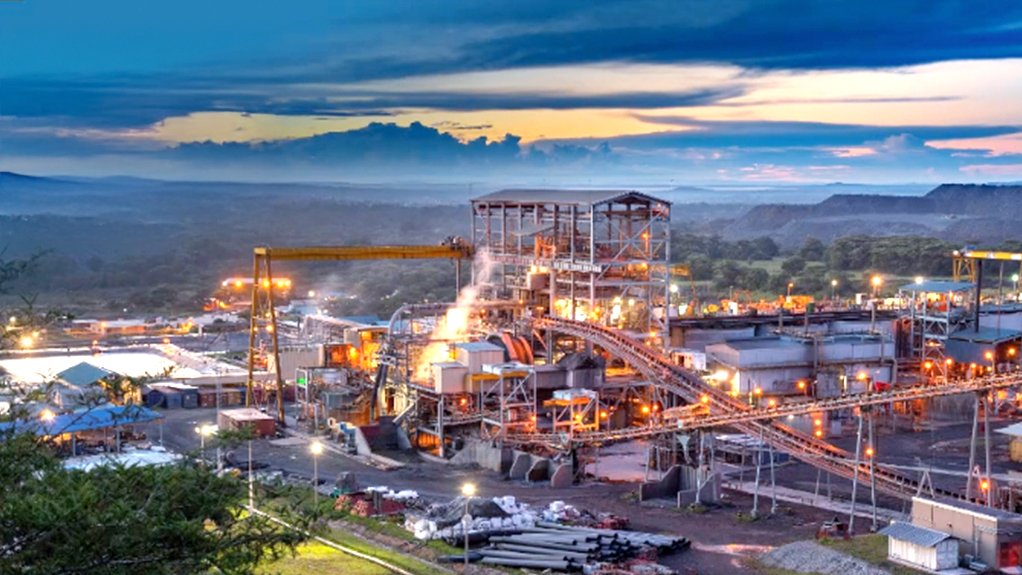



JOHANNESBURG (miningweekly.com) – By optimising existing operations and leveraging established infrastructure, gold mining company AngloGold Ashanti is targeting the addition of more than 400 000 oz of annual gold production by the end of 2029.
The Johannesburg Stock Exchange-listed AngloGold is expecting an additional 130 000 oz from Obuasi in Ghana as this gold mine ramps up, 100 000 oz from Siguiri in Guinea, 100 000 oz from Geita in Tanzania, and 75 000 oz from Cuiabá in Brazil.
At Obuasi, AngloGold is continuing to look for ways to derisk this asset by building operational flexibility and consistency.
The targeted 130 000 oz/y production growth on top of last year's base of 260 000 oz will take output to 400 000 oz/y.
A structural challenge being tackled includes the elimination of historical single point bottlenecks amid blocks eight and ten currently being accessed from one decline.
With the KMS shaft not working, there is only one way out. In October 30 000 oz of ore was mined but lack of flexibility is an issue.
“We’ll expand this in 2029 to four distinct areas of operation. This decongestion is critical for securing unimpeded ore delivery to the surface as we run towards our 400 000 oz target,” AngloGold CEO Alberto Calderon explained during this week’s presentation of results covered by Mining Weekly.
To ensure the mill stays fed even if underground constraints arise, alternative ore resources are being established. A nearby openpit that has been identified that would provide about 25 000 oz in 2027 and the plan is to go to 50 000 oz around 2028.
Also, the shallower, higher-grade Cote d'Or mining area is being evaluated to establish safe access to additional mining areas through another decline by the first half of 2029.
This provides flexibility while the main underground ramps up, and we're also advancing the deep decline on track to reach higher Block 11 next year.
The KMS shaft was built fundamentally for Block 11, which will almost exclusively be operated through KMS.
Optimising the development sequences and gaining early access through the KMS shaft will be a margin catalyst for the asset, bringing in ore at about 50% higher grade than the average underground mine reserve grade.
SIGUIRI TIER 1 POTENTIAL
At Siguiri, the objective is to unlock Tier 1 potential by developing additional full-grade ore sources to directly displace current marginal stockpile feed.
Total estimated capital expenditure (capex) of around $70-million is expected to fund the planned 100 000 oz/y production growth.
“This growth is driven by two near-pit developments. First is Block 3, which sits roughly 50 km from Block 1, with the haul road and infrastructure construction nearing completion, mining expected to start by around year-end, and first gold targeted in the first half of next year,” Calderon reported.
Block 3 is projected to add 40 000 oz/y to 50 000 oz/y over the next five years.
Operationally, this allows Block 3 to be fed at an average grade of 1.22 g/t, replacing 0.55 g/t material in the plant feed.
Also, land agreements are being finalised to secure land packages and complete site preparation to ramp up mining from the satellite deposit in Block 1. Mining is expected to commence and the targeted date for first gold from the satellite deposit is late next year. This will provide an even higher-grade feed at 1.64 g/t, further displacing the low grade ore sources.
To support medium-term growth, a prefeasibility study will begin next year to increase Siguiri's hard rock treatment capacity. This will provide the processing capacity needed to handle harder, fresh rock over the longer term to deconstrain the mining schedule for additional full-grade ore.
This year’s total reaffirmed gold production guidance is 2 800 000 oz to 3 170 000 oz, amid 2 164 000 oz of gold being produced in the first nine months of 2026.
The Geita project, the most capital-intensive of the four, has an internal rate of return (IRR) of more than 35% and the three other projects, which have significantly lower capex tags are poised to deliver even higher IRRs.
GEITA MILL ENLARGEMENT
At Geita, estimated capex is in the range of $480-million to $580-million, a price tag higher than initially flagged, which reflects a strategic pivot to a considerably larger mill with a three-million-ton-a-year optimal configuration processing rate. In addition to the 100 000 growth ounces are ten years of reserve. The superior operational flexibility provided has limited integration and shutdown impacts, and allows for future modular expansion.
The three primary initiatives that drove Geita’s growth plan were:
- the targeting a five-million-ounce mineral reserve by 2028 from an expanded drilling programme at Nyamulilima Stage 5, and other high-confidence opencast and underground targets across the lease.
- the commencement of a feasibility study to add three-million tons a year of new processing capacity, increasing total capacity from 5.5-million to 8.5-million tons a year. This project is targeted for commissioning by late 2029 or early 2030, with a new line intended to unlock value in Nyamulilima Stage 5, while growing lower-grade stockpiles.
- the planned next-quarter move into the implementation phase amid the feasibility study for the paste backfill plant at Nyankanga underground mine nearing completion. Targeted for commission in the first quarter of 2028, this plant will help fast-track backfill and unlock high-grade pillars in the underground mine.
Together, these initiatives support the target to increase Geita's long-term yearly production to 600 000 oz by the end of 2029 and into 2030.
CUIABÁ UNLOCKING
At Cuiabá, the strategy is to unlock spare capacity at the Queiroz metallurgical plant with production growth of about 75 000 oz/y targeted at a total estimated capital spend of between $200-million and $250-million.
“This growth is mainly driven by two key projects. First, the safe restart of CdS. This is very important. We will not run this complete standalone operation. Instead, this will be run at a much reduced footprint, mainly to mine the ore while leveraging the more efficient processing capacity of Queiroz plant. If we used to have, in CdS days, 2 800 people and autoclaves and all the processing, this will be about 800 people, no autoclaves and all the processing in the more efficient Queiroz plant," Calderon noted.
Preparation is well advanced for a targeted startup in the first quarter (Q1) of next year, with CdS projected to provide an additional 800 000 oz/y, yielding 50 000 oz to 60 000 oz and driving a 30% increase to baseline production.
Productivity and life-of-mine infrastructure at the Cuiabá underground mine is also being addressed, with $150-million being invested in deep-level infrastructure, specifically ventilation, refrigeration, and base fill.
Studies on materials handling optimisation are also targeting a combined ore feed of 1.9-million tons a year from the Cuiabá and the Lamego underground mine.
‘We’re seeing a very strong Q4. That's where we are recommitting to guidance very close to the midpoint of the guidance in production, and guidance on all metrics,” said Calderon. Full-year gold production guidance of 2 800 000 oz to 3 170 000 oz has been reaffirmed. In the first nine months of this year 2 164 000 oz were produced.
“Our balance sheet is exceptionally robust. We closed the quarter with $1.26-billion in net cash and $4.5-billion in liquidity buffer. The financial strength means our business is entirely self-funded and can comfortably cover our investment requirements.
“We've declared $1.3-billion in dividends year to date, coupled with our $2-billion approved share buyback. We have exceptional capital flexibility. Ultimately, our current valuation presents a significant opportunity to further re-rate,” Calderon added.
Article Enquiry
Email Article
Save Article
Feedback
To advertise email advertising@creamermedia.co.za or click here
Research Reports


Projects

Latest Multimedia
Latest News
Showroom

Complete range of security sealing solutions including security seals bags and labels.
VISIT SHOWROOM
Mitsubishi Chemical Advanced Materials South Africa (Pty) Ltd is a leading manufacturer of high-performance engineering plastics for the mining...
VISIT SHOWROOM

Announcements
What's On
Subscribe to improve your user experience...
Option 1 (equivalent of R125 a month):
Receive a weekly copy of Creamer Media's Engineering News & Mining Weekly magazine
(print copy for those in South Africa and e-magazine for those outside of South Africa)
Receive daily email newsletters
Access to full search results
Access archive of magazine back copies
Access to Projects in Progress
Access to ONE Research Report of your choice in PDF format
Option 2 (equivalent of R375 a month):
All benefits from Option 1
PLUS
Access to Creamer Media's Research Channel Africa for ALL Research Reports, in PDF format, on various industrial and mining sectors
including Electricity; Water; Energy Transition; Hydrogen; Roads, Rail and Ports; Coal; Gold; Platinum; Battery Metals; etc.
Already a subscriber?
Forgotten your password?
Receive weekly copy of Creamer Media's Engineering News & Mining Weekly magazine (print copy for those in South Africa and e-magazine for those outside of South Africa)
➕
Recieve daily email newsletters
➕
Access to full search results
➕
Access archive of magazine back copies
➕
Access to Projects in Progress
➕
Access to ONE Research Report of your choice in PDF format
RESEARCH CHANNEL AFRICA
R4500 (equivalent of R375 a month)
SUBSCRIBEAll benefits from Option 1
➕
Access to Creamer Media's Research Channel Africa for ALL Research Reports on various industrial and mining sectors, in PDF format, including on:
Electricity
➕
Water
➕
Energy Transition
➕
Hydrogen
➕
Roads, Rail and Ports
➕
Coal
➕
Gold
➕
Platinum
➕
Battery Metals
➕
etc.
Receive all benefits from Option 1 or Option 2 delivered to numerous people at your company
➕
Multiple User names and Passwords for simultaneous log-ins
➕
Intranet integration access to all in your organisation