Minerals Council drives gender equity programme for change

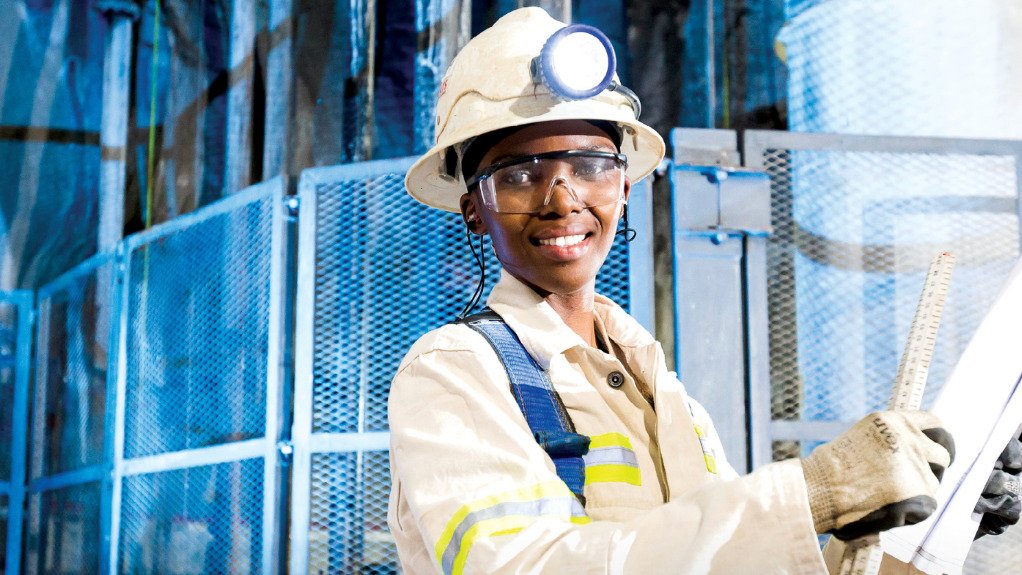
EQUAL EQUITY The ambition of the Minerals Council Women in Mining programme is to scale successful initiatives across the sector and improve women’s representation in management and core mining roles


Gender equity in the South African mining sector is linked to equity competitiveness; skills development; product innovation; environmental, social and governance performance; the long-term sustainability of the sector and a positive, enduring socioeconomic impact, says industry employers’ association Minerals Council South Africa women in mining (WiM) programme manager Boitumelo Nkomo.
From a WiM programme perspective, the priority is to translate this ambition into practical industry action.
“This will be achieved by improving the attraction, retention and development of women; strengthening leadership accountability; supporting member companies with tools and shared learning; and ensuring that women’s lived workplace experiences improve in measurable ways,” she adds.
In the short term, the Minerals Council’s goal is to embed its refreshed 2025 to 2027 WiM strategy across the industry, focusing on practical workplace changes that women can experience directly.
The refreshed strategy, launched in August 2025, is a renewed gender transformation plan aimed at driving deeper inclusion, equity and advancement of women across the mining sector. This includes safer workplaces, inclusive personnel facilities, stronger reporting systems and clearer development pathways, says Nkomo.
The strategy builds on Minerals Council South Africa’s WiM initiative which was introduced in 2020, and focuses on systemic cultural change and establishing equitable workplaces reflective of broader society.
“In the medium term, our ambition is to scale successful initiatives across the sector, improve women’s representation in management and core mining roles and build a stronger pipeline of women leaders,” she enthuses.
Breaking Barriers
Nkomo explains that the barriers most often encountered by women include persistent gender stereotypes, biased workplace culture, harassment, gender-based violence and femicide, as well as a lack of inclusive personal facilities.
Women are also subjected to limited career growth opportunities, gender pay gaps, equity concerns, work-life balance challenges and recruitment practices that might still have inherent biases.
“These challenges are systemic and require coordinated leadership, not one-off interventions,” she adds.
Minerals Council South Africa is attempting to tackle these barriers by setting a unified industry agenda, ensuring member accountability, sharing research and best practices, promoting zero tolerance for women abuse and supporting initiatives to improve workplace design, reporting, culture, training and advancement.
Across the mining industry, Nkomo says progress has been strongest where companies have treated gender equality as a business priority rather than a compliance obligation and where such companies have committed to address transformation beyond a legal and regulatory compliance imperative.
“Visible leadership commitment at various levels, including boards, has proven effective in driving visible change.”
The key lesson learned, she adds, is that representation alone is not enough, and progress must be supported by improved workplace cultures where women feel safe, respected, developed and that they are given meaningful opportunities.
The WiM programme, therefore, highlights and shares examples that can be adapted across the sector while recognising that implementation will vary by company size, commodity and operating environment.
Minerals Council South Africa’s message is that transformation must be experienced by women on the ground in how they are recruited, equipped, protected, developed, promoted and heard: “The WiM programme provides an industry platform to drive that change collaboratively, with urgency and accountability,” she explains.
Although the Minerals Council South Africa does not manage member companies’ in-house programmes, it does provide strategic direction, shared platforms, good-practice guidance, research insights and opportunities for benchmarking and peer learning.
This includes the WiM Gender Diversity and Inclusion portal, which helps members track progress against key transformation metrics and provides useful insights into areas that still require focused action.
“The portal enables companies to identify gaps, compare progress and adopt interventions that are practical for different commodities, operations and organisational contexts,” she adds.
Through the WiM programme, the Minerals Council South Africa also supports alignment regarding common priorities through sector-wide campaigns that address safety, dignity and respect at work.
Article Enquiry
Email Article
Save Article
Feedback
To advertise email advertising@creamermedia.co.za or click here
Research Reports
Projects
Latest Multimedia
Latest News
Showroom
ZF Aftermarket is the after-sales division of the world-renowned German ZF group, a global leader in mobility technology.
VISIT SHOWROOM
Announcements
What's On
Subscribe to improve your user experience...
Option 1 (equivalent of R125 a month):
Receive a weekly copy of Creamer Media's Engineering News & Mining Weekly magazine
(print copy for those in South Africa and e-magazine for those outside of South Africa)
Receive daily email newsletters
Access to full search results
Access archive of magazine back copies
Access to Projects in Progress
Access to ONE Research Report of your choice in PDF format
Option 2 (equivalent of R375 a month):
All benefits from Option 1
PLUS
Access to Creamer Media's Research Channel Africa for ALL Research Reports, in PDF format, on various industrial and mining sectors
including Electricity; Water; Energy Transition; Hydrogen; Roads, Rail and Ports; Coal; Gold; Platinum; Battery Metals; etc.
Already a subscriber?
Forgotten your password?
Receive weekly copy of Creamer Media's Engineering News & Mining Weekly magazine (print copy for those in South Africa and e-magazine for those outside of South Africa)
➕
Recieve daily email newsletters
➕
Access to full search results
➕
Access archive of magazine back copies
➕
Access to Projects in Progress
➕
Access to ONE Research Report of your choice in PDF format
RESEARCH CHANNEL AFRICA
R4500 (equivalent of R375 a month)
SUBSCRIBEAll benefits from Option 1
➕
Access to Creamer Media's Research Channel Africa for ALL Research Reports on various industrial and mining sectors, in PDF format, including on:
Electricity
➕
Water
➕
Energy Transition
➕
Hydrogen
➕
Roads, Rail and Ports
➕
Coal
➕
Gold
➕
Platinum
➕
Battery Metals
➕
etc.
Receive all benefits from Option 1 or Option 2 delivered to numerous people at your company
➕
Multiple User names and Passwords for simultaneous log-ins
➕
Intranet integration access to all in your organisation