Storage can complement hydrogen solutions

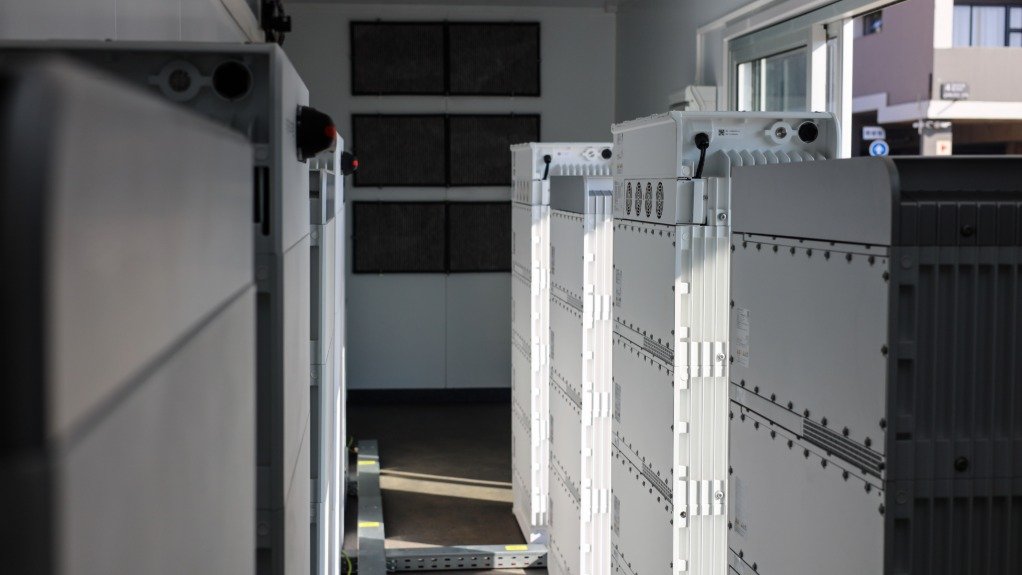
SUPPORTING RENEWABLES Battery storage shifts surplus renewable energy to periods of higher demand, reducing reliance on diesel generators


As hydrogen energy and fuel cells attract policy and investment attention across Southern Africa, battery storage systems can play a complementary role, demonstrating the need to accelerate hydrogen adoption rather than competing with it, says renewable-energy company Blockpower engineering head Timothy Mahlangu.
The region’s platinum resources, established chemicals sector and surplus renewable- energy potential provide a strong foundation for hydrogen, which remains in the developmental stage.
Meanwhile, battery storage adoption has accelerated in response to unreliable energy availability and distribution, Mahlangu says, adding that this has limitations and challenges, particularly for utilities or companies with complex and large-scale storage requirements.
The resulting gap is where hydrogen becomes critical, with battery storage and hydrogen offering value in different applications and storage durations.
Battery storage is generally most commercially competitive for short- to medium- duration applications, commonly ranging from about two to eight hours. This makes battery systems well-suited for daily cycling, frequency regulation, demand management and backup power.
However, for durations extending beyond 12 hours, conventional lithium-ion systems become less economical, particularly where the additional capacity is used infrequently or reserved for backup purposes.
Conversely, hydrogen and hydrogen- derived fuels may be particularly valuable in select heavy-transport, maritime and hard-to-electrify industrial applications.
“Although its round-trip efficiency is lower than that of batteries, duration and storage capacity become more important when the alternative is curtailing or wasting renewable energy,” Mahlangu says.
Given these contrasting strengths, he expects hydrogen development to concentrate on industry, transport and export, while batteries remain the primary stationary storage solution for commercial and industrial applications.
Additionally, as costs decline and local supply chains mature, Mahlangu expects hybrid systems – that combine batteries, for rapid response, with hydrogen, for extended resilience – to gain traction, particularly at remote and offgrid industrial sites.
In the interim, battery storage is the practical bridge to the green economy, closing the gap between intermittent renewables generation and electricity demand, he says.
While providing various advantages in comparison to carbon-based energy, solar only produces energy during daylight hours while wind output fluctuates.
Consequently, renewable generation may be curtailed where production exceeds demand, storage capacity or available grid-export capacity.
Battery storage helps address this challenge by shifting surplus renewable energy to periods of higher demand, reducing reliance on diesel generators, limiting exposure to grid instability and combining resilience, cost savings and decarbonisation in a “single bankable solution”.
Ensuring Stability
Initially functioning primarily as advanced uninterruptible power supply systems to provide short-term backup during outages, battery storage has since evolved into a strategic energy management asset, supporting peak shaving, time-of-use arbitrage, renewable integration and demand response.
This shift was driven by significant loadshedding in 2022 and 2023, combined with a substantial decline in lithium-iron-phosphate (LFP) battery costs.
The market has increasingly adopted repeatable system configurations, bankable manufacturer warranties, experienced local engineering capability and dedicated insurance products.
Mahlangu points out that in energy-stable markets, battery storage is a financial optimisation tool, which limits the urgency or willingness of these markets to enter into long-term energy service agreements at scale.
However, in South Africa, battery storage has become essential infrastructure.
This creates a strong sense of urgency, shortens perceived payback periods and increases demand for zero-capital-expenditure solutions such as Blockpower’s Energy-as-a-Service model.
Industry Developments
LFP has become the dominant chemistry across commercial, industrial and utility-scale applications owing to its significant thermal stability, longer cycle life and the absence of cobalt.
Meanwhile, vanadium redox flow batteries suit long-duration, grid-scale applications where extended cycle life and electrolyte longevity can justify its higher capital costs. While interest in batteries is growing, the market remains limited, Mahlangu says.
Despite the advances in battery technology, several regulatory reforms are required to boost storage deployment in South Africa.
He emphasises that the most urgent reform is a standardised, time-bound grid connection framework with clear technical requirements and enforceable approval timelines across State-owned electricity utility Eskom and municipal distribution areas.
Article Enquiry
Email Article
Save Article
Feedback
To advertise email advertising@creamermedia.co.za or click here
Research Reports


Latest Multimedia
Latest News

Showroom
M and J Mining are leading suppliers of physical support systems as used by the underground mining industry. Our selection of products are not...
VISIT SHOWROOM
Virtual Gas Network supplies compressed natural gas via a virtual gas distribution network.
VISIT SHOWROOM
Announcements
What's On
Subscribe to improve your user experience...
Option 1 (equivalent of R125 a month):
Receive a weekly copy of Creamer Media's Engineering News & Mining Weekly magazine
(print copy for those in South Africa and e-magazine for those outside of South Africa)
Receive daily email newsletters
Access to full search results
Access archive of magazine back copies
Access to Projects in Progress
Access to ONE Research Report of your choice in PDF format
Option 2 (equivalent of R375 a month):
All benefits from Option 1
PLUS
Access to Creamer Media's Research Channel Africa for ALL Research Reports, in PDF format, on various industrial and mining sectors
including Electricity; Water; Energy Transition; Hydrogen; Roads, Rail and Ports; Coal; Gold; Platinum; Battery Metals; etc.
Already a subscriber?
Forgotten your password?
Receive weekly copy of Creamer Media's Engineering News & Mining Weekly magazine (print copy for those in South Africa and e-magazine for those outside of South Africa)
➕
Recieve daily email newsletters
➕
Access to full search results
➕
Access archive of magazine back copies
➕
Access to Projects in Progress
➕
Access to ONE Research Report of your choice in PDF format
RESEARCH CHANNEL AFRICA
R4500 (equivalent of R375 a month)
SUBSCRIBEAll benefits from Option 1
➕
Access to Creamer Media's Research Channel Africa for ALL Research Reports on various industrial and mining sectors, in PDF format, including on:
Electricity
➕
Water
➕
Energy Transition
➕
Hydrogen
➕
Roads, Rail and Ports
➕
Coal
➕
Gold
➕
Platinum
➕
Battery Metals
➕
etc.
Receive all benefits from Option 1 or Option 2 delivered to numerous people at your company
➕
Multiple User names and Passwords for simultaneous log-ins
➕
Intranet integration access to all in your organisation