Hybrid project’s completion brings company closer to 2030 target

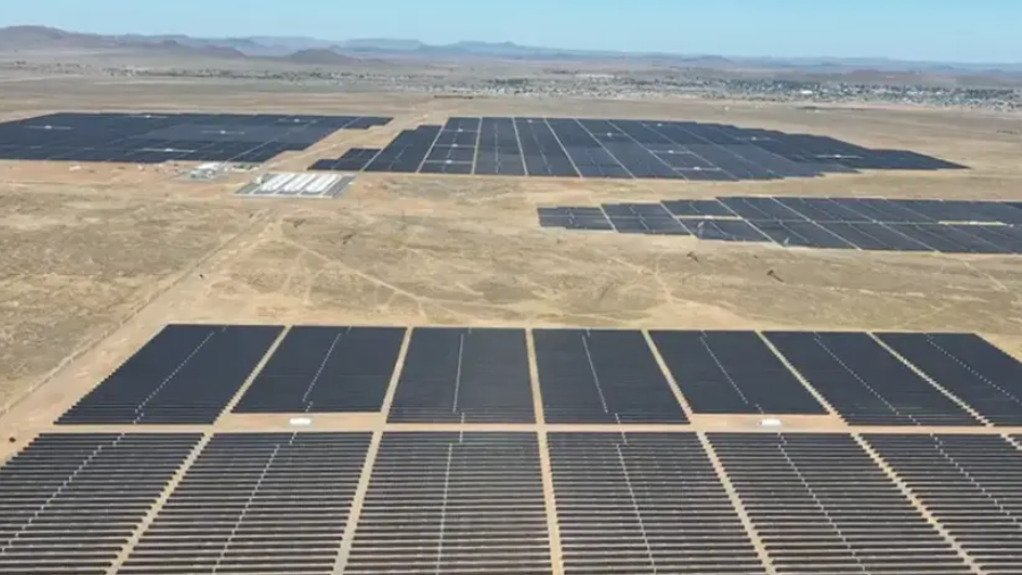
HYBRID HYDRA SOLAR TotalEnergies Renewables Southern Africa's expansive solar installation at the Hydra hybrid project has been commissioned in the Northern Cape


As part of its ambition to grow its renewables portfolio to more than 1 GW of installed capacity by the end of the decade, TotalEnergies Renewables Southern Africa has successfully commissioned its Hydra hybrid project, in South Africa’s Northern Cape province.
TotalEnergies, together with its partners independent power producer Hydra Storage Holding and investment holding company Reatile Renewables, inaugurated the project in July.
It is reportedly the largest hybrid renewable-energy project in Africa, according to South Africa’s official Risk Mitigation Independent Power Producer Procurement Programme, which is managed by the Department of Electricity and Energy.
The project connects to the Hydra substation, one of the largest main transmission substations in the country.
“The facility comprises a 216 MWp solar PV plant and a 500 MWh battery energy storagesystem (BESS), which can produce more than 400 GWh/y of electricity,” says TotalEnergies Southern Africa MD Magali Pailhé.
At a contract capacity of 75 MW, the PV and BESS plants are integrated by an energy management system (EMS) to optimise production aligned to the power purchase agreement (PPAs) requirements stipulated by State-owned power utility Eskom.
“The EMS is a key element that runs locally, interfaced with the plant operator’s supervisory control and data acquisition systems,” she adds.
The BESS is fully charged by the PV plant every day and then discharged every evening and in the early hours of the next morning, before being charged again, which means that the Hydra project does not draw from the grid to charge its batteries.
“The experience gained in building such a project has, of course, a lot of value in terms of lessons learned, which will benefit our upcoming projects,” states Pailhé.
This experience is vital because it demonstrates how daytime solar surpluses help hybrid solar BESSs stabilise the grid by supplying power during morning and evening peaks. This combination of technologies transforms intermittent renewable sources into clean, reliable, and dispatchable energy.
“The lessons learnt on the hybrid PV BESS design and optimisation will also assist TotalEnergies to better size and offer proven hybrid model products through corporate PPAs,” she adds.
These models will enable TotalEnergies to champion hybrid solutions to private-sector consumers, consequently enabling them to increase their renewables penetration while supporting the grid’s overall stability.
On the Safe Side
TotalEnergies has placed sustainable development at the forefront of its project portfolio, establishing rules to protect biodiversity and decrease operational emissions, including its insistence on regulatory search-and-rescue operations to locate and transplant sensitive flora from the project area.
Additionally, dust control measures were implemented to mitigate dust from the large number of construction and delivery vehicles.
“The project team also elected not to strip any vegetation during construction, which further mitigated dust and loss of plant cover, and helped to improve the rehabilitation of disturbed areas.”
Moreover, seasonal avifaunal studies were conducted to monitor construction impact, and the company can report that current birdlife is in line with baseline assessments, adds Pailhé.
During construction, more than 90% of the workforce employed were South African citizens, of whom 45% were recruited from the De Aar area.
The project also contributed over R5-million to support local suppliers and small businesses.
Project Perks
The project is designed to deliver at its maximum allowed grid export capacity – in line with Eskom’s connection agreement.
Hydra’s PV panels are mounted on single-axis trackers that follow the sun from east to west, improving energy yield, compared with fixed-tilt systems, and maximising the Northern Cape’s high solar irradiation.
The BESS is charged with surplus daytime energy. It is sized to maintain the plant’s contracted capacity until solar generation resumes.
“Together, these systems enable Hydra to supply 75 MW continuously from 05:00. to 21:30, delivering more than 400 GWh per year,” concludes Pailhé.
Article Enquiry
Email Article
Save Article
Feedback
To advertise email advertising@creamermedia.co.za or click here
Research Reports
Projects

Latest Multimedia

Latest News
Showroom
Iritron delivers advanced automation, control, and optimisation solutions to the Mining, Minerals & Metals, Consumer Package Goods and...
VISIT SHOWROOM
M and J Mining are leading suppliers of physical support systems as used by the underground mining industry. Our selection of products are not...
VISIT SHOWROOM


Announcements
What's On
Subscribe to improve your user experience...
Option 1 (equivalent of R125 a month):
Receive a weekly copy of Creamer Media's Engineering News & Mining Weekly magazine
(print copy for those in South Africa and e-magazine for those outside of South Africa)
Receive daily email newsletters
Access to full search results
Access archive of magazine back copies
Access to Projects in Progress
Access to ONE Research Report of your choice in PDF format
Option 2 (equivalent of R375 a month):
All benefits from Option 1
PLUS
Access to Creamer Media's Research Channel Africa for ALL Research Reports, in PDF format, on various industrial and mining sectors
including Electricity; Water; Energy Transition; Hydrogen; Roads, Rail and Ports; Coal; Gold; Platinum; Battery Metals; etc.
Already a subscriber?
Forgotten your password?
Receive weekly copy of Creamer Media's Engineering News & Mining Weekly magazine (print copy for those in South Africa and e-magazine for those outside of South Africa)
➕
Recieve daily email newsletters
➕
Access to full search results
➕
Access archive of magazine back copies
➕
Access to Projects in Progress
➕
Access to ONE Research Report of your choice in PDF format
RESEARCH CHANNEL AFRICA
R4500 (equivalent of R375 a month)
SUBSCRIBEAll benefits from Option 1
➕
Access to Creamer Media's Research Channel Africa for ALL Research Reports on various industrial and mining sectors, in PDF format, including on:
Electricity
➕
Water
➕
Energy Transition
➕
Hydrogen
➕
Roads, Rail and Ports
➕
Coal
➕
Gold
➕
Platinum
➕
Battery Metals
➕
etc.
Receive all benefits from Option 1 or Option 2 delivered to numerous people at your company
➕
Multiple User names and Passwords for simultaneous log-ins
➕
Intranet integration access to all in your organisation