EaaS solution delivers prepaid cost savings


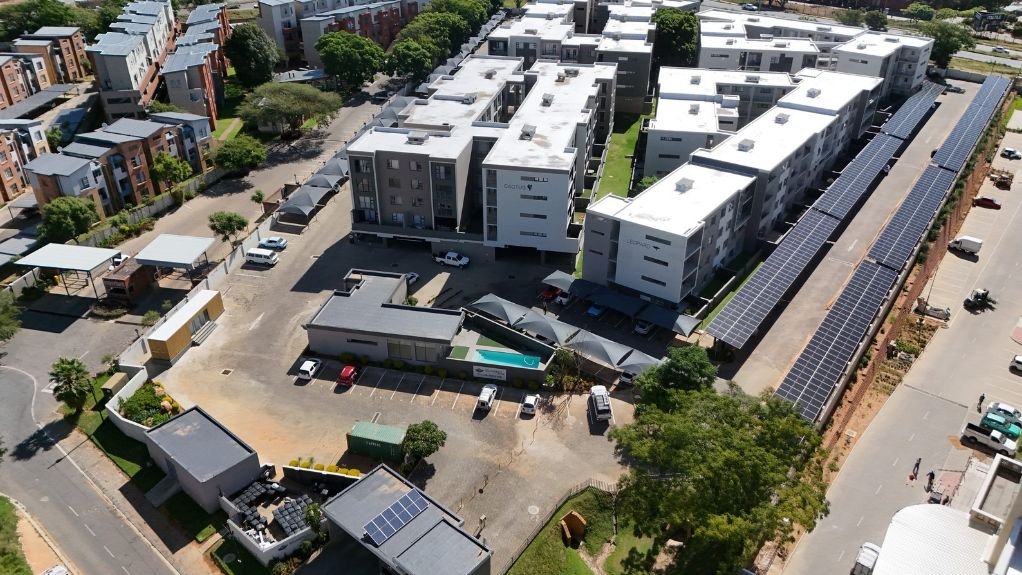
TIMOTHY MAHLANGU Residents keep buying electricity through their prepaid meters while Blockpower takes over the municipal account, pays the utility for grid energy and reconciles solar, grid and unit consumption monthly
AFFORDABLE ENERGY SOLUTIONS Blockpower funds and owns the solar PV, battery storage, smart prepaid meters and energy management system under an Energy as a Service solution, providing lower metering and tariff benefits to customers




Community housing schemes with a bulk municipal supply point are emerging as viable sites for hybrid solar and storage deployment under an Energy as a Service (EaaS) solution, says renewable-energy and infrastructure company Block- power.
The approach is distinct from a conventional power purchase agreement (PPA) in ownership structure and risk allocation.
Under a conventional PPA, the provider typically owns the panels and sells power at an agreed tariff while the scheme retains the municipal account, metering, resident billing and collection risk, says Blockpower engineering head Timothy Mahlangu.
Under an EaaS system, Block-power funds and owns the solar PV, battery storage, smart prepaid meters and energy management system, and the housing scheme does not have to commit to any capital investment. The solution also shifts responsibility for the municipal electricity account from the scheme to the company.
“Blockpower pays the estate’s electricity bill. Its own meters measure what the estate actually uses, so it can see when a municipal charge doesn’t match real consumption,” Mahlangu adds.
Residents continue to buy electricity through prepaid meters as before and collection risk is managed through prepayment, with the smart meters flagging tampering and every scheme credit-checked and approved before Blockpower invests.
Further, “residents pay before they use, so there are no unit arrears to chase”.
Isabel Estate
The EaaS solution is operating at Isabel Estate – a 276-unit complex where a hybrid solution has been operational since March 2026 – in Northriding, Gauteng.
Mahlangu says Blockpower designed, built, owns and operates the energy management system coordinating solar, battery and smart geyser control in every unit, adding that metering comprises a smart prepaid meter in every unit, plus a bulk check meter at the grid connection.
The system operates behind one municipal supply point and comprises 305 kWp of solar PV mounted on carports, 550 kW of modular hybrid inverter capacity and 480 kWh of lithium-ion battery storage.
Residents buy electricity for the prepaid meters while Blockpower takes over the municipal electricity account, pays the utility for grid energy, and reconciles solar, grid and unit consumption monthly.
The financial outcome is a reported 19.8% monthly prepaid cost saving for residents, says Mahlangu. The effective rate fell from R4.69/kWh to R3.92/kWh, which equates to about 42 additional kilowatt hours on a R1 000 spend.
He attributes one fifth of this benefit to lower metering commissions and the remainder to fairer tariff structures.
“Every kilowatt hour generated on site replaces a kilowatt hour bought from the municipality, and that margin funds the system while residents pay less,” Mahlangu says.
On energy balance, the design offset for Isabel Estate is 55% of yearly consumption, to be covered by the PV and battery system, with 45% used from the grid.
Generation is metered continuously and reported against forecasts in monthly and biannual operations and maintenance reports. Maintenance and insurance are carried by Blockpower, with zero maintenance cost to the scheme at the estate.
Storage sizing was based on on-site load logging to enable the whole estate to run for about three hours at the evening peak, and up to six hours at lighter loads, Mahlangu explains.
During outages, residents retain full unit supply, not just essential circuits, with only geyser heating switched off to extend battery duration. Stored hot water carries the households during the outage.
From a grid perspective, resilience-related benefits accrue at the estate and municipal level. At estate level, supply availability has consistently exceeded the municipal grid’s level since commissioning. At municipal level, the estate eases pressure on the local network.
During sunny days, the estate draws “almost nothing” from the grid for most of the day. Geyser heating has moved from evenings and nights into the solar window, allowing for load shifting. The battery typically covers the early-morning peak, providing peak-shaving savings, says Mahlangu.
Establishing Bankability
The minimum technical requirement for the bankability of projects, such as Isabel Estate, is one bulk municipal supply point. Mahlangu says similar gains could be achieved for industrial properties, often with stronger results, as most industrial loads peak during the day, increasing direct solar use.
Time-of-use and demand charges also enable the battery energy storage system to affect peak costs in addition to providing backup, while multi-tenant industrial parks, office parks and commercial buildings can benefit under a bespoke offering, he suggests.
Blockpower also offers environmental reporting based on measured production. About 504 t/y of CO2-equivalent emissions are offset at Isabel Estate, calculated from the system’s yearly solar generation and the South African grid emission factor. Solar output is metered continuously, and monthly and biannual operation and maintenance reports track generation against forecast.
“The carbon figure, therefore, rests on measured production, not on a design estimate,” Mahlangu says.
Backup power is becoming a standard expectation for buyers and tenants. An estate that can demonstrate continuous supply during extended outages, alongside a reduction in effective cost per unit, is positioned for marketability and rentability, with measurable generation providing data for sustainability reporting, he concludes.
Article Enquiry
Email Article
Save Article
Feedback
To advertise email advertising@creamermedia.co.za or click here
Research Reports


Projects


Latest Multimedia


Latest News


Showroom

Sulzer South Africa, established in 1922, partners with critical industries like power, oil & gas, water, mining, and chemicals to boost...
VISIT SHOWROOM
SABAT Batteries is a renowned brand in the battery industry, manufacturing a wide range of batteries at its state-of-the-art production facility in...
VISIT SHOWROOM


Announcements
What's On
Subscribe to improve your user experience...
Option 1 (equivalent of R125 a month):
Receive a weekly copy of Creamer Media's Engineering News & Mining Weekly magazine
(print copy for those in South Africa and e-magazine for those outside of South Africa)
Receive daily email newsletters
Access to full search results
Access archive of magazine back copies
Access to Projects in Progress
Access to ONE Research Report of your choice in PDF format
Option 2 (equivalent of R375 a month):
All benefits from Option 1
PLUS
Access to Creamer Media's Research Channel Africa for ALL Research Reports, in PDF format, on various industrial and mining sectors
including Electricity; Water; Energy Transition; Hydrogen; Roads, Rail and Ports; Coal; Gold; Platinum; Battery Metals; etc.
Already a subscriber?
Forgotten your password?
Receive weekly copy of Creamer Media's Engineering News & Mining Weekly magazine (print copy for those in South Africa and e-magazine for those outside of South Africa)
➕
Recieve daily email newsletters
➕
Access to full search results
➕
Access archive of magazine back copies
➕
Access to Projects in Progress
➕
Access to ONE Research Report of your choice in PDF format
RESEARCH CHANNEL AFRICA
R4500 (equivalent of R375 a month)
SUBSCRIBEAll benefits from Option 1
➕
Access to Creamer Media's Research Channel Africa for ALL Research Reports on various industrial and mining sectors, in PDF format, including on:
Electricity
➕
Water
➕
Energy Transition
➕
Hydrogen
➕
Roads, Rail and Ports
➕
Coal
➕
Gold
➕
Platinum
➕
Battery Metals
➕
etc.
Receive all benefits from Option 1 or Option 2 delivered to numerous people at your company
➕
Multiple User names and Passwords for simultaneous log-ins
➕
Intranet integration access to all in your organisation