Draco Group engineers the moment gravity takes over

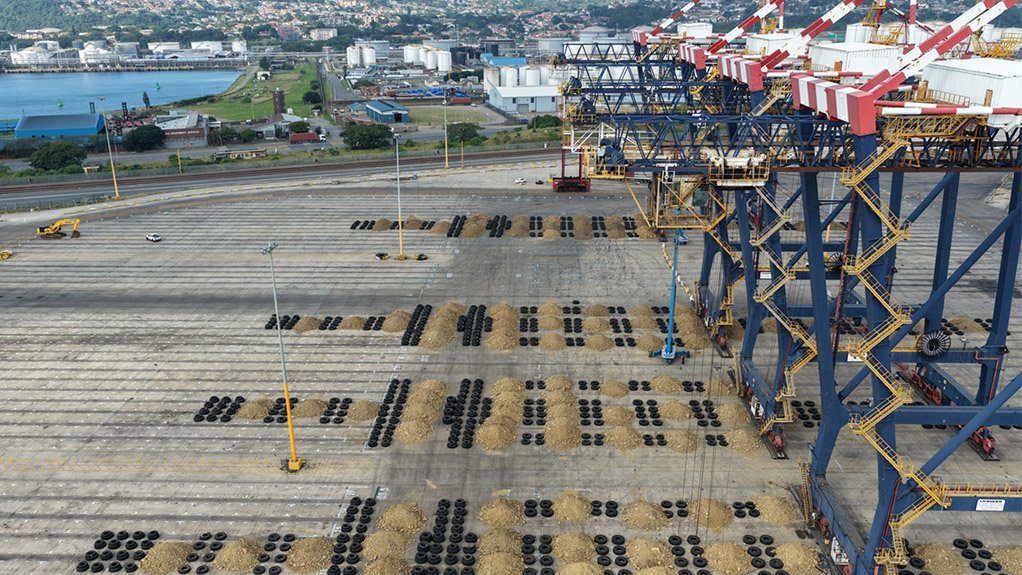
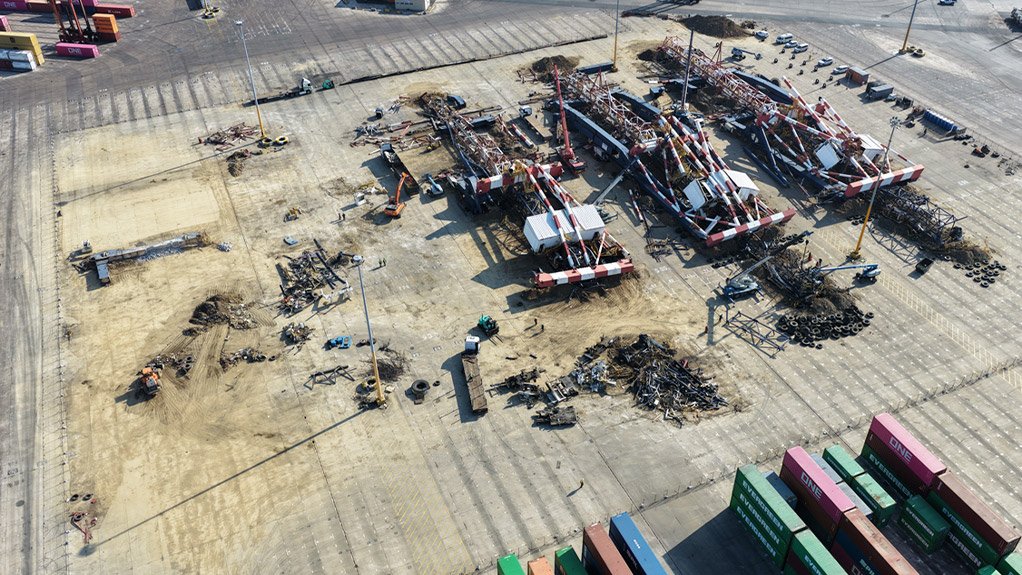
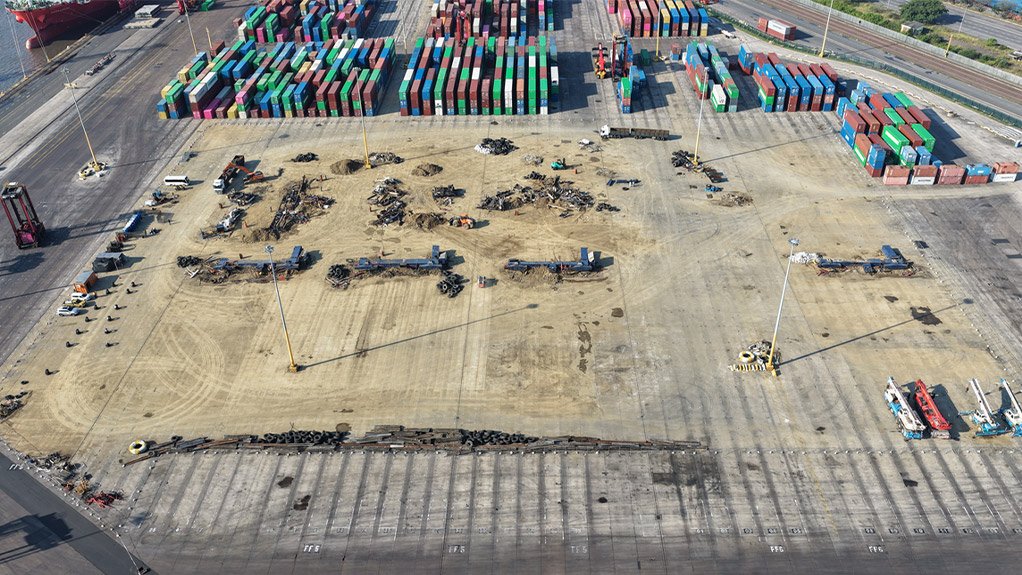
Rows of overburden and discarded straddle carrier tyres formed the impact mattresses, laid out across the quay along each crane's planned landing line.
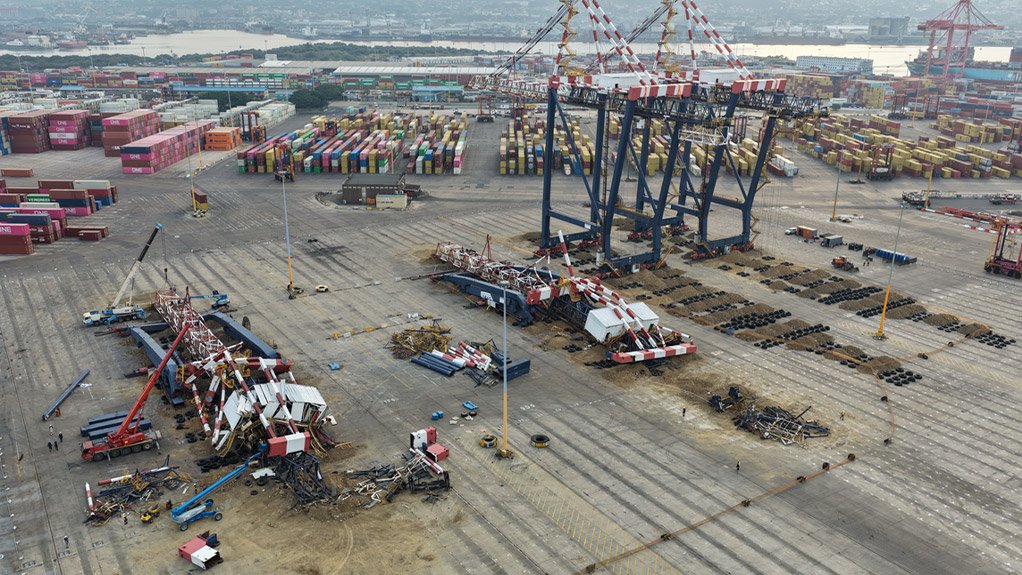
With two cranes down, crews began cutting the steel into transportable sections at ground level while the remaining two cranes stood over their prepared landing beds.
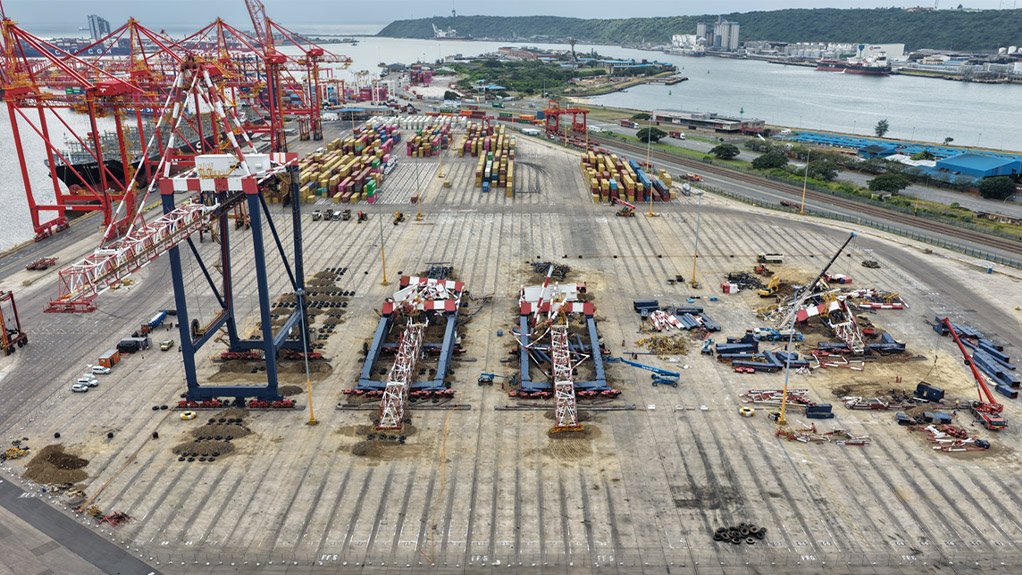
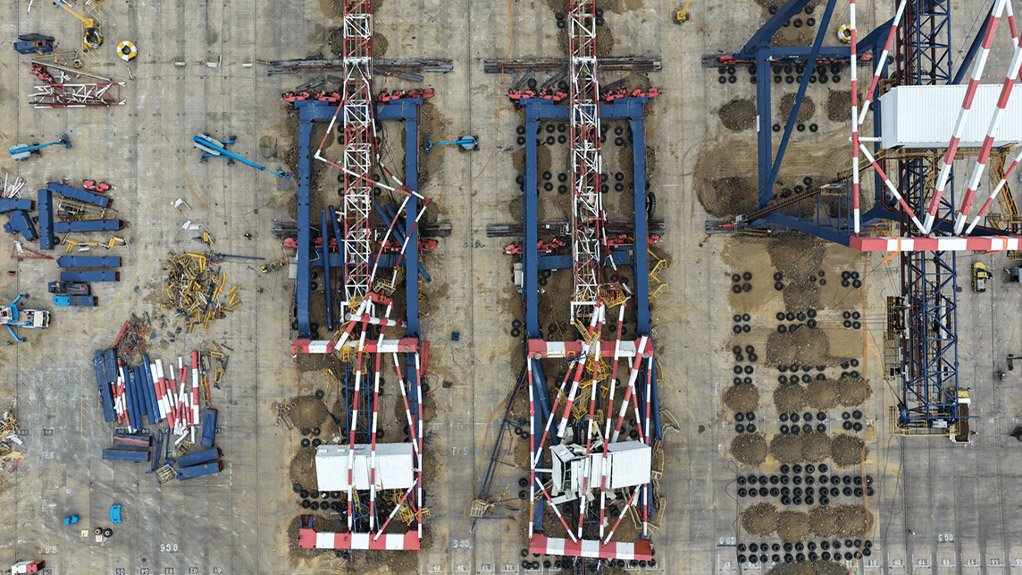
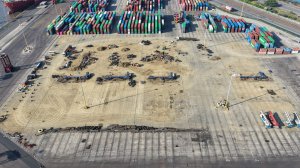
All four cranes landed inside their planned impact zones, leaving the quay, the rail system and the buried services undamaged.
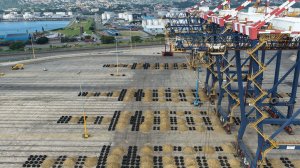
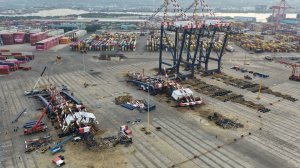
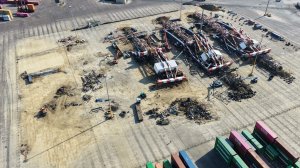
Two of the felled cranes lie on their impact mattresses, with cut sections stacked alongside and a third crane still standing over its landing bed.
Once on the ground, the cranes were dismantled in a fenced work zone of about 40 000 m², kept separate from daily operations in the live terminal.
Around 3 450 tons of ferrous steel and 25 tons of copper cabling were recovered from the four cranes, and 98% of all material generated by the project was recycled.
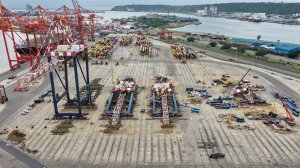
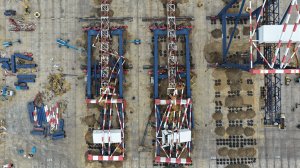


Draco Group judges every demolition method on safety first, and few structures test that principle like a ship-to-shore (STS) crane. Each is a steel frame the height of a 25-storey building, weighing close to 900 tonnes. The conventional way to remove one is from the top down. The boom, machinery house and girder sections come off one at a time, swinging from mobile cranes 80 m above the quay, while crews work beside the suspended loads. Every lift carries the same risk, repeated for months. Draco Group engineered another way to do it.
At Durban Gateway Terminal, Draco Group was asked to remove four of these cranes. The brief allowed five to seven months to dismantle them piece by piece. The company proposed controlled freefall instead: engineer each crane to topple into a prepared landing zone, then dismantle it at ground level. All four came down exactly where planned. The work took ten weeks, with zero injuries and zero infrastructure damage, and is believed to be the first project of its kind in the Southern Hemisphere or on the African continent.
Engineering the fall
A standing structure stays up while its centre of gravity sits within its base. Move it past the pivot line and self-weight takes over. For each crane, Draco Group calculated the weakening points, so the structure would hinge along a defined line while standing safely until the pull; the pulling force needed to tip it past balance; and the landing footprint on the quay. All three had to be worked out in tandem, because each one shapes the next. Certified rigging teams set up the pulling system, and two excavators started each fall. They only had to move the crane far enough to tip, and gravity did the rest.
Protecting what lies beneath
The quay slab sat above buried services and stormwater infrastructure. Draco Group built impact mattresses from more than 4,822 tons of imported overburden, reinforced with discarded straddle carrier tyres, to extend each crane's stopping distance and spread the load. Nothing below ground was damaged.
Site investigation also showed that the crane rails sat on timber sleepers instead of being fixed to the concrete. A toppling crane pushes sideways at its base, so it could have shifted as it fell. Draco Group designed a temporary restraint system that held everything in place and kept the rails intact for future use.
A working terminal
The terminal stayed open throughout. Draco Group fenced off a work zone of about 40 000 m². Cutting the programme by more than half handed the quay back months earlier.
The team recovered around 3 450 tons of ferrous steel cabling and recycled 98% of all material.
How Durban compares
Controlled toppling of STS cranes has been done before, though not often, and the published examples are all in the Northern Hemisphere. They show how differently the same problem can be tackled.
At the Port of Casablanca in Morocco, two STS cranes totalling more than 1 400 tons were taken down conventionally this year. Two large all-terrain mobile cranes worked in synchronised lifts at heights of up to 70 metres, inside an operating terminal. In San Juan, Puerto Rico, a heavily corroded 37-year-old crane about 55 m tall was pre-cut in 2018 and pulled over with wire ropes and large forklift trucks onto a gravel drop zone. At the Port of Felixstowe in the UK, eight STS cranes, the largest about 1 000 tons and 105 m tall, were brought down after a calculated cutting sequence onto steel plates and piles of sand. A similar example is at APM Terminals Elizabeth in New Jersey, where a crane standing about 103 m tall was cut at key supports and brought down in a single morning in February 2025. The terminal said the approach reduced the programme from six to eight months to just 10 to 11 weeks, while allowing up to 90% of the material to be recycled.
Durban's results stand up well in that company: a similar step change in programme and 98% of material recycled. Two things set Draco Group's approach apart. The landing beds were engineered for a quay with buried services and stormwater infrastructure below. And the sleeper-mounted rails, a condition not described in the other published projects, needed a purpose-designed restraint so the terminal could keep them.
For more information about Draco Group and their full turnkey solutions, visit the website: https://dracogroup.co.za/ and join the conversations on Facebook and LinkedIn.
Article Enquiry
Email Article
Save Article
Feedback
To advertise email advertising@creamermedia.co.za or click here
Research Reports


Projects
Latest Multimedia



Showroom

ESAB South Arica, the leading supplier of high-end welding and cutting products to the Southern African industrial market is based in...
VISIT SHOWROOM
North Ridge Pumps is an independent manufacturer of pumps. We have a proven track record for product support and customer service throughout the...
VISIT SHOWROOM


Press Office
Announcements
What's On
Subscribe to improve your user experience...
Option 1 (equivalent of R125 a month):
Receive a weekly copy of Creamer Media's Engineering News & Mining Weekly magazine
(print copy for those in South Africa and e-magazine for those outside of South Africa)
Receive daily email newsletters
Access to full search results
Access archive of magazine back copies
Access to Projects in Progress
Access to ONE Research Report of your choice in PDF format
Option 2 (equivalent of R375 a month):
All benefits from Option 1
PLUS
Access to Creamer Media's Research Channel Africa for ALL Research Reports, in PDF format, on various industrial and mining sectors
including Electricity; Water; Energy Transition; Hydrogen; Roads, Rail and Ports; Coal; Gold; Platinum; Battery Metals; etc.
Already a subscriber?
Forgotten your password?
Receive weekly copy of Creamer Media's Engineering News & Mining Weekly magazine (print copy for those in South Africa and e-magazine for those outside of South Africa)
➕
Recieve daily email newsletters
➕
Access to full search results
➕
Access archive of magazine back copies
➕
Access to Projects in Progress
➕
Access to ONE Research Report of your choice in PDF format
RESEARCH CHANNEL AFRICA
R4500 (equivalent of R375 a month)
SUBSCRIBEAll benefits from Option 1
➕
Access to Creamer Media's Research Channel Africa for ALL Research Reports on various industrial and mining sectors, in PDF format, including on:
Electricity
➕
Water
➕
Energy Transition
➕
Hydrogen
➕
Roads, Rail and Ports
➕
Coal
➕
Gold
➕
Platinum
➕
Battery Metals
➕
etc.
Receive all benefits from Option 1 or Option 2 delivered to numerous people at your company
➕
Multiple User names and Passwords for simultaneous log-ins
➕
Intranet integration access to all in your organisation