Why standard valves fail in dense media separation

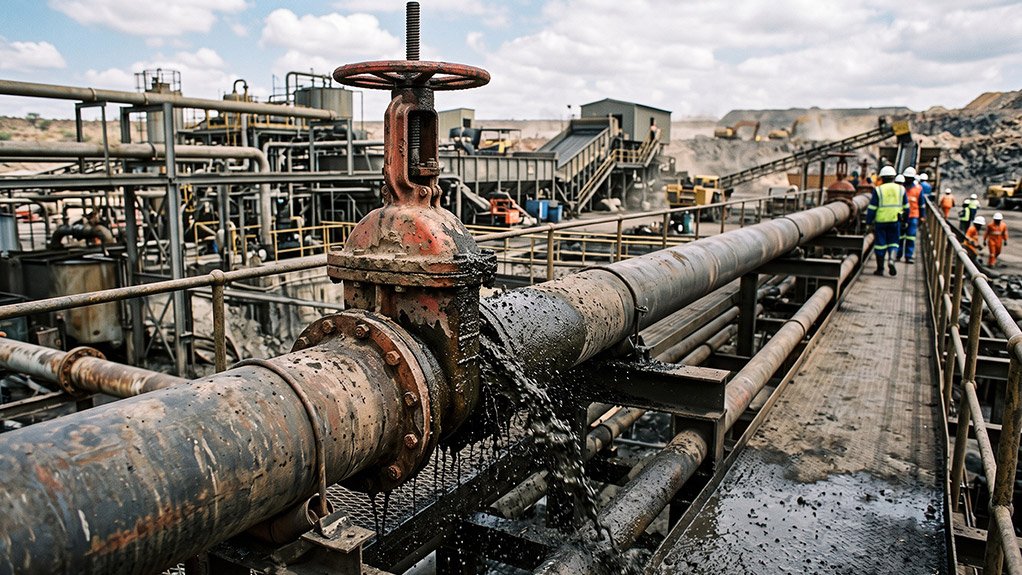

A standard commercial valve failing under high pressure on a heavy mineral slurry line, leading to costly environmental spills and plant downtime.
M Bond Pumps mining and industrial logo




Dense Media Separation (DMS) plants operate at the core of mineral recovery. Across the Southern African Development Community (SADC) region—from the sprawling copper and cobalt operations of the Zambian Copperbelt and the Democratic Republic of Congo, to the diamond recovery plants of Botswana and the platinum-rich reefs of South Africa’s Bushveld Complex—these specialised metallurgical circuits rely on high-density mixtures of water and ferrosilicon to separate ultimately valuable commodities from waste rock based purely on density.
Because this dense media must remain permanently suspended in the pumped media to prevent rapid settling and pipe blockages, the slurries are forced through the pipework at sustained high velocities. Consequently, these DMS circuits, thickener underflows, and heavy tailings lines yield some of the most abrasive and highly erosive flow conditions found anywhere where pumping exists. A ferrosilicon slurry is not simply "dirty water"; it is effectively a high-velocity liquid abrasive engineered to extract valuable minerals.
Despite the extreme kinetic forces at play, a problematic and costly trend persists in regional mine procurement and plant design: the "pipe-fitting fallacy." Driven by a mandate to aggressively cut initial capital expenditure (capex) during plant upgrades or greenfield developments, procurement teams and mechanical contractors frequently install generic, resilient-seated butterfly valves or standard municipal wedge gate valves to isolate high-velocity slurry and acidic return-water lines. In the demanding reality of an African metallurgical plant, substituting severe-duty equipment for commercial alternatives is not a reliable cost-saving measure; it creates a high probability of pressure blowouts, plant flooding, and significant operational downtime that rapidly offsets any initial capex savings.
The Mechanics of Wire-Drawing and Elastomer Degradation
Standard commercial industrial valves are fundamentally engineered for clean liquids, light agricultural pumping, or municipal water distribution. The mechanics of their failure in a severe-duty mining environment are rooted directly in the principles of fluid continuity and the physics of high-velocity particulate impingement. When a standard HVAC-style butterfly valve or wedge gate is actuated to close against a heavy ferrosilicon or tailings column, the internal aperture naturally narrows. As the opening restricts, the slurry velocity spikes dramatically to force the same volume of pumped media through the shrinking gap.
This localised, high-pressure jetting of sharp particulate matter creates a destructive phenomenon known in the engineering world as "wire-drawing". The abrasive suspended solids act much like a precision waterjet cutter. They rapidly erode the soft elastomer seals and gouge deep, permanent micro-channels into the metallic seating faces of the valve.
Once a micro-channel is cut, achieving a bi-directional, bubble-tight seal becomes mechanically impossible. The high specific gravity (SG) slurry will systematically widen the channel every hour the valve is closed. Within days the valve will leak continuously under high line pressure, compromising process safety. In SADC regions with increasingly stringent environmental regulations, this leakage can cause hazardous environmental spills into surrounding groundwater, demanding a total line shutdown for premature replacement.
Chatter, Cavitation and Stem Failure
Further, the physical architecture of commercial valves inherently introduces vulnerable failure points when exposed to high-velocity 1.5 SG to 2.5 SG slurry lines:
- Butterfly valves: The central disc remains directly in the flow path, even when fully open. This exposed disc acts as an immovable impact target. The constant bombardment of abrasive media quickly strips away protective epoxy coatings and induces localised cavitation in the downstream wake, aggressively eroding internal pipe liners, flanges and downstream instrumentation. This relentless flow turbulence also causes significant mechanical chatter. The harmonic vibration travels directly up the valve stem, systematically degrading the packing glands, damaging pneumatic actuators, and potentially fracturing the internal bottom pivot.
- Wedge gate valves: The bottom cavity—designed to receive the sealing wedge—quickly fills with settling rock, heavy grit, and hardened ferrosilicon the moment flow stops. When the plant operator attempts to close the valve, the gate hits this compacted debris, preventing full closure. Operators frequently resort to using "cheater bars" to force the handwheel, resulting in permanently bent or snapped stems from severe over-torquing.
The Knife Gate Necessity
To survive mineral extraction and high-density slurry transport, flow isolation must be reliable and uncompromising. This requires hardware that physically removes the fragile sealing mechanisms from the direct line of abrasive wear and possesses the mechanical force to sever through suspended solids. For return water lines, thickener underflow, and general slurry isolation, process engineers must specify severe-duty valves engineered specifically for unimpeded, heavy-media flow.
The definitive, engineered solution for these severe applications is the knife gate valve. While standard slurry-rated knife gates feature a sharpened, heavy-duty stainless-steel edge designed explicitly to physically shear through dense media, modern extraction facilities handling extreme abrasion now rely heavily on "push-through" elastomer-lined (urethane or heavy-duty natural rubber) slurry knife gate valves. As the blade actuates downward through two heavy-duty elastomer sleeves, it pushes abrasive particulates completely out of the seating area rather than trapping them against a fragile seal.
Crucially, when fully open, the gate retracts entirely out of the flow path into the upper body of the valve. This creates a full-bore, zero-restriction conduit. There is no central disc left in the flow path to induce turbulence, no bottom cavity for abrasive solids to accumulate in, and no exposed seating face to suffer from high-velocity wire-drawing. The operational impact is immense: plants that switch from commercial wedge gates to slurry-rated knife gates often see valve lifespans extend from a few weeks to well over 18 months.
A valve in a mining line is never just a passive piece of pipework; it is a critical dynamic control mechanism that dictates the safety, efficiency and uptime of the entire plant. Engineers should understand that installing a generic commercial valve into a tailings or DMS line results in rapid erosion and a false economy. By aligning pipeline flow dynamics with the correct mechanical choices, processing plants can effectively mitigate wire-drawing and maintain uninterrupted mineral recovery.
For engineers managing cross-border projects, ensuring that the right severe-duty hardware arrives on site is just as critical as specifying it. By leveraging specialised suppliers with dedicated SADC export services, mines in remote regions can secure the correct flow control mechanisms without crippling supply chain delays.
Article Enquiry
Email Article
Save Article
Feedback
To advertise email advertising@creamermedia.co.za or click here
Research Reports




Latest Multimedia
Latest News

Showroom

Rio Carb is an OEM (Original Equipment Manufacturer) of R-C700 Chromium Carbide (CrC) alloy clad wear plates and pipes used for heavy materials...
VISIT SHOWROOM
The Aluminium Federation of South Africa (AFSA), is the voice of the South African aluminium industry.
VISIT SHOWROOM


Announcements
What's On
Subscribe to improve your user experience...
Option 1 (equivalent of R125 a month):
Receive a weekly copy of Creamer Media's Engineering News & Mining Weekly magazine
(print copy for those in South Africa and e-magazine for those outside of South Africa)
Receive daily email newsletters
Access to full search results
Access archive of magazine back copies
Access to Projects in Progress
Access to ONE Research Report of your choice in PDF format
Option 2 (equivalent of R375 a month):
All benefits from Option 1
PLUS
Access to Creamer Media's Research Channel Africa for ALL Research Reports, in PDF format, on various industrial and mining sectors
including Electricity; Water; Energy Transition; Hydrogen; Roads, Rail and Ports; Coal; Gold; Platinum; Battery Metals; etc.
Already a subscriber?
Forgotten your password?
Receive weekly copy of Creamer Media's Engineering News & Mining Weekly magazine (print copy for those in South Africa and e-magazine for those outside of South Africa)
➕
Recieve daily email newsletters
➕
Access to full search results
➕
Access archive of magazine back copies
➕
Access to Projects in Progress
➕
Access to ONE Research Report of your choice in PDF format
RESEARCH CHANNEL AFRICA
R4500 (equivalent of R375 a month)
SUBSCRIBEAll benefits from Option 1
➕
Access to Creamer Media's Research Channel Africa for ALL Research Reports on various industrial and mining sectors, in PDF format, including on:
Electricity
➕
Water
➕
Energy Transition
➕
Hydrogen
➕
Roads, Rail and Ports
➕
Coal
➕
Gold
➕
Platinum
➕
Battery Metals
➕
etc.
Receive all benefits from Option 1 or Option 2 delivered to numerous people at your company
➕
Multiple User names and Passwords for simultaneous log-ins
➕
Intranet integration access to all in your organisation