Trump supporters imperil $4bn aluminium plant central to his industrial push



A cow wearing a gas mask is the first sign something may be amiss in Inola, Oklahoma.
“Protect Our Farms. #StopTheInolaSmelter,” reads the text below the image, splashed across a billboard towering over one of the main highways to this prairie town with a population of 1 890 people. The smelter in question: a $4-billion aluminium processing plant touted by President Donald Trump as part of his push to revive the industry in the US.
In a June 29 letter, Trump urged the town’s council to approve the project “without delay, so that together we may strengthen our national security, supercharge our economy, and lead our Nation boldly into a new Golden Age of American greatness.”
Instead, the five-person board of trustees for Inola, located just east of Tulsa, voted unanimously that day to impose a moratorium on the project. The smelter, a joint venture between the United Arab Emirates’ State-owned Emirates Global Aluminium PJSC and Chicago-based Century aluminium Co, would be the first new US plant in nearly 50 years to process aluminium that’s derived from raw material rather than recycled.
Opponents of the plant say they’re afraid toxic emissions from the facility will damage agricultural land in Inola, which has dubbed itself the “Hay Capital the World” in a nod to the prized Bluestem prairie grass that grows there. There’s also concern that the plant’s intensive power needs will drive up electricity prices. The controversy has surfaced in the Oklahoma governor’s race, with one candidate in the upcoming Republican primary supporting the project and the other opposing it.
Inola’s backlash underscores the challenges of revitalizing US industrial might in an age of NIMBYism, showing that Trump’s sway has limits even in conservative States. The outcry over the smelter comes amid growing wave of opposition to energy-thirsty data centers in red and blue states alike.
That kind of pushback threatens Trump’s efforts to restore manufacturing that has largely been lost to overseas competition. Once the world’s top aluminium producer, the US has seen the sector hollowed out by plant closures, leaving the country reliant on imports of the metal used in everything from iPhones to fighter jets as the Iran war roils foreign supply. For the Inola project to move forward, the developers will need to assuage the town council’s environmental concerns and secure a long-term contract for affordable power — an outcome that isn’t guaranteed, industry analysts said.
“Are there limits to the transformative power of Trumpism? Absolutely,” said Edward Alden, a senior fellow at the Council on Foreign Relations who specializes in US economic competitiveness. “This project is a great example of that.”
Kush Desai, a spokesman for the White House, said in an emailed statement that “mindless left-wing” activism has “done enough damage to America’s industrial base.”
“The Trump administration is committed to reshoring critical manufacturing and strengthening our national and economic security,” Desai said.
Like many in Inola, Joleta Ingersoll, who co-owns a 12 000 acre (4 856 ha) ranch a few miles outside the town, voted for Trump. Though she still supports him, she worries that hydrogen fluoride — a hazardous gas that can damage the skin and lungs — emitted from the aluminium plant would poison the Bluestem prairie hay she grows and the cattle that eat the crop.
If the smelter is built, “we’re done,” Ingersoll said in an interview from the ranch’s wood-paneled clubhouse. “What you see right here is not going to be here anymore.”
While some Inola residents have expressed worries about the facility’s electricity use and the partnership that gives foreign-owned EGA a 60% stake, one of primary concerns is the plant’s emissions of hydrogen fluoride. Cows that eat hay contaminated with the chemical can develop fluorosis, a condition that can destroy the animals’ teeth and create skeletal deformities.
Alarm grew after the the company, in a filing with the Oklahoma Department of Environmental Quality, applied to emit 425 tons of hydrogen fluoride annually. The joint venture partners say the actual amount the facility emits will be much lower, adding that they have a financial incentive to capture the chemical because it can be re-used for smelting.
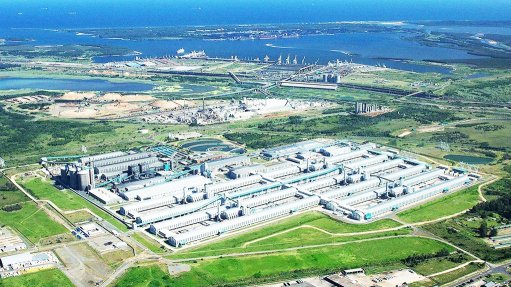
Ziad Fares, an EGA executive and project director for Oklahoma Primary aluminium, the official name of the joint venture, said it’s working to address the community’s concerns. The plant will be modeled after EGA’s Al Taweelah plant in Abu Dhabi, which the company says is recognized as one of the best-performing in the world.
The company “was not expecting to have a backlash to that extent,” Fares said in an interview, adding the project is slated for an area zoned for heavy industries. “What we will be bringing is our latest and greatest technology.”
Fares said the moratorium isn’t expected to have an impact on the project’s timing. The joint venture partners have said they expect the plant to open around 2030.
The smelter, which was touted by the White House in May 2025 as part of $200-billion in deals secured by the president during a visit to the UAE, is set to be the largest in the US, producing 750 000 tons of aluminium a year. That would more than double US production of the metal.
Today only four smelters remain in the US, where about 60% of the aluminium it uses is imported, mostly from Canada and the UAE. Global supplies have been constrained since Iranian drones damaged aluminium plants in the UAE and Bahrain, sending prices for the metal soaring earlier this year.
“The US government has realized that if we are dependent on foreign sources of aluminium, we're potentially at risk,” said Matt Aboud, a senior vice president at Century A
Aluminum.
Though the Trump administration has moved to bolster domestic aluminium production by imposing tariffs on imports of the metal, Aboud said the joint venture’s financial projections for the project don’t assume the duties will stay in place over the long term.
On a recent weekday morning in Inola, red and white yard signs proclaiming “No Smelter” and “Save Our Farms” dotted the tiny downtown.
“I think we’re a political ping-pong ball,” Scott Devers, the town’s administrator, said in an interview. “We want what’s right for our community first, and then if we can help the country out, we will.”
The 60-day pause allows time for additional environmental analysis to be done on hydrogen fluoride emissions from the plant, Devers said. The moratorium will end September 28, he added, because an official notice was published in a local paper in late July.
While Devers spoke positively about the smelter, he said that whether the council votes to renew the moratorium will depend on whether details about the plant’s emissions are enough to ease the community’s concerns.
At the single-story town hall building, Larry Grigg, a member of Inola’s board of trustees, said the issue has divided longtime friends and even family members. While he said he supports the plant “if it’s safe,” he voted for the 60-day moratorium. A proposal for a longer pause drew threats of legal action from Oklahoma Primary aluminium.
Gubernatorial politics are also playing a role in the battle over the smelter. Outgoing Republican Gov. Kevin Stitt is in favor of the project, and Mike Mazzei, a Republican candidate to replace him, announced he was supporting the project just hours before Trump endorsed him in May. His primary opponent, Oklahoma Attorney General Gentner Drummond, filed a lawsuit seeking to block the smelter days later.
“The controlling hand behind the largest smelter ever proposed on American soil belongs not to Oklahomans, nor even to Americans, but to a foreign sovereign more than 7 000 miles away,” Drummond wrote in the petition.
The two candidates are heading to an Aug. 25 runoff after securing about 26% of the vote each, putting them in a dead heat.
The town’s vote to impose the moratorium on the project came after a tense six-hour meeting.
Among those who spoke in favour of the smelter was Audrey Robertson, an Energy Department assistant secretary. She said the plant, the largest Oklahoma economic development project, would bring thousands of jobs while meeting environmental standards.
“Build it at Mar-a-Lago,” someone in the crowd jeered.
Ultimately, the plant’s fate may come down to power prices. Aluminium smelting is an energy-intensive process, and electricity can account for roughly a third of the cost of producing the metal.The Inola project will require about 1.2 GW of electricity — enough to power roughly 900 000 US homes. As soaring energy bills become a political flashpoint, any industrial project with high power consumption is at risk of public backlash.
American Electric Power’s Public Service Company of Oklahoma is in final negotiations with the Inola smelter developers, and new power generation projects will help serve growth “without burdening other customers,” a spokesperson for the utility said. Any agreement would go before the State utility regulator for approval.
Still, elevated aluminium prices leave room to absorb high electricity costs, according to Greg Wittbecker, a former executive at Alcoa Corporation who’s now an industry consultant. While supply bottlenecks from the Iran war may dissipate, aluminium demand is expected to grow in the long term, driven by its use in electric-vehicle batteries and data-center cooling systems.
Regardless of the cost of power, companies face financial hurdles to build or restart US aluminium plants. Alcoa, the top US producer, has concentrated most of its output of non-recycled aluminium in Canada and Europe. Some firms have sold shuttered smelter sites to companies developing data centers.
The advantage of Century’s smelter project is its partnership with EGA, which spent decades improving technology to become more efficient, according to Wells Fargo analyst Timna Tanners.
“The EGA smelters are renowned for using less electricity than the legacy ones,” said Tanners.
Among those counting on the project are Ryan Plotkin, whose company signed an agreement with EGA and Century aluminium in February to explore the development of a fabrication plant near the smelter. The facility will use hot aluminium from the plant to manufacture specialty items like wire rod.
His family owns M-D Building Products, a 106-year-old aluminium manufacturing facility in Oklahoma City. The plant makes products including floor transitions and weather stripping.
As Plotkin stood on the factory floor last month, a conveyor belt fed a massive cylinder of aluminium into an oven that heated it close to 1 000 degrees Fahrenheit (538 Celsius) The cylinder was then sent to an extrusion press, where narrow strips of aluminium to be used as stair edges poured out like Play-Doh.
Nearby, a rack held several of the cylinders. Plotkin picked up a label showing they were “Made in the UAE.”
“Soon this will say made in Oklahoma,” he said.
Article Enquiry
Email Article
Save Article
Feedback
To advertise email advertising@creamermedia.co.za or click here
Research Reports

Projects
Latest Multimedia
Latest News
Showroom
We partner growth of our select clients through our comprehensive and competitive integrated international logistics, trade finance and information...
VISIT SHOWROOM
Sika South Africa is a trusted partner for the nation’s infrastructure, commercial, residential, and industrial sectors.
VISIT SHOWROOM
Announcements
What's On
Subscribe to improve your user experience...
Option 1 (equivalent of R125 a month):
Receive a weekly copy of Creamer Media's Engineering News & Mining Weekly magazine
(print copy for those in South Africa and e-magazine for those outside of South Africa)
Receive daily email newsletters
Access to full search results
Access archive of magazine back copies
Access to Projects in Progress
Access to ONE Research Report of your choice in PDF format
Option 2 (equivalent of R375 a month):
All benefits from Option 1
PLUS
Access to Creamer Media's Research Channel Africa for ALL Research Reports, in PDF format, on various industrial and mining sectors
including Electricity; Water; Energy Transition; Hydrogen; Roads, Rail and Ports; Coal; Gold; Platinum; Battery Metals; etc.
Already a subscriber?
Forgotten your password?
Receive weekly copy of Creamer Media's Engineering News & Mining Weekly magazine (print copy for those in South Africa and e-magazine for those outside of South Africa)
➕
Recieve daily email newsletters
➕
Access to full search results
➕
Access archive of magazine back copies
➕
Access to Projects in Progress
➕
Access to ONE Research Report of your choice in PDF format
RESEARCH CHANNEL AFRICA
R4500 (equivalent of R375 a month)
SUBSCRIBEAll benefits from Option 1
➕
Access to Creamer Media's Research Channel Africa for ALL Research Reports on various industrial and mining sectors, in PDF format, including on:
Electricity
➕
Water
➕
Energy Transition
➕
Hydrogen
➕
Roads, Rail and Ports
➕
Coal
➕
Gold
➕
Platinum
➕
Battery Metals
➕
etc.
Receive all benefits from Option 1 or Option 2 delivered to numerous people at your company
➕
Multiple User names and Passwords for simultaneous log-ins
➕
Intranet integration access to all in your organisation