Steady improvement in South Africa’s mineral exploration landscape reported

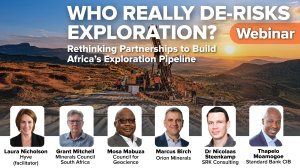
Panellists at the Who Really De-Risks Exploration webinar discuss the key roles of finance, geoscience, government and the mining industry in de-risking mineral exploration and unlocking investment.
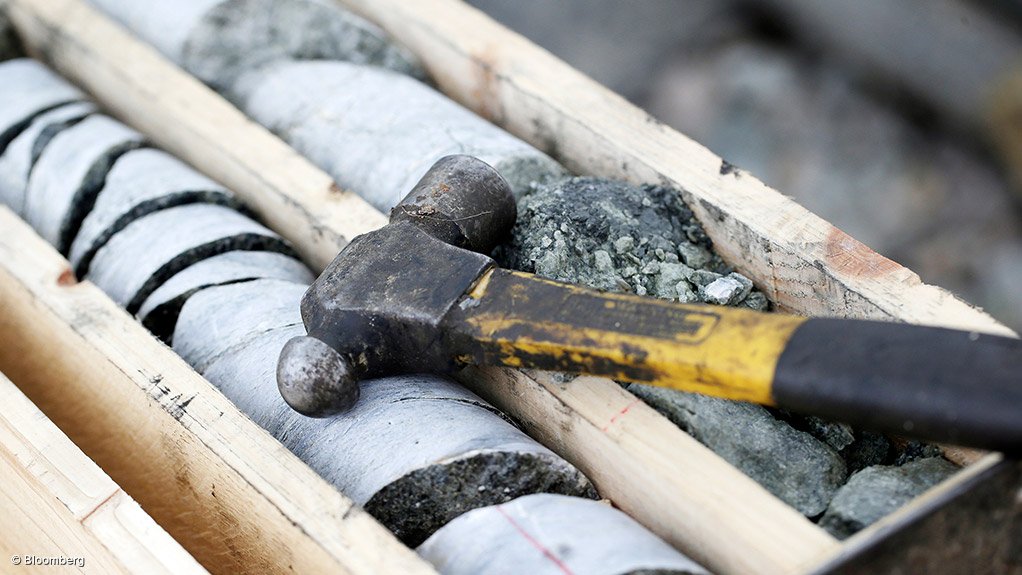
Photo by Bloomberg


While South Africa’s targeted mineral exploration activity has been limited for a decade or two, mining industry professionals participating in a webinar hosted by Creamer Media have reported promising improvements that could drive a resurgence in exploration.
The 'Who Really De-Risks Exploration' webinar was held on October 28 and facilitated by events organiser Hyve Investing in African Mining Indaba industry director Laura Nicholson. The panel of speakers were Standard Bank Corporate and Investment Banking metals and mining coverage executive head Thapelo Moamogoe, Minerals Council South Africa junior and emerging miners desk lead Grant Mitchell, Council for Geoscience CEO Mosa Mabuza, mining and water consulting firm SRK Consulting geological and geotechnical consultant and mining business analyst Dr Nicolaas Steenkamp and copper and base metals miner Orion Minerals sustainability and business support executive Marcus Birch.
Moamogoe cited the emerging partnership between the mining industry and government, the absence of which had previously dampened mining activity, as the first of the promising developments, adding that the private sector and government both understood the need to drive the growth and development of the industry.
Secondly, there was a global drive to source so-called critical minerals, and South Africa was not immune to this, with increased movement in its financial sector to fund exploration or mining of minerals that would be needed for low-carbon economies, said Mitchell.
The country is making progress in addressing the three main challenges facing exploration in South Africa – mining right processing and a public mining information system, regulatory certainty and crime and corruption – that had been identified in the 2022 Exploration Implementation Plan.
The Minerals Council was engaged in constructive dialogue with government to ensure the draft Mineral Resources Development Bill was investor-friendly and helped to support exploration, he added.
On mining rights, South Africa had operated without a cadastral system for years, which meant its mining rights processes were inefficient and opaque. This was viewed as a major disincentive for investors who want transparency to see the availability of mining rights and to track their applications.
The Minerals Council and the mining industry had provided funding to help with capturing the data for a cadastre, as this was a significant challenge. The industry had also partnered with the Department of Mineral and Petroleum Resources to help establish a mining cadastre, said Mitchell.
The target date for having a national mining cadastre in place was now March 31, 2027, although the deadline for achieving this goal has suffered delays before.
Further, the mining industry was working with the security establishment and the police to try to reduce and mitigate the impact of crime and corruption on mining projects.
A positive development has been the inclusion of mining as one of the three focus sectors for the third phase of South Africa’s Government-Business Partnership under the Presidency, which provided another platform on which the mining industry can work with partners to find solutions.
“Taken together, the industry is moving in the right direction. The environment is more positive than it was a few years ago,” said Mitchell.
Further, the Council for Geoscience (CGS) had formed a partnership with diversified multinational miner BHP to pool expertise on mineral systems delineation approaches, which would bolster the CGS's work, said Mabuza.
The CGS is also working with several local companies on data and data assessments, and is working with local and international companies to secure geological and mineralogy data.
The theme of the importance of geological data persisted throughout the webinar, with Mabuza noting that exploration data was a great currency for exploration geologists, who could assess the data, evaluate potential and potentially trigger other activities.
“A junior can look at historical data collected by South Africa’s geological survey [which is the CGS] with new eyes, and perhaps new technologies and processes, and can identify an opportunity.
“Having access to historical data significantly reduces the time to access and use geological data to answer the questions needed to trigger mining activities. It is important for [the CGS] to make such data accessible.”
Junior miners needed access to quality data. South Africa should make use of its mining legacy and the high-quality data present in the country to provide them with access that would help to trigger exploration in the country, he said.
The CGS had proposed to government to map South Africa’s geological data at a more granular scale of 1:50 000. While this was a significant investment, it would narrow down the areas that present potential, said Mabuza.
The CGS was also providing technical support to the Industrial Development Corporation-managed Exploration Fund, he added.
In response to Mabuza, Mitchell noted that lots of historical data was not publicly available in South Africa. This data would be very useful for junior miners, but was often expensive to obtain.
South Africa’s historical exploration had been funded by large mining companies, not all of which left a repository of data when they left. Similarly, unsuccessful exploration data was also often not captured, noted Steenkamp.
This lost data required time and effort to generate again and even data from unsuccessful exploration would be useful.
However, exploration was not free, and having data freely available was difficult. It was reasonable to expect fair payment for exploration data, he said.
Mitchell said the Minerals Council’s programme to have major mining companies mentor junior miners was of limited success because the country’s juniors were seasoned miners.
However, its junior miner accelerator programme, which brought three new small companies into the industry and exposed them to the financial markets and processes, had been very successful, and a mentorship programme for new entrants into exploration could work very well, he said.
Birch, meanwhile, stressed the importance of partnerships to junior miners, saying that no junior could carry a project throughout exploration and development and into production on its own balance sheet.
Article Enquiry
Email Article
Save Article
Feedback
To advertise email advertising@creamermedia.co.za or click here
Research Reports

Projects
Latest Multimedia
Latest News

Showroom
Supplier & Distributor of the Widest Range of Accurate & Easy-to-Use Alcohol Breathalysers
VISIT SHOWROOM
Design, Construction and Maintenance of Site Erected, Welded Bulk Storage Tanks for the Petrochemical, LNG, Ammonia and Sustainable fuel Sectors.
VISIT SHOWROOM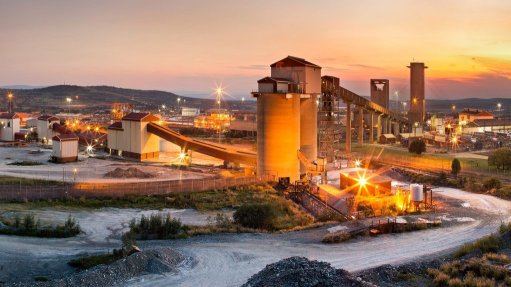

Press Office
Announcements
What's On
Subscribe to improve your user experience...
Option 1 (equivalent of R125 a month):
Receive a weekly copy of Creamer Media's Engineering News & Mining Weekly magazine
(print copy for those in South Africa and e-magazine for those outside of South Africa)
Receive daily email newsletters
Access to full search results
Access archive of magazine back copies
Access to Projects in Progress
Access to ONE Research Report of your choice in PDF format
Option 2 (equivalent of R375 a month):
All benefits from Option 1
PLUS
Access to Creamer Media's Research Channel Africa for ALL Research Reports, in PDF format, on various industrial and mining sectors
including Electricity; Water; Energy Transition; Hydrogen; Roads, Rail and Ports; Coal; Gold; Platinum; Battery Metals; etc.
Already a subscriber?
Forgotten your password?
Receive weekly copy of Creamer Media's Engineering News & Mining Weekly magazine (print copy for those in South Africa and e-magazine for those outside of South Africa)
➕
Recieve daily email newsletters
➕
Access to full search results
➕
Access archive of magazine back copies
➕
Access to Projects in Progress
➕
Access to ONE Research Report of your choice in PDF format
RESEARCH CHANNEL AFRICA
R4500 (equivalent of R375 a month)
SUBSCRIBEAll benefits from Option 1
➕
Access to Creamer Media's Research Channel Africa for ALL Research Reports on various industrial and mining sectors, in PDF format, including on:
Electricity
➕
Water
➕
Energy Transition
➕
Hydrogen
➕
Roads, Rail and Ports
➕
Coal
➕
Gold
➕
Platinum
➕
Battery Metals
➕
etc.
Receive all benefits from Option 1 or Option 2 delivered to numerous people at your company
➕
Multiple User names and Passwords for simultaneous log-ins
➕
Intranet integration access to all in your organisation