South Africa risks leaving much manganese value unrealised if logistics issues persist

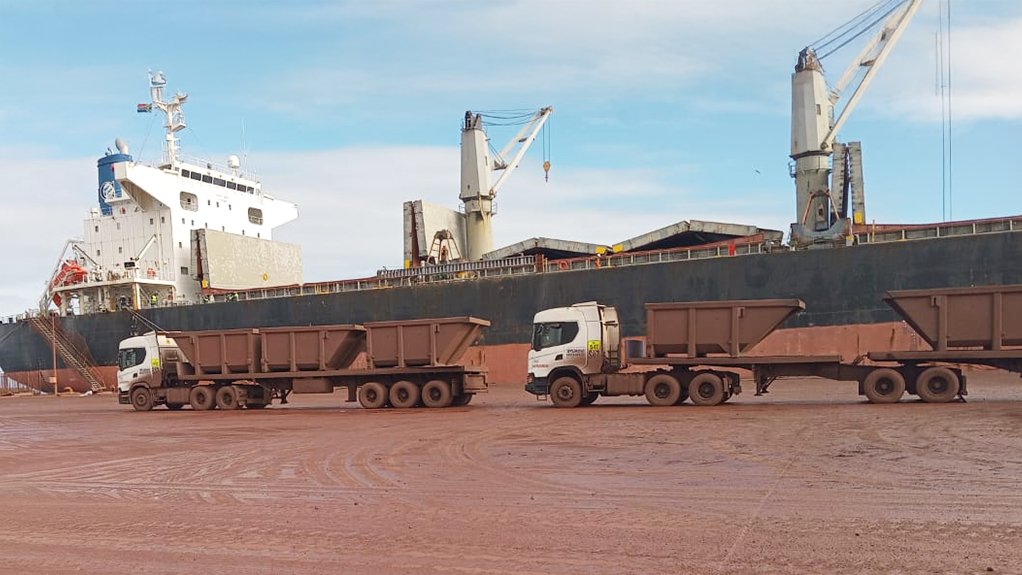


JOHANNESBURG (miningweekly.com) – South Africa’s Manganese Producers Consortium (MPC), which represents producers that account for 60% of South Africa’s manganese ore exports, does not direct individual producers on the corridors or export routes they use.
Those decisions reflect each producer’s specific operational, commercial, customer and logistics requirements, and it is therefore not the MPC’s remit to comment on individual routing choices.
This is what the MPC pointed out in response to a Mining Weekly reader noting the use of Namibia’s Port of Lüderitz by South Africa’s manganese exporters and whether there were any plans to strengthen the Upington–Ariamsvlei–Lüderitz rail link and to step up exports via Lüderitz.
The reader query arose ahead of the ASX-listed Jupiter Mines reporting in its latest financial year 2026 (FY26) annual report that of the above-plan 3.5-million tonnes of manganese it sold in FY26, 828 000 t went through Lüderitz.
In South Africa, the Saldanha Bay corridor and the Gqeberha/Nelson Mandela Bay corridor are the two manganese ore transport corridors, with Saldanha regarded as a good bulk-commodity transport route because very little else travels along it. In contrast, the rail line to Gqeberha is considerably more complicated in that, as a multi-freight line, it carries a lot more than just manganese and even has passenger and automotive connections at different points.
Also, when it reaches the Gqeberha port, the manganese ore is made to wend its way through a four-terminal port complex.
Several manganese mining companies tell Engineering News & Mining Weekly that, instead of 16 t being made to go along the troublesome Gqeberha route and only 8 t along the better Saldanha route, the way forward should be for 12-million tonnes a year to go down the Saldanha line, and a matching 12-million tonnes through Gqeberha, as part of what they term the 12x12 strategy.
Regarding the use of Lüderitz and whether this rail route is going to be strengthened for greater use, the MPC stated in its response to Mining Weekly’s reader query: “We recognise that some manganese ore volumes are exported through Lüderitz, with the Upington–Ariamsvlei–Lüderitz route providing an alternative logistics option for certain producers. These and other alternative routes currently play an important bridging role while the Saldanha Bay and Gqeberha/Nelson Mandela Bay corridors are not yet able to move the full 24-million tonnes per annum by rail envisaged under the long-term dual corridor 12x12 strategy.
“We support the government’s national rail reform programme and its efforts to develop a well-coordinated, balanced and optimal solution across South Africa’s two principal manganese export corridors, namely Saldanha Bay and Gqeberha/Nelson Mandela Bay. This aligns with the dual-corridor approach reflected in the recently published draft National Rail Master Plan.
“The dual corridor 12x12 strategy envisages a sustainable, long-term rail capacity of 12-million tonnes per annum through Saldanha Bay and 12-million tonnes per annum through Gqeberha. This approach provides the most appropriate long-term basis for planning manganese rail and port capacity, investment and operational recovery.
“Critically, bulk ore logistics systems need to be designed and managed as integrated mine-to-port corridor systems,” the MPC pointed out.
“Rail and port performance are interdependent: reliable rail capacity without a functioning export terminal does not deliver additional exports, and additional terminal capacity without dependable and cost-effective rail supply does not solve the logistics constraint.
“The objective must therefore be to achieve a balance to ensure cost-effective and sustainable end-to-end performance across both rail and port infrastructure.”
The MPC described its purpose as being to assist and participate in restoring and developing a dependable, competitive and integrated capacity on the two main South African corridors, through coordinated reform, investment and appropriately structured private-sector participation.
FAR FROM PORTS
South Africa’s main manganese orebodies lie 1 000 km from export terminals, making transport cost and system efficiency decisive determinants of competitiveness — yet largely outside the control of individual producers.
As a rough approximation, the cost of producing and delivering a tonne of manganese ore consists of three roughly equal components: mining, inland transport to port, and onward delivery to end‑users, primarily in Asia, India and Europe.
So, although South Africa’s manganese ore endowment is a significant national asset, resources alone do not determine outcomes. What ultimately matters is the sustainable operational and cost effectiveness of the systems built around them.
If logistics constraints persist, South Africa risks leaving much of the value of its manganese ore resources unrealised.
Converting demand for the ore into sustained export volumes, jobs and revenue requires an export system that is competitive.
In addition to port constraints, South Africa’s freight rail operates on narrow gauge, with lower axle loads and challenging gradients. This requires more wagons, more energy and higher operating costs to transport the same volume as many global peers. Over time, these structural disadvantages shape production decisions, deter new investment and influence the long-term trajectory of the sector.
Article Enquiry
Email Article
Save Article
Feedback
To advertise email advertising@creamermedia.co.za or click here
Research Reports

Projects
Latest Multimedia
Latest News
Showroom

We supply customers with practical affordable solutions for their testing needs. Our products include benchtop, portable, in-line process control...
VISIT SHOWROOM
Developed to exceed the latest EN 15964 standards for police breathalysers proving that it will remain accurate and reliable for many years to come.
VISIT SHOWROOM
Press Office
Announcements
What's On
Subscribe to improve your user experience...
Option 1 (equivalent of R125 a month):
Receive a weekly copy of Creamer Media's Engineering News & Mining Weekly magazine
(print copy for those in South Africa and e-magazine for those outside of South Africa)
Receive daily email newsletters
Access to full search results
Access archive of magazine back copies
Access to Projects in Progress
Access to ONE Research Report of your choice in PDF format
Option 2 (equivalent of R375 a month):
All benefits from Option 1
PLUS
Access to Creamer Media's Research Channel Africa for ALL Research Reports, in PDF format, on various industrial and mining sectors
including Electricity; Water; Energy Transition; Hydrogen; Roads, Rail and Ports; Coal; Gold; Platinum; Battery Metals; etc.
Already a subscriber?
Forgotten your password?
Receive weekly copy of Creamer Media's Engineering News & Mining Weekly magazine (print copy for those in South Africa and e-magazine for those outside of South Africa)
➕
Recieve daily email newsletters
➕
Access to full search results
➕
Access archive of magazine back copies
➕
Access to Projects in Progress
➕
Access to ONE Research Report of your choice in PDF format
RESEARCH CHANNEL AFRICA
R4500 (equivalent of R375 a month)
SUBSCRIBEAll benefits from Option 1
➕
Access to Creamer Media's Research Channel Africa for ALL Research Reports on various industrial and mining sectors, in PDF format, including on:
Electricity
➕
Water
➕
Energy Transition
➕
Hydrogen
➕
Roads, Rail and Ports
➕
Coal
➕
Gold
➕
Platinum
➕
Battery Metals
➕
etc.
Receive all benefits from Option 1 or Option 2 delivered to numerous people at your company
➕
Multiple User names and Passwords for simultaneous log-ins
➕
Intranet integration access to all in your organisation