Restoration project advances

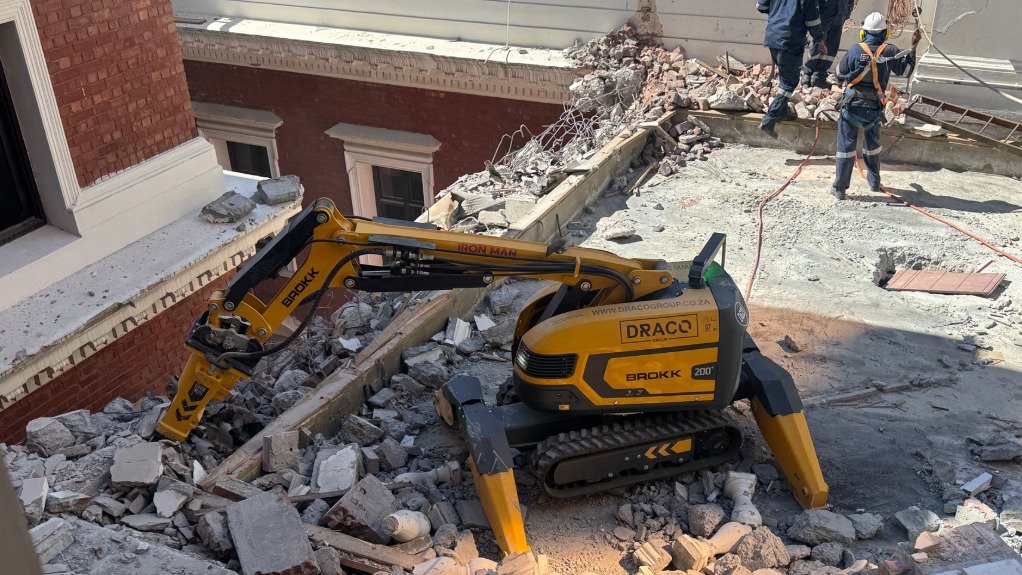
NAVIGATING CHALLENGES Challenges including unknown structural conditions and asbesto were revealed as work advance, requiring concurrent management to meet the project timeline


Following its appointment in May 2025 to assist in restoring and rehabilitating Parliament’s Old Assembly Building, in Cape Town, demolition contractor Draco Group completed its full scope of work last month, significantly ahead of the new projected timeline, says Draco Group CEO Teddy Habib.
The full restoration, which is ongoing, forms part of the broader Parliament Infrastructure Programme, with the Development Bank of Southern Africa acting as the implementing agent.
The restoration programme follows a fire in January 2022, which burned for three days, significantly damaging the National Assembly Building and the adjacent Old Assembly Wing.
“A fire of that duration causes damage well beyond the surface. Reinforced concrete can spall, steel reinforcement can lose strength, masonry joints can crack, and connections can deform as materials expand under heat and contract during cooling,” says Habib.
Under a R1.3-billion contract with an 18-month provisional construction period, Draco Group delivered its full specialist scope in-house, encompassing demolition, controlled demolition, asbestos abatement, hazardous waste management, site rehabilitation and earthworks.
Habib reflects that the most demanding aspect of the project was maintaining progress and quality while navigating changing conditions.
“The building’s shortcomings were revealed as work advanced. Unknown structural conditions, asbestos, security requirements, as well as weather and the need to protect irreplaceable heritage fabric, had to be managed concurrently,” he says.
Temporary works and site protection were established first. This included dust- containment barriers, external hoarding, crash barriers and secure access control systems. The barriers ensured site protection from the strong south-easterly winds, separated the building site from the public, preserved emergency routes and maintained clear security sight lines.
Changing Conditions
Owing to a lack of as-built drawings, Draco Group carried out investigative and as-built verification works to physically verify the building’s specifications and conditions before finalising design and execution decisions. This included closed-circuit television inspections, three-dimensional scanning, detailed recording of existing conditions and structural assessments.
“In some areas, the team’s findings differed from what had been assumed. This meant the structural engineering team had to make real-time design adjustments during delivery,” says Habib.
Subsequently, the company conducted controlled demolition and strip-out of all fire-damaged structural and finishing elements, ensuring the protection of retained heritage elements, with salvage and reuse applied where possible.
Asbestos-containing materials added to the project’s complexity, which the company expected to find given the building’s construction history spanning from 1885 to the mid-twentieth century. Asbestos was widely used in South African construction from the 1920s until the late 1980s across various applications.
However, upon the building’s evaluation, the scale significantly exceeded Draco Group’s expectations, with 31.8 t extracted from the Old Assembly and Link buildings, Habib states.
This affected the project schedule, as every affected zone had to be identified, isolated, cleared, monitored and certified before construction could resume. To prevent a full site shutdown, teams were relocated to previously cleared areas while abatement proceeded within appropriate safety and regulatory parameters.
All removal work was carried out under the oversight of an approved inspection authority, supported by sealed containment areas, negative pressure systems, high-efficiency particulate air filtration and continuous air monitoring.
Subsequent structural rehabilitation encompassed concrete spalling repairs, crack stitching and brickwork reinforcement, among other interventions.
Draco Group emphasises that particular care was required for the heritage masonry zones, where repair materials had to be compatible with the soft historic brickwork to mitigate long-term damage.
Fire remedial works and compliance upgrades also formed part of the scope, including fire-rated doors and structural fire protection systems, to ensure that the restored building could meet current safety requirements at handover.
Heritage Conservation
The parliamentary precinct was declared a National Heritage Site in April 2014 by administrative body South African Heritage Resources Agency (SAHRA), with the Old Assembly Building holding Grade 1 status – the highest level of heritage protection.
The precinct’s falling in the City of Cape Town’s Central City Heritage Protection Overlay Zone prompted the project team to meet national requirements through SAHRA, and local heritage overlay requirements through the city, with every intervention required to comply with permit conditions and an approved heritage methodology.
Following a 13-month consultative process with conservation organisations and affected parties, Section 27 permission applications were approved in December 2024.
Draco Group worked according to a conservation-first sequence approved by project management and engineering consultancy Henry Fagan Group before any broader works began.
The Old Assembly chamber was retained in its original form throughout, with its seating, architectural features and spatial character treated as central preservation priorities. “Our team understood that this was not simply a construction contract. It was work on a building that has witnessed more than a century of South African political life,” Habib concludes.
Article Enquiry
Email Article
Save Article
Feedback
To advertise email advertising@creamermedia.co.za or click here
Research Reports
Projects

Latest Multimedia
Latest News

Showroom
M and J Mining are leading suppliers of physical support systems as used by the underground mining industry. Our selection of products are not...
VISIT SHOWROOM
SABAT Batteries is a renowned brand in the battery industry, manufacturing a wide range of batteries at its state-of-the-art production facility in...
VISIT SHOWROOM


Announcements
What's On
Subscribe to improve your user experience...
Option 1 (equivalent of R125 a month):
Receive a weekly copy of Creamer Media's Engineering News & Mining Weekly magazine
(print copy for those in South Africa and e-magazine for those outside of South Africa)
Receive daily email newsletters
Access to full search results
Access archive of magazine back copies
Access to Projects in Progress
Access to ONE Research Report of your choice in PDF format
Option 2 (equivalent of R375 a month):
All benefits from Option 1
PLUS
Access to Creamer Media's Research Channel Africa for ALL Research Reports, in PDF format, on various industrial and mining sectors
including Electricity; Water; Energy Transition; Hydrogen; Roads, Rail and Ports; Coal; Gold; Platinum; Battery Metals; etc.
Already a subscriber?
Forgotten your password?
Receive weekly copy of Creamer Media's Engineering News & Mining Weekly magazine (print copy for those in South Africa and e-magazine for those outside of South Africa)
➕
Recieve daily email newsletters
➕
Access to full search results
➕
Access archive of magazine back copies
➕
Access to Projects in Progress
➕
Access to ONE Research Report of your choice in PDF format
RESEARCH CHANNEL AFRICA
R4500 (equivalent of R375 a month)
SUBSCRIBEAll benefits from Option 1
➕
Access to Creamer Media's Research Channel Africa for ALL Research Reports on various industrial and mining sectors, in PDF format, including on:
Electricity
➕
Water
➕
Energy Transition
➕
Hydrogen
➕
Roads, Rail and Ports
➕
Coal
➕
Gold
➕
Platinum
➕
Battery Metals
➕
etc.
Receive all benefits from Option 1 or Option 2 delivered to numerous people at your company
➕
Multiple User names and Passwords for simultaneous log-ins
➕
Intranet integration access to all in your organisation