BHP confident of group’s future growth opportunities, despite warning of lower 2027 copper output

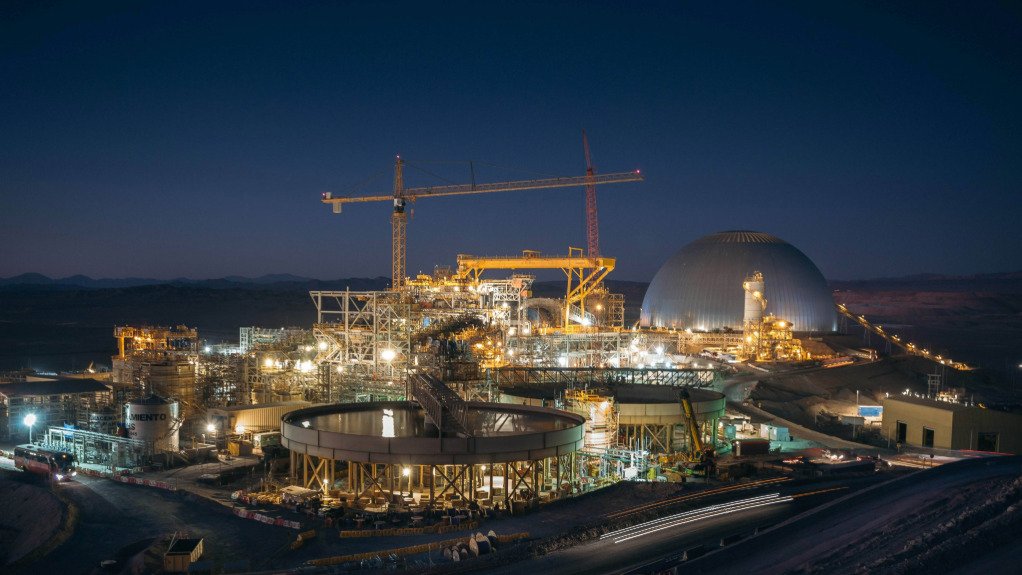


Global diversified miner BHP produced nearly two-million tonnes of copper and record iron-ore production for the financial year ended June 30, but has substantially lowered its copper production guidance for the 2027 financial year, mainly as a result of a decline in grades at the Escondida mine, in Chile.
The company’s copper mines produced 1.95-million tonnes in the 2026 financial year, in line with guidance of 1.9-million to two-million tonnes. Iron-ore output, meanwhile, increased by 1% year-on-year to a record 265-million tonnes, in line with guidance of 258-million to 269-million tonnes.
“We finished the year strongly, delivering safe and reliable operations while setting several performance records across the business.
“For the second consecutive year, we produced around two-million tonnes of copper and delivered record iron-ore production, demonstrating the power of a disciplined operating system and world-class assets.
“We achieved this against a backdrop of stronger realised prices for both copper and iron-ore, with copper prices around 35% higher than a year ago. Cost control was particularly strong, with every asset expected to be within unit cost guidance despite headwinds from inflation, higher diesel prices and global supply chain disruptions,” says CEO Brandon Craig.
He adds that the group is also continuing to build the next phase of growth. During the year under review, it progressed applications to restart Cerro Colorado, in Chile, defined development pathways for Copper South Australia, Escondida and Spence, and expanded its future copper options in the US through progress at Resolution and its investment in Faraday, while Vicuña, in Argentina, received Incentive Regime for Large Investments approval.
“In Canada, Jansen is on track to begin potash production next year, adding a new commodity and further diversifying our portfolio.
“We enter the new year with momentum and significant opportunities to accelerate improvements in safety, productivity and reliability through our operating system and the adoption of technology,” Craig comments.
COPPER
BHP has set its copper guidance for the 2027 financial year at between 1.65-million and 1.8-million tonnes – a year-on-year decrease of about 15%.
For the year ended June 30, the Escondida mine produced 1.26-million tonnes of copper, a 3% year-on-year decline as a result of a planned lower concentrator feed grade of 0.90%, compared with 1.02% the year before.
Concentrator feed grade for the 2027 financial year is expected to be about 0.70% and Escondida is expected to produce between one-million and 1.1-million tonnes of copper for the financial year.
Meanwhile, BHP’s Pampa Norte operations, which include the Spence and Cerro Colorado mines, produced 213 000 t of copper for the 2026 financial year – a 21% year-on-year decrease.
Output at the Spence mine decreased as a result of ongoing challenges with processing complex ore at the concentrator and the planned decline in stacked feed grade at the cathode plant.
The Spence Concentrator Upgrade Recovery project, which upgrades the flotation circuit to increase residence time and improve recoveries, was sanctioned in June, with first production expected during the 2028 financial year.
“Once commissioned, we expect the project will allow us to more effectively manage Spence’s ore complexity and variability,” BHP reports.
The group in June also sanctioned the Spence Chalcopyrite Leaching project, which will include the implementation of BHP’s sulphide leaching technology, Simple Approach to Leaching 2, to enable processing of hypogene ores and to use latent capacity in the cathode infrastructure. First production expected in the 2028 calendar year.
Spence is expected to produce between 210 000 t and 230 000 t of copper in the 2027 financial year.
At Cerro Colorado, BHP in June submitted an environmental-impact assessment (EIA), setting out a plan to restart operations and extend the mine life for an additional 20 years through upgrading existing infrastructure and developing a sustainable water solution.
The project aims to leverage existing resources and proven BHP chloride leaching technology to produce copper cathodes.
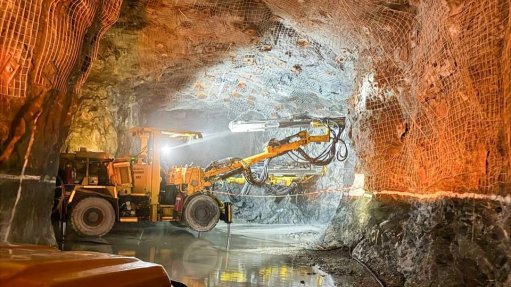
Meanwhile, production at BHP’s Copper South Australia operations increased by 2% year-on-year to 321 000 t owing to a strong operational performance, including record material mined and ore milled.
Olympic Dam achieved a 20-year copper production record, while Prominent Hill benefited from higher feed grades. Carrapateena achieved record material mined and milled, which partially offset the impact of planned lower grades.
BHP points out that the underground conveyor belt at Carrapateena suffered an unplanned failure in July and will need to be replaced. The recovery and replacement process is expected to result in up to eight weeks of mine production impact.
“We also plan to increase our anode inventory in the 2027 financial year to supply the refinery during the (six yearly) smelter campaign maintenance scheduled for the first half of the 2028 financial year,” BHP notes.
Copper South Australia’s production for the 2027 financial year is, therefore, expected to be between 290 000 t and 320 000 t.
BHP further reports that production at its Antamina mine, in Peru, reached a record 152 000 t for the 2026 financial year on the back of higher feed grades and an improved operational performance.
The mine also delivered 96 000 t of zinc.
Production at the mine for the 2027 financial year is guided at 120 000 t to 140 000 t of copper and between 35 000 t and 55 000 t of zinc.
In the US, the definitive agreements entered into by BHP and Faraday provide a pathway for the development by Faraday of a new copper hub in Arizona, combining existing infrastructure and mineral inventory at San Manuel with Faraday’s adjacent Copper Creek project.
“Consolidated development will support future investment, employment opportunities and help advance domestic US copper supply,” the group states.
BHP’s shareholding in Faraday is expected to increase to about 32.5% by the end of the first quarter of the 2027 financial year. BHP also holds interests in other projects within the broader Arizona copper district, including at Resolution and Globe-Miami.
IRON-ORE
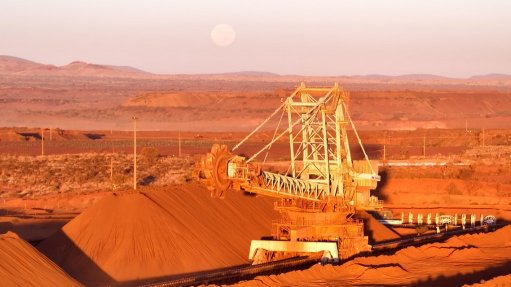
BHP has set its iron-ore production guidance at between 260-million and 272-million tonnes for the 2027 financial year. Its West Australia Iron Ore (WAIO) operations are expected to produce between 286-million and 298-million tonnes, of which BHP’s share will be between 253-million and 264-million tonnes.
The joint venture (JV) Samarco mine, in Brazil, is meanwhile expected to produce between 7.5-million and eight-million tonnes of iron-ore on a 100% basis in the 2027 financial year.
BHP has announced that $900-million will be invested (on a 100% basis) into the future of WAIO, with the Ministers North Project, a high-grade Brockman ore deposit south-east of Yandi, in Western Australia’s Pilbara region, having been approved.
The project will leverage existing Yandi infrastructure to deliver 20-million tonnes a year of iron-ore once ramped up, playing an important role in sustaining tonnes and supporting BHP’s 305-million-tonne-a-year medium-term iron-ore production target.
Site works for the development are planned to start this month, with first ore expected in the 2029 financial year.
"Yandi has been an important part of our WAIO operations for more than 30 years.
"Our investment in Ministers North helps us build on that legacy. We're making the most of the infrastructure, skills and experience we already have to bring a new orebody into production and keep our high-quality Pilbara iron-ore flowing.
"This is about maintaining continuity as Yandi matures naturally and backing the future of the Pilbara and our iron-ore business," says BHP WAIO president Tim Daly.
Ministers North is a JV between BHP, Itochu Corporation and Mitsui & Co, with ownership interests of 85%, 8% and 7%, respectively.
COAL
Meanwhile, the group’s steelmaking coal operations produced 37.3-million tonnes in the 2026 financial year, with BHP’s share at 18.6-million tonnes. Production for the 2027 financial year is expected to be between 37-million and 41-million tonnes, with BHP’s share at between 18.5-million and 20.5-million tonnes.
The energy coal operations produced 16.4-million tonnes in the year under review and are expected to produce between 14-million and 16-million tonnes in the 2027 financial year.
Article Enquiry
Email Article
Save Article
Feedback
To advertise email advertising@creamermedia.co.za or click here
Projects
Latest Multimedia
Latest News
Showroom

Occupational health services, mobile clinics, wellness campaigns, aviation.
VISIT SHOWROOM

Announcements
What's On
Subscribe to improve your user experience...
Option 1 (equivalent of R125 a month):
Receive a weekly copy of Creamer Media's Engineering News & Mining Weekly magazine
(print copy for those in South Africa and e-magazine for those outside of South Africa)
Receive daily email newsletters
Access to full search results
Access archive of magazine back copies
Access to Projects in Progress
Access to ONE Research Report of your choice in PDF format
Option 2 (equivalent of R375 a month):
All benefits from Option 1
PLUS
Access to Creamer Media's Research Channel Africa for ALL Research Reports, in PDF format, on various industrial and mining sectors
including Electricity; Water; Energy Transition; Hydrogen; Roads, Rail and Ports; Coal; Gold; Platinum; Battery Metals; etc.
Already a subscriber?
Forgotten your password?
Receive weekly copy of Creamer Media's Engineering News & Mining Weekly magazine (print copy for those in South Africa and e-magazine for those outside of South Africa)
➕
Recieve daily email newsletters
➕
Access to full search results
➕
Access archive of magazine back copies
➕
Access to Projects in Progress
➕
Access to ONE Research Report of your choice in PDF format
RESEARCH CHANNEL AFRICA
R4500 (equivalent of R375 a month)
SUBSCRIBEAll benefits from Option 1
➕
Access to Creamer Media's Research Channel Africa for ALL Research Reports on various industrial and mining sectors, in PDF format, including on:
Electricity
➕
Water
➕
Energy Transition
➕
Hydrogen
➕
Roads, Rail and Ports
➕
Coal
➕
Gold
➕
Platinum
➕
Battery Metals
➕
etc.
Receive all benefits from Option 1 or Option 2 delivered to numerous people at your company
➕
Multiple User names and Passwords for simultaneous log-ins
➕
Intranet integration access to all in your organisation