Kamoa-Kakula’s second-quarter output reached 64 328 t of copper – Ivanhoe

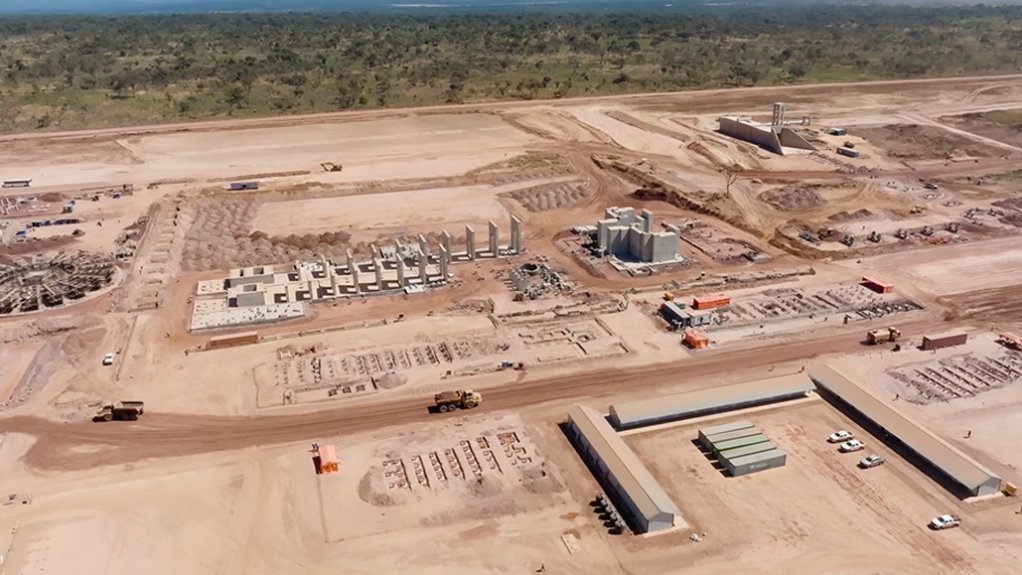


TSX-listed Ivanhoe Mines has reported that Kamoa-Kakula, in the Democratic Republic of Congo, produced 64 328 t of copper in the second quarter of this year, while improved mining rates and destocking of copper inventories are set to significantly boost copper production for the second half of the year.
During the second quarter, the Phase 1, 2, and 3 concentrators milled 2.97-million tonnes of ore, producing 61 134 t of copper in concentrate.
Kamoa-Kakula’s copper smelter produced 62 072 t of anode, and the Lualaba copper smelter (LCS) produced 2 256 t of copper in blister, for a total of 64 328 t of copper produced in anode, blister or saleable slag concentrate by Kamoa-Kakula during the quarter.
Ivanhoe explains that the decline in copper blister production was owing to a 56-day shutdown of LCS during the quarter. LCS resumed normal operations on July 1.
Copper held in inventory remained unchanged during the quarter at about 40 000 t of copper. The company says the planned destocking of up to 10 000 t of copper held in inventory will now take place during the second half of this year.
At the start of this year, about 50 000 t of copper were in inventory on site at Kamoa-Kakula and at LCS.
At the end of the second quarter, there were about 40 000 t of contained copper in inventory, which was unchanged from the end of the first quarter. Ivanhoe says Kamoa-Kakula’s management is targeting a year-end inventory of between 25 000 t and 30 000 t of copper.
The company also reports that copper production in the second half of this year is set to increase following improved mining rates at Kamoa, with additional mined ore to supply the Phase 1 and 2 concentrators.
The company says it maintains its production guidance at between 290 000 t and 330 000 t of copper in anode or blister.
The company notes that, in the second half of the year, mining rates across the Kamoa mines are planned to increase by 30% to 700 000 t a month, equivalent to about 8.5-million tonnes a year.
Ivanhoe says the increase is driven by the mobilisation of additional mining crews and the start of stoping. In addition, new access to the Kamoa mine was recently achieved through the Kahala box cut, the decline of which has been developing in ore since June.
The company notes that another decline is under development at the Kamoa mines, called Kansoko Sud. Construction of the Kansoko Sud boxcut was completed in the second quarter of this year, with twin declines currently being developed.
A further 700 m of decline development is required before reaching the orebody, which is expected in the first quarter of 2027.
During the second quarter, Ivanhoe notes, the Phase 1 and 2 concentrators were campaigned, or batch operated, owing to reduced ore availability from Kakula. With greater ore availability expected in the second half of the year from both Kakula and Kamoa, use of the Phase 1 and 2 concentrators is expected to increase.
Ivanhoe says ore feed into the Phase 1 and 2 concentrators in the second half of the year will continue to come predominantly from the western side of Kakula at a rate of about 400 000 t a month, or 4.8-million tonnes a year annualised, at a grade of about 2.7% copper.
In addition, with the mining rate at Kamoa expected to increase from 6.5-million to 8.5-million tonnes a year by the end of the third quarter of this year, the additional two-million tonnes a year of ore mined, at an average grade of 2.5% copper, will be processed by the Phase 1 and 2 concentrators.
Meanwhile, Ivanhoe notes that underground development rates at Kamoa and Kakula are advancing in line with the plan, positioning the complex for a production rate of approximately 500 000 t/y of copper from 2028.
As announced on March 31, the 2026 Kamoa-Kakula mineral reserve estimate outlines an updated mine plan for the Kamoa-Kakula copper complex to ramp up production to about 500 000 t/y of copper from 2028 onwards.
This includes operating the Phase 1, 2 and 3 concentrators at a steady-state rate of 17-million tonnes a year over about 25 years.
At both the Kamoa and Kakula underground mines, the company says development activities over the next 18 months are focusing on establishing long-term access and mine services ahead of stoping.
Production stoping has recently started at Kamoa, while stoping at Kakula is expected to start in the second half of 2027. Over the next nine to 12 months, Ivanhoe says ore mined at Kakula will be solely from development.
The company explains that development is focused on establishing peripheral access drives in lower-grade areas around the edges of the orebody, before stoping in the newly developed, high-grade mining areas can begin.
Year-to-date, development rates are advancing in line with the plan, notably including a 21% increase in development rate at Kakula achieved in the second quarter. Ivanhoe says it is expected that by year-end, the average development rate at Kamoa and Kakula will increase to about 128 m of advance per development drill rig a month.
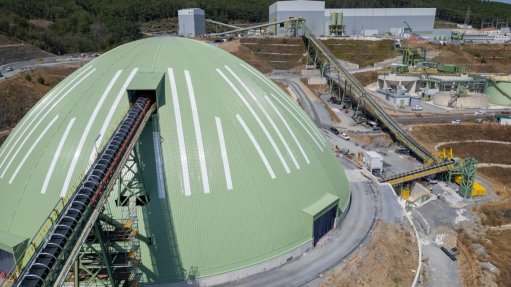
Further, Ivanhoe reports that the copper smelter is targeting production of about 850 t/d of copper in anode in the second half of this year, equivalent to an annualised rate of 300 000 t of copper, or about 60% of design capacity.
The company says further ramp-up of the smelter, beyond 60% capacity, is currently constrained by concentrate feed. The smelter is expected to ramp up to its full capacity of 500 000 t/y in 2028.
In addition to copper anodes, the smelter is producing high-strength sulphuric acid at an average rate of 1 250 t/d, equivalent to about 450 000 t/y compared with the steady-state design capacity of 700 000 t/y.
The sulphuric acid is sold to nearby mining operations on the DRC Copperbelt. The offtakers purchase the sulphuric acid from Kamoa-Kakula’s mine gate.
The realised price for high-strength sulphuric acid sales in July is set to be a record of about $840/t. During the quarter, 112 307 t of high-strength sulphuric acid were produced.
At the end of the quarter, about 11 300 t of acid were held in inventory and stored on-site.
SOLAR
Meanwhile, Ivanhoe reports that the commissioning of Kamoa-Kakula’s on-site solar PV facilities is under way. Once fully ramped up during the third quarter, the company says the facilities will deliver 60 MW of continuous baseload power to Kamoa Copper as its sole offtaker.
The two facilities are owned, operated and funded by CrossBoundary Energy and Green World Energie.
The two facilities have a combined 433 MW of peak installed solar PV capacity and 1 107 MWh of battery energy storage system (BESS) capacity. Ivanhoe says the facility is the largest hybrid solar PV and BESS facility installed by a mining company in Africa.
Kamoa-Kakula is advancing plans to double the on-site solar power capacity, with battery storage, up to 120 MW by the end of 2027.
In the second quarter, Ivanhoe notes that a tender was awarded, and a power purchase agreement (PPA) was signed with Green World Energie for an additional 30 MW on-site hybrid solar PV facility with BESS.
Construction is expected to be completed in the third quarter of 2027. A further 30 MW solar PV facility is currently undergoing final contract negotiation and is expected to be awarded soon.
Once fully ramped up, the new on-site solar facility will deliver 60 MW of continuous baseload power to Kamoa-Kakula’s operations.
KIPUSHI
Further, the company notes that the Kipushi concentrator produced a record 70 177 t of zinc in concentrate in the second quarter, up 8% quarter-on-quarter and equivalent to an annualised zinc production of about 280 000 t.
Ivanhoe says the quarterly performance was boosted by a record 200 774 t of ore milled, a record feed grade of 38.7% zinc and a record concentrator recovery of 92%. In addition, a record 25 677 t of zinc were produced in May.
Kipushi’s second-quarter production marks the seventh consecutive quarter-on-quarter increase in zinc production, with operations on track to meet the full-year production guidance of 240 000 t to 290 000 t of zinc in concentrate.
Moreover, at the Platreef mine, production from the 800 000 t/y Phase 1 concentrator started on November 18, 2025. Since then, Ivanhoe notes that about 3 931 oz of platinum, palladium, rhodium and gold have been produced.
Phase 1 operations have not yet reached commercial production. Therefore, production rates achieved to date are not representative of steady-state conditions, the company says.
Platreef mine’s Phase 1 concentrator continued to be campaigned, or batch operated, during the quarter, predominantly fed by lower-grade development ore.
Ivanhoe says commercial production is now expected in the fourth quarter of this year, when identified bottlenecks in materials handling and the processing plant are expected to be resolved.
Construction of Shaft #3 was completed on schedule in late first quarter of this year, with the first ore hoisted to the surface on April 1. Commissioning of the shaft was finalised in June.
Commissioning of the underground infrastructure supporting Shaft #3, consisting of a crusher, two conveyor belts and two strike tips, was also completed in June.
Following the commissioning of Shaft #3 and its associated underground infrastructure, the total hoisting capacity at the Platreef mine has increased by about fivefold. The new shaft also enables the concurrent hoisting of stoping ore and development waste, which was previously not possible with Shaft #1.
Following the increase in hoisting capacity, stoping of the higher-grade ore within the Flatreef orebody began at the end of the second quarter.
The mining of two stopes has been completed so far. Mining rates are expected to ramp up throughout the second half of 2026.
Shaft #3 is now also hoisting development waste, as the underground infrastructure is constructed in preparation for the Phase 2 expansion, which is expected to be completed by the end of 2027.
Additionally, Ivanhoe notes that earthworks on the Phase 2 expansion’s 3.3-million-tonne-a-year concentrator began at the start of the second quarter and are advancing according to plan. The first pour of the concentrator’s concrete foundations is expected later this month.
Engineering work on the concentrator is advancing, with the current focus on completing the civil and steel designs. The procurement of mechanical and electrical secondary long-lead items is underway, as well as the ordering of the electrical, control, and instrumentation packages.
The structural, mechanical, piping, and platework installation package for the flotation plant was awarded during the second quarter.
The widening of Shaft #2 from its current diameter of 3.1 m to 10 m began at the start of the second quarter.
The work consists of a mining technique called slipe-and-line that widens the shaft from the top down, while simultaneously installing a permanent shaft-wall lining.
Ivanhoe says Shaft #2 is expected to be ready to hoist labour and materials by the end of 2028 and ready to hoist ore by the end of 2029, supporting both the steady-state operations of Phase 2, as well as the future Phase 3 expansion.
Ivanhoe will report its financial results for the second quarter and a detailed update on its operations after market close on July 29.
Article Enquiry
Email Article
Save Article
Feedback
To advertise email advertising@creamermedia.co.za or click here
Research Reports
Latest Multimedia
Latest News
Showroom

Willard Batteries is one of the leading brands in automotive battery power products. With a rich history spanning over 70 years, Willard batteries...
VISIT SHOWROOM
AirNox (Pty) Ltd is a level 1 BBBEE manufacturer of complete AdBlue® solutions for operators of SCR diesel engines and AUS40 across South Africa...
VISIT SHOWROOM
Announcements
What's On
Subscribe to improve your user experience...
Option 1 (equivalent of R125 a month):
Receive a weekly copy of Creamer Media's Engineering News & Mining Weekly magazine
(print copy for those in South Africa and e-magazine for those outside of South Africa)
Receive daily email newsletters
Access to full search results
Access archive of magazine back copies
Access to Projects in Progress
Access to ONE Research Report of your choice in PDF format
Option 2 (equivalent of R375 a month):
All benefits from Option 1
PLUS
Access to Creamer Media's Research Channel Africa for ALL Research Reports, in PDF format, on various industrial and mining sectors
including Electricity; Water; Energy Transition; Hydrogen; Roads, Rail and Ports; Coal; Gold; Platinum; Battery Metals; etc.
Already a subscriber?
Forgotten your password?
Receive weekly copy of Creamer Media's Engineering News & Mining Weekly magazine (print copy for those in South Africa and e-magazine for those outside of South Africa)
➕
Recieve daily email newsletters
➕
Access to full search results
➕
Access archive of magazine back copies
➕
Access to Projects in Progress
➕
Access to ONE Research Report of your choice in PDF format
RESEARCH CHANNEL AFRICA
R4500 (equivalent of R375 a month)
SUBSCRIBEAll benefits from Option 1
➕
Access to Creamer Media's Research Channel Africa for ALL Research Reports on various industrial and mining sectors, in PDF format, including on:
Electricity
➕
Water
➕
Energy Transition
➕
Hydrogen
➕
Roads, Rail and Ports
➕
Coal
➕
Gold
➕
Platinum
➕
Battery Metals
➕
etc.
Receive all benefits from Option 1 or Option 2 delivered to numerous people at your company
➕
Multiple User names and Passwords for simultaneous log-ins
➕
Intranet integration access to all in your organisation