Hydrogen investment hits $130bn-plus mark on energy security, resilience rise



JOHANNESBURG (miningweekly.com) – Committed investment in clean hydrogen has hit the $130-billion-plus mark, driven by global energy security and resilience issues, with 90% of 570 clean hydrogen projects already under construction or in operation.
"Clean hydrogen's no longer a future bet," the Brussels-based Hydrogen Council reported in Global Hydrogen Compass 2026 on Thursday, September 10.
Construction of a capacity of 6.9-million hydrogen tonnes a year is under way right now.
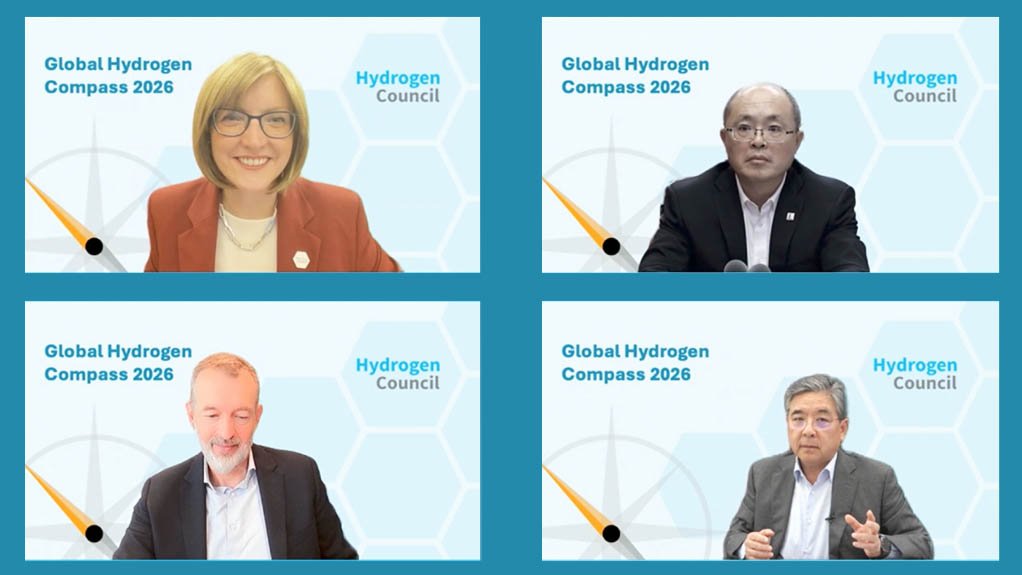
Operational capacity has nearly doubled in the last 12 months, and based on the pipeline, it is predicted that operational capacity will double again in 2027, an upbeat Hydrogen Council CEO Ivana Jemelkova forecast during a global webinar in which Hyundai vice-chair and Hydrogen Council co-chair Jaehoon Chang, Sinopec vice-chair Zhao Dong and Port of Rotterdam Authority CEO Boudewijn Siemons also took part.
The latest report, co-authored with McKinsey & Company and informed by the perspectives of some 70 global CEOs, coincides with shifting geopolitical priorities, which are strengthening hydrogen’s role as a "strategic resilience lever".
As governments seek to strengthen energy security, build more flexible economies and support long-term industrial growth, hydrogen is receiving renewed attention for its ability to help address multiple strategic priorities alongside deep decarbonisation, complementing growing electrification and use of renewable-energy sources.
Geographically, China remains the largest market, accounting for more than half of global committed renewable hydrogen capacity.
During the webinar covered by Mining Weekly, Dong's call was for the creation of a global system to facilitate large-scale cross-border green hydrogen trade.
“We need to promote key international standards such as full life-cycle carbon-footprint verification for green hydrogen,” said Dong.
Describing hydrogen as the new-energy future, Dong urged all parties to embrace openness and cooperation. “We need to enhance communication and programmatic cooperation in innovation, mutual recognition of standards, and joint investment.”
While he was talking, it was reported out of Oslo that Norwegian hydrogen enabler Nel ASA had entered into a framework agreement with Hydrasun to establish dedicated assembly and integration capabilities for the MC Series, Nel’s modular and scalable proton exchange membrane (PEM) technology platform. Interesting for South Africa is that PEM is catalysed by platinum group metals (PGMs), which South Africa hosts in abundance.
“We’re pleased to be working with Hydrasun to establish an experienced European integration partner for our standardized PEM electrolyser solutions, the MC Series.
“As demand for standardized, modular systems grows, this collaboration enhances our ability to serve key markets while creating greater flexibility and scalability across our production network,” Nel PEM operations senior VP Tushar Ghuwalewala stated in a media release to Mining Weekly.
With this partnership, Nel gains an experienced integration partner in Europe, complementing its existing integration setup in the US and widening its delivery capabilities for the European market. Nel’s PEM stack production will continue at Nel’s Connecticut facility in the US.
Europe now follows as the second-largest market, leading in project count and relative investment growth (+35% since 2025), while the US accounts for about 75% of globally committed low-carbon hydrogen and ammonia capacity.
Siemons described the Port of Rotterdam as having “a nice concentration of the elements that you basically need to build up a new hydrogen market and to go through this energy transition. On top of all, we're close to the sea, and a lot of the hydrogen will either be produced here through wind farms at sea and electrolysers, or it will have to be imported, and that's why we're also happy with what China is developing, because Europe will never be totally energy independent.”
Of the 11-million tonnes a year of potential clean hydrogen demand that existing policies could unlock by 2030, around six million tonnes a year is currently firmed by policies that have been enacted and enforced. Unlocking the remaining five million tonnes a year would require “urgent action” from governments to deliver on existing policy commitments.
For policymakers, the top priority is to implement enabling incentives and mandates, as well as robust carbon pricing instruments providing demand signals. For industry, the focus is to serve that demand cost effectively, which requires strong push to reduce cost and build the necessary infrastructure.
On what still needs to happen to facilitate global cross-border trade for hydrogen and its derivatives, Chang said: “We need two things: mutual recognition of certifications and the cost. The certificates issued in one country have to be accepted in another.
“If transportation, storage, and conversion, push the landed cost of hydrogen too high, demand will not follow. This is what technology and the scale have to solve.”
At what Chang described earlier as South Korea’s newly dubbed AI Hydrogen City, gigawatt-scale solar power and 200 MW electrolyser capacity had been brought together to produce green hydrogen. On the demand side are AI data centres, robotics manufacturing, and hydrogen fuel cell mobility. “Hydrogen doesn't arrive as a standalone business; it arrives as an ecosystem, and its industrial impact is broader than any other sector.” Being created by this project alone are more than 7000 jobs in a province that needs a new industry base.
Combining comprehensive industry data with CEO perspectives and lessons learned from some of the world’s most significant clean hydrogen projects, Global Hydrogen Compass 2026 provides a fact-based assessment of the industry’s progress and the practical actions needed to accelerate deployment. The report was launched today for the first time through a dedicated global virtual event, featuring the Hydrogen Council Co-Chairs alongside CEOs from Baker Hughes, CF Industries, Port of Rotterdam and Sinopec, with its findings also presented at the Hydrogen Energy Ministerial in Japan.
“Wherever countries deploy hydrogen solutions suited to their context and support them with policy, competitive hydrogen ecosystems are taking hold. By learning from those examples, we can build on that momentum faster and with greater confidence,” Chang explained.
“Hydrogen is not only a decarbonisation solution; it is also the indispensable partner to renewable electricity. Through their synergies, hydrogen strengthens the resilience and improves the efficiency and affordability of the overall energy system. As countries accelerate electrification, recognizing hydrogen’s systemic role will be essential to building secure, competitive and affordable energy systems for the future,” was the comment of François Jackow, CEO of Air Liquide and Hydrogen Council co-chair.
The council, whose mission is to make the world cleaner, more secure and resilient, with hydrogen as a critical contributor and enabler. brings together 140 companies from more than 20 countries across the hydrogen value chain.
Article Enquiry
Email Article
Save Article
Feedback
To advertise email advertising@creamermedia.co.za or click here

Projects
Latest Multimedia
Latest News
Showroom
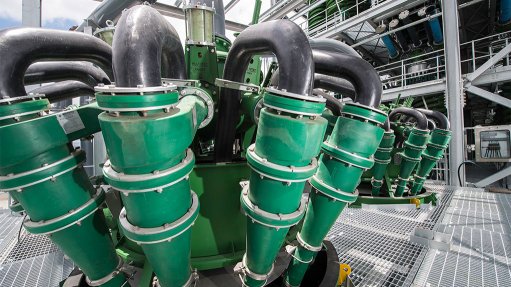
Multotec, recognised industry leaders in metallurgy and process engineering help mining houses across the world process minerals more efficiently,...
VISIT SHOWROOM
Virtual Gas Network supplies compressed natural gas via a virtual gas distribution network.
VISIT SHOWROOM
Announcements
What's On
Subscribe to improve your user experience...
Option 1 (equivalent of R125 a month):
Receive a weekly copy of Creamer Media's Engineering News & Mining Weekly magazine
(print copy for those in South Africa and e-magazine for those outside of South Africa)
Receive daily email newsletters
Access to full search results
Access archive of magazine back copies
Access to Projects in Progress
Access to ONE Research Report of your choice in PDF format
Option 2 (equivalent of R375 a month):
All benefits from Option 1
PLUS
Access to Creamer Media's Research Channel Africa for ALL Research Reports, in PDF format, on various industrial and mining sectors
including Electricity; Water; Energy Transition; Hydrogen; Roads, Rail and Ports; Coal; Gold; Platinum; Battery Metals; etc.
Already a subscriber?
Forgotten your password?
Receive weekly copy of Creamer Media's Engineering News & Mining Weekly magazine (print copy for those in South Africa and e-magazine for those outside of South Africa)
➕
Recieve daily email newsletters
➕
Access to full search results
➕
Access archive of magazine back copies
➕
Access to Projects in Progress
➕
Access to ONE Research Report of your choice in PDF format
RESEARCH CHANNEL AFRICA
R4500 (equivalent of R375 a month)
SUBSCRIBEAll benefits from Option 1
➕
Access to Creamer Media's Research Channel Africa for ALL Research Reports on various industrial and mining sectors, in PDF format, including on:
Electricity
➕
Water
➕
Energy Transition
➕
Hydrogen
➕
Roads, Rail and Ports
➕
Coal
➕
Gold
➕
Platinum
➕
Battery Metals
➕
etc.
Receive all benefits from Option 1 or Option 2 delivered to numerous people at your company
➕
Multiple User names and Passwords for simultaneous log-ins
➕
Intranet integration access to all in your organisation