Generators support electrical equipment

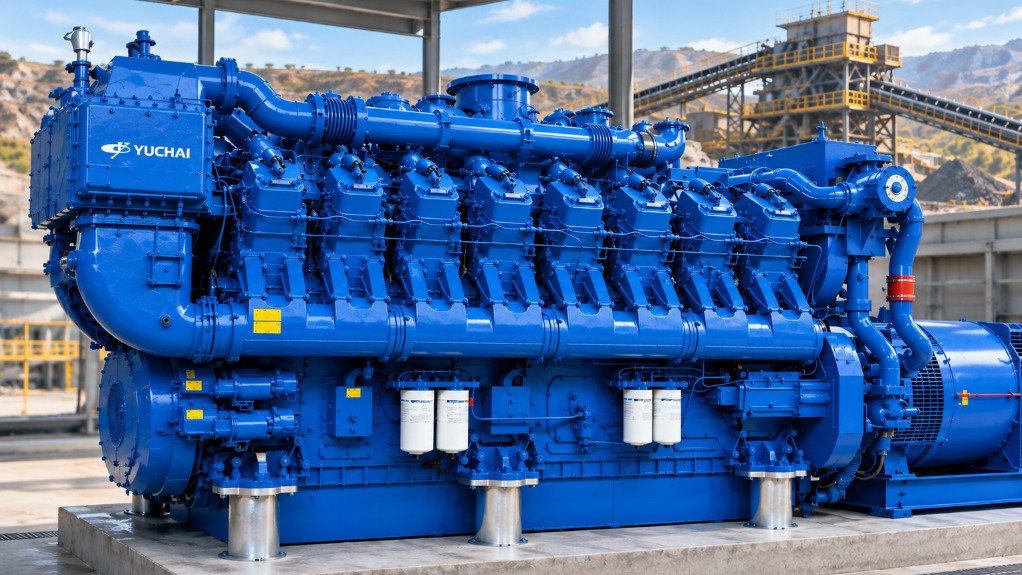
RELIABLE BACKUP Diesel-powered generators remain a dependable solution for mining operations that integrate electric fixed and mobile equipment


As mining operations increasingly electrify fixed and mobile equipment, the role of diesel engines is shifting from driving machinery directly to providing reliable and dispatchable electricity, particularly in remote mining operations, says diesel engine provider YC Diesel GM Paul Lastrucci.
While equipment, such as conveyors, crushers, pumps, fans, hoists and other fixed installations are natural candidates for electric motors, power interruptions can carry consequences beyond the outage.
Electrical drives can provide high efficiency and precise control and can, in many cases, result in lower operating and maintenance costs, thereby offering significant value, particularly where mines have sufficiently robust grid electrical supply and equipment operates in fixed or predictable locations, he adds.
However, the impact of any electrical outage extends beyond the electrical items, with outages stopping conveyor material flow, crushers requiring controlled restarts after a power cut, dewatering pumps being put at risk of water accumulation and offline ventilation systems raising safety implications for underground mines.
Therefore, Lastrucci says diesel-powered generators remain a dependable solution for mining operations that require mobility, an independent power source, rapid deployment, backup capability and resilience against primary power source interruptions.
Working Together
Ideally, diesel generators, and electrified motors and drives systems, should be deployed to work together on the same mine site as a form of redundancy or baseload power generation in remote applications, says Lastrucci.
Remote operations are integrating fully electric crushers, conveyor drives, pumps and auxiliary systems alongside a diesel generator set (genset), to supply electricity when required.
For example, in mine dewatering applications, operations are integrating electric motor-driven pumps, owing to their good control and efficiency, which are then powered by a diesel genset.
Lastrucci suggests that, at remote mine sites, a diesel genset can even be used as a “mine’s power station”, supplying primary electrical power for electrically driven equipment.
Beyond carrying a steady-state load, diesel gensets must also handle the dynamic behaviour of certain connected equipment, such as an electric motor starting or ramping up, the transient pump loads as pumping duties shift, and fluctuating crusher demand as different volumes and grades of materials are processed.
He adds that sizing a generator based solely on the total running kilowatt load can result in poor performance. Generator selection should, therefore, also account for load steps, motor starting requirements, the power factor, harmonics, load sequencing and the characteristics of variable-speed drives (VSDs).
“For a remote mine, the objective is to provide a power source that can reliably support the site’s critical electrical infrastructure under the actual operating conditions,” says Lastrucci.
Genset Selection
The engines and genset market is becoming increasingly differentiated by technical requirements rather than simply by a shift from diesel to electric power.
Lastrucci adds that customers require more detailed information on load profiles, motor-starting currents, critical loads, grid connections, battery and renewable-energy integration, as well as the distinction between prime and standby applications.
In Southern Africa, the opportunity is increasingly about right-sized, technically appropriate generation integrated into a diversified mine-site energy system, noting also that interest in hybrid diesel-electric power setups is also increasing.
Generators no longer need to be sized for a site’s theoretical maximum connected load, he says. Hybrid diesel-electric systems are used to enable batteries to absorb short-duration peaks and support motor starting, while solar reduces daytime demand. This enables diesel generators to operate as the system’s dispatchable power source rather than respond to every fluctuation in demand.
Consequently, generator sizing is shifting from a single output figure to a comprehensive load-profile analysis that considers continuous load, motor-starting requirements, step-load acceptance, battery and inverter capacity, renewable output, response time and paralleling requirements, adds Lastrucci.
He points out that, as an official Yuchai distributor and original-equipment manufacturing partner in Southern Africa, YC Diesel has access to diesel engine manufacturer Yuchai’s continued development of high-output generator engines to serve this trend. This evolution is evident in its engine offerings, such as the YC16VC platform.
Developed for high-power generating applications, the YC16VC platform includes a 3 000 kW prime-rated genset, which was also supplied to a mining-related project in China.
Yuchai gensets are available for prime and limited-duration standby applications, including dewatering and slurry pumping.
“A generator can have sufficient rated capacity and still perform poorly if the electrical and mechanical characteristics of the connected loads are not properly understood.”
Inadequate transient response or voltage and frequency recovery can cause motor-starting failures, “nuisance trips”, VSD faults and production losses; conversely, oversizing can lead to inefficient operation, higher fuel consumption and poor engine performance at low loads.
Load sequencing is also critical, elaborates Lastrucci. While a generator may have sufficient capacity to run all equipment once operational, it may not be able to start everything simultaneously. A properly engineered restart sequence, therefore, allows for control systems and essential auxiliaries to come online first, followed by ventilation, pumps and larger process loads.
“Electrification makes power quality increasingly important as mines become more dependent on electrical infrastructure for reliable operation,” he concludes.
Article Enquiry
Email Article
Save Article
Feedback
To advertise email advertising@creamermedia.co.za or click here

Projects
Latest Multimedia

Latest News
Showroom
Occupational health services, mobile clinics, wellness campaigns, aviation.
VISIT SHOWROOM
For over 15 years, Lilak Aluminium, a trusted leader in architectural extrusion supply, has delivered excellence to businesses like yours.
VISIT SHOWROOM


Press Office
Announcements
What's On
Subscribe to improve your user experience...
Option 1 (equivalent of R125 a month):
Receive a weekly copy of Creamer Media's Engineering News & Mining Weekly magazine
(print copy for those in South Africa and e-magazine for those outside of South Africa)
Receive daily email newsletters
Access to full search results
Access archive of magazine back copies
Access to Projects in Progress
Access to ONE Research Report of your choice in PDF format
Option 2 (equivalent of R375 a month):
All benefits from Option 1
PLUS
Access to Creamer Media's Research Channel Africa for ALL Research Reports, in PDF format, on various industrial and mining sectors
including Electricity; Water; Energy Transition; Hydrogen; Roads, Rail and Ports; Coal; Gold; Platinum; Battery Metals; etc.
Already a subscriber?
Forgotten your password?
Receive weekly copy of Creamer Media's Engineering News & Mining Weekly magazine (print copy for those in South Africa and e-magazine for those outside of South Africa)
➕
Recieve daily email newsletters
➕
Access to full search results
➕
Access archive of magazine back copies
➕
Access to Projects in Progress
➕
Access to ONE Research Report of your choice in PDF format
RESEARCH CHANNEL AFRICA
R4500 (equivalent of R375 a month)
SUBSCRIBEAll benefits from Option 1
➕
Access to Creamer Media's Research Channel Africa for ALL Research Reports on various industrial and mining sectors, in PDF format, including on:
Electricity
➕
Water
➕
Energy Transition
➕
Hydrogen
➕
Roads, Rail and Ports
➕
Coal
➕
Gold
➕
Platinum
➕
Battery Metals
➕
etc.
Receive all benefits from Option 1 or Option 2 delivered to numerous people at your company
➕
Multiple User names and Passwords for simultaneous log-ins
➕
Intranet integration access to all in your organisation