A governed layer between the historian and the boardroom

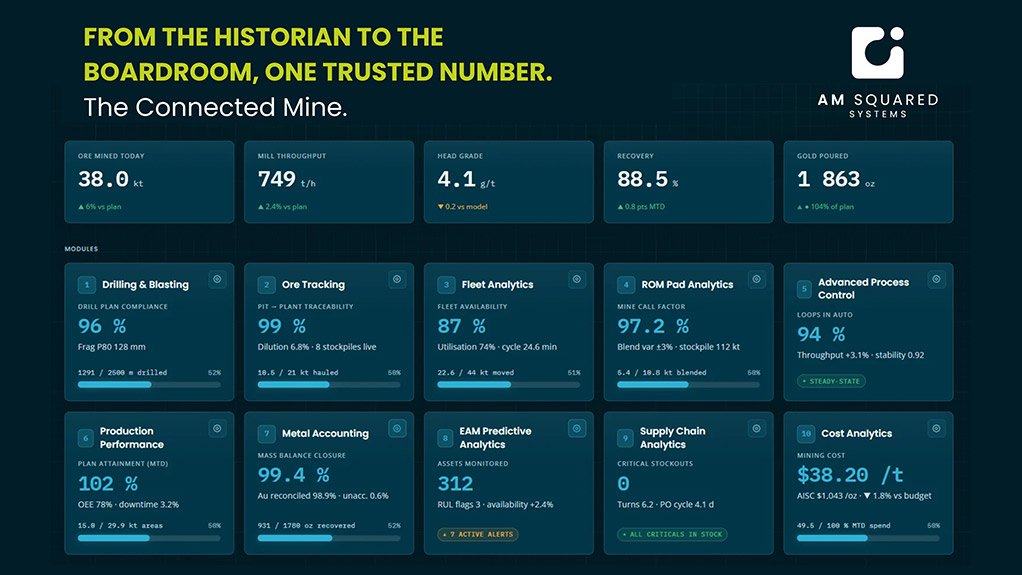


Mining operations do not necessarily need more technology. They need existing systems to work together securely, reliably and with information the business can trust.
The modern mine is not short of technology. Historians capture process information, Supervisory Control and Data Acquisition (SCADA) systems manage operational control, maintenance platforms track equipment performance, and enterprise systems support planning, finance and reporting.
Individually, these systems often perform exactly as intended.
The challenge begins when the business expects them to operate as one.
A production figure moves from a plant historian into a management dashboard. Maintenance information is combined with equipment utilisation data. Financial reporting draws on operational information collected from multiple sites.
Each integration creates value, but also introduces questions that technology leaders ultimately have to answer: Where did the information originate? Who owns it? How was it transformed? Is the connection secure? And can the business defend the number when it reaches the boardroom?
For mining CTOs, the challenge is no longer simply connecting information technology (IT) and operational technology (OT). It is connecting them without creating an increasingly complex, expensive and difficult-to-govern technology estate.
The Hidden Cost
Mining technology environments rarely develop according to a single architectural plan.
A historian is implemented during plant commissioning. A new SCADA platform arrives with an expansion project. A different maintenance management system is inherited through an acquisition. Corporate reporting requirements introduce additional applications and integration demands.
Over time, the estate becomes a collection of capable systems connected through interfaces developed for individual projects.
The immediate business requirement may be satisfied, but each point-to-point integration introduces another dependency to maintain, secure, document and support.
When a system changes, an interface breaks or a new reporting requirement emerges, the organisation may find itself funding another bespoke integration.
The resulting technical debt is not always visible in the original project business case. It emerges through recurring support costs, duplicated data pipelines, inconsistent business definitions and increasing reliance on specialist knowledge.
For the CTO, this creates a difficult balance: enabling new digital capabilities while protecting the stability, security and value of technology investments already made.
Integration should be an enterprise capability, not a recurring project
Mining technology and industrial data company AM SQUARED approaches this challenge by focusing on the architecture between existing systems rather than replacing them.
Engineered primarily on Microsoft Azure, AM SQUARED's source-agnostic integration approach uses its MiX technologies to connect operational and enterprise information across different platforms and environments.
Depending on site requirements and system capabilities, this can include historians, SCADA-related data sources, computerised maintenance management systems, enterprise resource planning platforms and other operational applications.
The objective is to establish a reusable, governed data foundation that supports multiple business requirements without rebuilding the integration architecture for every new initiative.
Operational systems remain responsible for their primary functions. The historian continues recording process information. SCADA remains focused on operational monitoring and control. Business systems continue managing their respective processes.
What changes is the ability to make selected information available consistently and securely across the organisation.
Rather than creating another isolated reporting solution, the architecture establishes a foundation that can support operational dashboards, enterprise analytics, performance management and future digital initiatives.
The value is not another platform to manage. It is reducing the complexity of making existing platforms work together.
The Numbers
Data governance becomes particularly important when operational information moves beyond the system in which it was originally generated.
Consider a production figure presented in a management report.
That figure may originate from a plant historian, be combined with dispatch information, pass through several transformations and ultimately appear in a consolidated group dashboard.
If the reported figure is challenged, the organisation needs to understand its origin, the business rules applied and the processes responsible for producing it.
Without documented data ownership, consistent definitions and traceability, different departments can present different versions of what should be the same operational result.
A governed integration architecture helps address this problem by establishing defined data flows, appropriate metadata, transformation controls and monitoring.
When supported by the necessary governance processes and technical capabilities, these controls make it easier to trace reported information to its underlying sources, investigate discrepancies and maintain confidence in enterprise reporting.
For technology leadership, trusted information is not simply a reporting objective. It is a foundation for operational accountability, investment decisions and effective business governance.
Security cannot be added after the connection is built.
Integrating operational and enterprise environments also creates responsibilities that extend beyond data availability.
Mining OT environments are designed around safety, reliability and production continuity. Their security requirements are fundamentally different from those of conventional corporate IT systems.
Connecting operational information to enterprise or cloud services must therefore be approached deliberately, with clearly defined network boundaries, approved communication paths, appropriate access controls and monitoring.
A governed architecture provides an opportunity to standardise these requirements rather than allowing individual projects to introduce unmanaged connections.
Each integration should be assessed against the operation's security policies, OT network architecture and operational requirements.
This includes determining what information needs to move, how it should move, which systems may access it and what controls are required to protect the production environment.
For the CTO and OT security teams, the objective is to enable business visibility without compromising operational integrity.
Digital transformation should not require an operation to trade control-system stability for access to information.
Building Architecture that can Grow
The long-term value of a reusable integration foundation becomes clearer as the organisation evolves.
A new processing facility introduces additional operational systems. An acquisition brings another technology estate. A maintenance improvement programme requires information from multiple departments. Corporate leadership requests a consolidated performance view across geographically separated operations.
In a fragmented environment, each requirement risks becoming another standalone integration project.
With a governed, extensible foundation, existing integration patterns, security controls and data definitions can be reused where appropriate.
New systems will still require assessment, configuration and integration engineering. However, the organisation is better positioned to reduce duplicated effort, manage dependencies and maintain architectural consistency as requirements change.
This is particularly important for multi-site mining groups where different operations may use different technology platforms but are expected to report against common performance measures.
The strategic opportunity is to move from project-specific integration towards a sustainable enterprise capability.
From Technology Complexity to Business Improvement
A successful integration strategy should ultimately be measured by what it enables the business to achieve.
Can operational reporting be delivered more consistently? Can teams spend less time reconciling information manually? Can new analytics requirements be implemented without rebuilding existing interfaces? Can the data be live or near-real-time? Can the organisation maintain stronger control over its data and integration environment?
These outcomes require more than selecting the correct technology.
They depend on understanding the existing architecture, identifying risks and dependencies, agreeing on data ownership and developing a practical roadmap aligned with business priorities.
AM SQUARED combines mining-focused technology expertise, integration engineering and consulting capabilities to help organisations assess their current environments and establish a structured path towards more connected operations.
This approach begins with understanding what already exists, what works, where the architectural risks lie and which improvements will deliver the greatest business value.
For CTOs and CIOs, the next digital initiative should not automatically mean another standalone system, another bespoke interface or another reporting environment to maintain.
Before approving the next integration project, technology leaders should be asking:
Are we building another connection that solves one immediate problem, or are we strengthening an architecture that will make the next ten requirements easier to deliver?
The distinction has implications for long-term technology cost, cybersecurity, operational resilience and the organisation's ability to scale its digital capabilities.
AM SQUARED works with mining organisations to assess data integration maturity, identify architectural and governance gaps, and develop practical approaches to connecting existing operational and enterprise systems.
Headquartered in Johannesburg, with international offices in the United Kingdom and New Zealand, AM SQUARED has experience delivering connected-operations solutions for Tier 1 mining operators. Its integration and governance capabilities also extend to manufacturing, energy and oil and gas environments.
The strongest digital foundation is not necessarily the one with the most technology. It is the one that enables the business to trust, secure and reuse the technology it already owns.
To explore how AM SQUARED can assist with an IT/OT integration and data governance assessment, visit www.am2systems.com or contact info@am2systems.com.
Article Enquiry
Email Article
Save Article
Feedback
To advertise email advertising@creamermedia.co.za or click here
Research Reports
Projects
Latest Multimedia


Showroom

SABAT Batteries is a renowned brand in the battery industry, manufacturing a wide range of batteries at its state-of-the-art production facility in...
VISIT SHOWROOM
As a reticulator, Egoli Gas provides natural gas to homes and businesses via underground pipes.
VISIT SHOWROOM
Announcements
What's On
Subscribe to improve your user experience...
Option 1 (equivalent of R125 a month):
Receive a weekly copy of Creamer Media's Engineering News & Mining Weekly magazine
(print copy for those in South Africa and e-magazine for those outside of South Africa)
Receive daily email newsletters
Access to full search results
Access archive of magazine back copies
Access to Projects in Progress
Access to ONE Research Report of your choice in PDF format
Option 2 (equivalent of R375 a month):
All benefits from Option 1
PLUS
Access to Creamer Media's Research Channel Africa for ALL Research Reports, in PDF format, on various industrial and mining sectors
including Electricity; Water; Energy Transition; Hydrogen; Roads, Rail and Ports; Coal; Gold; Platinum; Battery Metals; etc.
Already a subscriber?
Forgotten your password?
Receive weekly copy of Creamer Media's Engineering News & Mining Weekly magazine (print copy for those in South Africa and e-magazine for those outside of South Africa)
➕
Recieve daily email newsletters
➕
Access to full search results
➕
Access archive of magazine back copies
➕
Access to Projects in Progress
➕
Access to ONE Research Report of your choice in PDF format
RESEARCH CHANNEL AFRICA
R4500 (equivalent of R375 a month)
SUBSCRIBEAll benefits from Option 1
➕
Access to Creamer Media's Research Channel Africa for ALL Research Reports on various industrial and mining sectors, in PDF format, including on:
Electricity
➕
Water
➕
Energy Transition
➕
Hydrogen
➕
Roads, Rail and Ports
➕
Coal
➕
Gold
➕
Platinum
➕
Battery Metals
➕
etc.
Receive all benefits from Option 1 or Option 2 delivered to numerous people at your company
➕
Multiple User names and Passwords for simultaneous log-ins
➕
Intranet integration access to all in your organisation