Vesconite Hilube bearings used in advanced four-bar prosthetic knee



This article has been supplied.
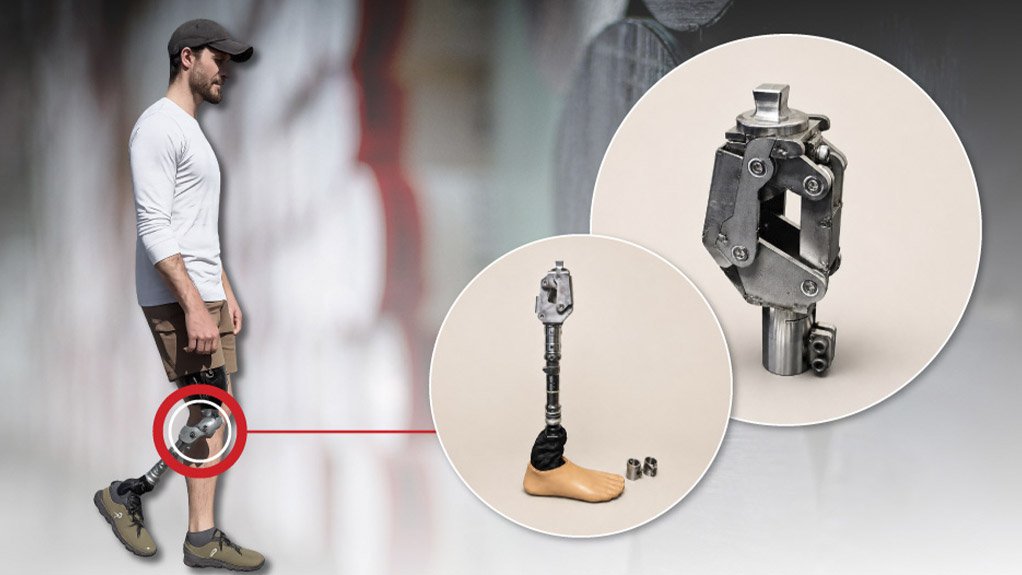
Vesconite Bearings is proud to announce that its Vesconite Hilube bearing material has been incorporated into version three of a mechanically advanced prosthetic knee developed by the Engineering Department at North West University’s Potchefstroom campus in South Africa.
The innovation forms part of the university’s “Beyond Limits” programme, which focuses on developing practical, manufacturable and, most importantly, affordable prosthetic solutions aimed at improving mobility and accessibility for amputees in South Africa.
The prosthetic knee represents a significant evolution from conventional single-axis hinge designs commonly used in lower-cost prosthetic applications. By incorporating a four-bar linkage system with Vesconite Hilube bearings at each pivot point, the design introduces a cycloid motion profile that more closely replicates the behaviour of a natural human knee during walking.
Four-bar linkage design improves stability and gait performance
The prosthetic knee is based on a four-bar linkage mechanism consisting of four rigid links connected by pivot joints. Each of these joints uses Vesconite Hilube bearings, enabling smooth and controlled articulation under load.
Unlike a single-axis hinge knee that rotates around a fixed point, the four-bar system produces a moving centre of rotation. This cycloid behaviour allows the knee to follow a more complex path through the gait cycle, improving both stability and motion efficiency.
During heel strike, the geometry of the linkage positions the instantaneous centre of rotation behind the load line. This creates a natural stabilising effect that helps prevent knee collapse without requiring active user control.
In mid-stance, the linkage maintains stability while supporting body weight. During the swing phase, the mechanism allows controlled bending and a slight functional shortening of the limb, improving toe clearance and reducing the risk of tripping.
According to the development team, the system also reduces compensatory movements often required with simpler prosthetic knees.
Ian Thomson, of the project team, explains that the geometry enables controlled movement through the walking cycle. He notes that the system provides automatic stability under load and improves clearance during swing, describing it as a design that “locks when loaded and releases naturally when the load shifts.”
Vesconite selected after design constraints limited conventional bearings
The selection of Vesconite Hilube followed extensive design and prototyping challenges. The engineering team reported that standard bearing solutions were unsuitable for the compact structure of the prosthetic knee, which is constructed using thin three-millimetre plate components.
Conventional options, including needle roller bearings and phosphor bronze bushings, were assessed but found to be too large, too rigid in design constraints, or unsuitable for machining at the required scale.
JP van Deventer, from the project team, explains that the team reached a point where standard components could not be adapted to the design without significant redesign. He describes the challenge as a situation where available bearings simply did not fit the geometry or load requirements of the system.
He states that Vesconite offered a practical solution, noting that it “solved the sizing problem without major re-engineering” and could be machined directly to the required dimensions.
This flexibility allowed the bearing solution to integrate into the design rather than forcing changes to the overall knee architecture.
Low friction and durability essential for real-world use
Beyond manufacturability, performance in demanding environments was a key factor in material selection. The prosthetic knee is intended for use in a wide range of South African conditions, including rural terrain, dusty environments and situations where exposure to moisture and dirt is unavoidable.
The engineering team emphasised that friction control at the pivot points is critical to achieving a natural gait. Even small increases in resistance can be felt by the user and negatively impact walking efficiency.
Vesconite Hilube was selected for its low-friction characteristics, which support smooth articulation through the gait cycle.
Thomson highlights that unrestricted movement at the linkage points is essential for user comfort and function. He notes that even minor mechanical resistance would be noticeable while walking and could compromise the prosthetic system’s performance.
Vesconite’s wear resistance and dimensional stability were also important considerations. Unlike some traditional materials, Vesconite does not swell in the presence of moisture and performs well in contaminated or dirty operating conditions.
This reduces the need for complex sealing systems and supports longer service life in real-world use.
Simplified manufacturing and design flexibility
A further advantage identified by the engineering team is the ability to machine Vesconite components to precise specifications. This allowed the bearings to serve not only as pivot elements but also as integrated structural interfaces within the prosthetic knee assembly.
The team noted that this approach reduces part count and simplifies assembly. Instead of requiring multiple separate components made from different materials, Vesconite enables a single machined solution that performs multiple roles within the mechanism.
This design flexibility is particularly important in a low-cost manufacturing environment, where reducing complexity can significantly improve scalability and accessibility.
Towards a commercially viable prosthetic solution for South Africa
The North West University prosthetics engineering team believes the current version of the prosthetic knee represents a commercially viable platform that could improve access to functional mobility solutions in South Africa, particularly within the public healthcare sector.
The design aims to provide a meaningful alternative to basic hinge-type prosthetic knees, which often dominate lower-cost supply channels despite offering limited stability and gait performance.
The team is now exploring further development opportunities, including enhanced stability features and potential funding partnerships to support broader production and deployment.
Article Enquiry
Email Article
Save Article
Feedback
To advertise email advertising@creamermedia.co.za or click here
Research Reports


Latest Multimedia

Latest News
Showroom
ESAB South Arica, the leading supplier of high-end welding and cutting products to the Southern African industrial market is based in...
VISIT SHOWROOM
Iritron delivers advanced automation, control, and optimisation solutions to the Mining, Minerals & Metals, Consumer Package Goods and...
VISIT SHOWROOM
Announcements
What's On
Subscribe to improve your user experience...
Option 1 (equivalent of R125 a month):
Receive a weekly copy of Creamer Media's Engineering News & Mining Weekly magazine
(print copy for those in South Africa and e-magazine for those outside of South Africa)
Receive daily email newsletters
Access to full search results
Access archive of magazine back copies
Access to Projects in Progress
Access to ONE Research Report of your choice in PDF format
Option 2 (equivalent of R375 a month):
All benefits from Option 1
PLUS
Access to Creamer Media's Research Channel Africa for ALL Research Reports, in PDF format, on various industrial and mining sectors
including Electricity; Water; Energy Transition; Hydrogen; Roads, Rail and Ports; Coal; Gold; Platinum; Battery Metals; etc.
Already a subscriber?
Forgotten your password?
Receive weekly copy of Creamer Media's Engineering News & Mining Weekly magazine (print copy for those in South Africa and e-magazine for those outside of South Africa)
➕
Recieve daily email newsletters
➕
Access to full search results
➕
Access archive of magazine back copies
➕
Access to Projects in Progress
➕
Access to ONE Research Report of your choice in PDF format
RESEARCH CHANNEL AFRICA
R4500 (equivalent of R375 a month)
SUBSCRIBEAll benefits from Option 1
➕
Access to Creamer Media's Research Channel Africa for ALL Research Reports on various industrial and mining sectors, in PDF format, including on:
Electricity
➕
Water
➕
Energy Transition
➕
Hydrogen
➕
Roads, Rail and Ports
➕
Coal
➕
Gold
➕
Platinum
➕
Battery Metals
➕
etc.
Receive all benefits from Option 1 or Option 2 delivered to numerous people at your company
➕
Multiple User names and Passwords for simultaneous log-ins
➕
Intranet integration access to all in your organisation