South Africa makes case in Beijing for Chinese investment in energy

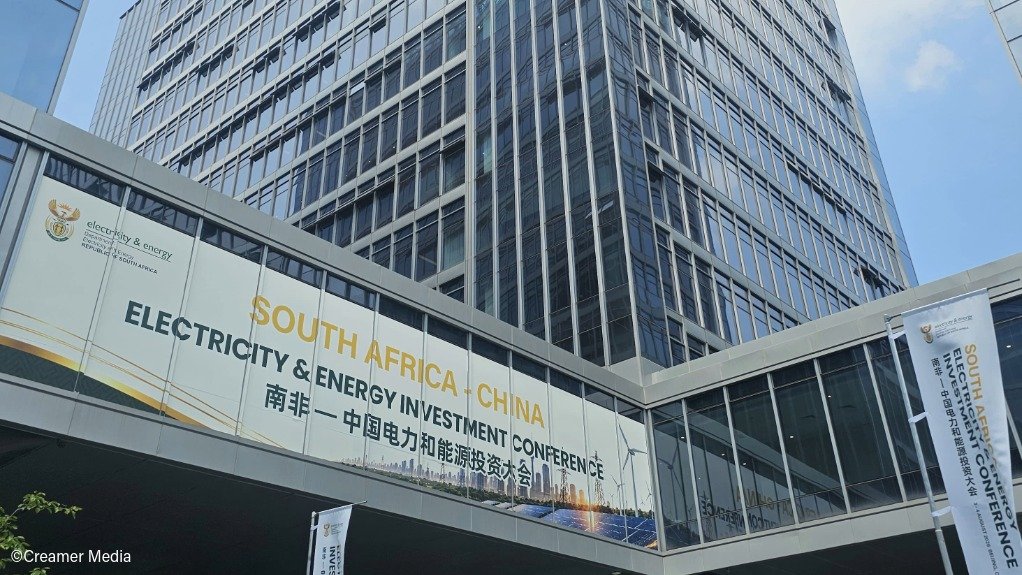


Electricity and Energy Minister Dr Kgosientsho Ramokgopa is attending the South Africa-China Electricity & Energy Investment Conference, in Beijing, this week, where he has advocated for strategic partnerships and investment to secure South Africa's energy future, with opportunities underpinned by the Integrated Resources Plan (IRP) 2025.
He acclaimed that the IRP, approved late last year, articulated in the most comprehensive way, the various energy sources being pursued in South Africa, dealt with issues around emissions and sustainability and outlined the costs associated with each source.
The conference was part of the initiatives to execute and implement the plan, and the industrial capacity that the country was seeking to build on the back of it, Ramokgopa pointed out.
He described this as a “significant departure” from previous modes of interaction, with partners in the Global South instead seeking to build lasting infrastructure, industries and shared prosperity.
Ramokgopa said South Africa was at a decisive decade in its energy market transformation, with opportunities in generation and transmission, as well as for investors to shape the architecture of Africa’s future power system, given that the country was the gateway to the continent, and responsible for much of it power generation.
He highlighted that the IRP indicated R2.2-trillion of investable energy opportunities entering the market through to 2039 and a R440-billion transmission expansion programme, with this investment enabling about 105 GW of new, mixed generation capacity and 14 500 km of new transmission infrastructure to unlock investment.
Ramokgopa expressed his belief that this ambition could be met, and that the country’s industrial capacity could be built on the back of it.
He averred that South Africa’s stable policy framework was accelerating private-public investment and that there was a unique opportunity to deepen South-South industrial and investment cooperation.
Promoting South Africa’s investment case, he highlighted the country’s high-quality renewable-energy resources which enable low-cost generation at scale. It was also well positioned to capitalise on green hydrogen and power-to-X opportunities emerging from it resources and geopolitical stability.
The rationale for seeking Chinese investment included that it produces nearly one-third of the world’s manufactured goods, manufactures over 80% of the globe’s solar PV modules and leads in wind technology, and produces over 75% of the global lithium-ion batteries and about 60% of electric vehicles.
Ramokgopa said that these “staggering statistics” affirmed the agility, speed and cost advantages that China possessed in delivering its renewable-energy programme and that South Africa could leverage this expertise to reduce its own learning curve.
With South Africa having resolved loadshedding, and a “competitive tariff regime”, it can return to a growth trajectory.
He said that the country’s electricity costs were, while expensive, cheaper than other jurisdictions by comparison and work to make this more affordable would continue.
Ramokgopa also mentioned current and future opportunities to accelerate grid expansion to support investment and growth, with the country’s grid being one of the largest in the world and posited to have the potential to be a catalyst for energy growth in the region.
South Africa required five times the amount of investment in the next decade to ensure the grid could support its energy needs, he pointed out.
Ramokgopa also noted that the data centre and critical minerals booms provided considerable value upside if the country could unlock its potential. South Africa was also at the forefront of the continent’s data centre growth, experiencing the largest increase in activity across the region, and was the only country with every cloud operator in Africa present as compared to peers, he highlighted.
South African State-owned utility Eskom group CE Dan Marokane stressed that the country “has moved to implementation”.
He said investors could expect policy and regulatory framework certainty; a diversified and balanced energy mix; a sequenced and guaranteed procurement pipeline of generation, storage and transmission; and a local manufacturing opportunity. He highlighted that there were 96 investment book projects available.
Trade, Industry and Competition Minister Parks Tau pointed out that reforms under way in South Africa further supported its investment potential.
He explained that, as part of broader structural reform in energy, private partners were being brought in in generation and there was a restructuring of the utility and creation of the National Transmission Company South Africa.
Moreover, industrial policy reform was hinged on diversification of industries that propel economic growth; digitalisation and building of infrastructure to propel this; and decarbonisation, Tau averred.
He added that linked to this was a critical minerals strategy, enabling a focus on industrialising on the back of these resources.
Linked to last is a critical mineral strategy, enabling focus on mineral extraction and industrialising and growing on the back of these resources.
Tau outlined the competitive advantages of the country’s special economic zones (SEZs), with these providing customs control, proximity to port, and streamlined compliance, amongst others. Moreover, cross border SEZs were also now being pursued. He also outlined a focus on scalable blended finance.
CHINESE SUPPORT
Conference partner POWERCHINA president Wang Xiaojun welcomed the conference and highlighted the strategic relationship between the two countries.
Xiaojun stressed energy security as a critical issue, central to national development. He pointed out that POWERCHINA was positioned to help South Africa with implementing the IRP to secure this, highlighting the country as the global leader in green energy, and the company as the largest engineering, procurement and construction contractor on the continent.
Xiaojun offered proposals, including building an official coordination mechanism to turn the blueprint of the IRP into reality.
He indicated that the company could leverage its expertise to work with South African counterparts on this, thereby engendering direct action.
He further called for the promotion of electricity enabled industry growth and integrated industrial development, which would also capitalise on the company’s expertise.
Meanwhile, China Development Bank executive VP Wang Peng highlighted that the bank had already contributed considerably to the country, helping to support it energy stability, including in several PV projects.
He indicated that there would be a focus on engaging on more innovative funding mechanism and products, with the Development Bank of Southern Africa and the Industrial Development Corporation also present at the conference.
Ambassador of South Africa to China Dipuo Letsatsi-Duba stressed that the outcomes of the conference should respond directly to the IRP, aiming to address both immediate capacity constraints and long-term energy planning.
She said that with the IRP seeking to modernise the energy sector, diversify its energy mix and support industrial development capacity in the country, this presented an opportunity for Chinese companies, and called on them to invest.
*Tasneem Bulbulia is attending the investment conference as a guest of the Department of Electricity and Energy.
Article Enquiry
Email Article
Save Article
Feedback
To advertise email advertising@creamermedia.co.za or click here
Latest Multimedia
Latest News
Showroom
Multotec, recognised industry leaders in metallurgy and process engineering help mining houses across the world process minerals more efficiently,...
VISIT SHOWROOM
Complete range of security sealing solutions including security seals bags and labels.
VISIT SHOWROOM
Announcements
What's On
Subscribe to improve your user experience...
Option 1 (equivalent of R125 a month):
Receive a weekly copy of Creamer Media's Engineering News & Mining Weekly magazine
(print copy for those in South Africa and e-magazine for those outside of South Africa)
Receive daily email newsletters
Access to full search results
Access archive of magazine back copies
Access to Projects in Progress
Access to ONE Research Report of your choice in PDF format
Option 2 (equivalent of R375 a month):
All benefits from Option 1
PLUS
Access to Creamer Media's Research Channel Africa for ALL Research Reports, in PDF format, on various industrial and mining sectors
including Electricity; Water; Energy Transition; Hydrogen; Roads, Rail and Ports; Coal; Gold; Platinum; Battery Metals; etc.
Already a subscriber?
Forgotten your password?
Receive weekly copy of Creamer Media's Engineering News & Mining Weekly magazine (print copy for those in South Africa and e-magazine for those outside of South Africa)
➕
Recieve daily email newsletters
➕
Access to full search results
➕
Access archive of magazine back copies
➕
Access to Projects in Progress
➕
Access to ONE Research Report of your choice in PDF format
RESEARCH CHANNEL AFRICA
R4500 (equivalent of R375 a month)
SUBSCRIBEAll benefits from Option 1
➕
Access to Creamer Media's Research Channel Africa for ALL Research Reports on various industrial and mining sectors, in PDF format, including on:
Electricity
➕
Water
➕
Energy Transition
➕
Hydrogen
➕
Roads, Rail and Ports
➕
Coal
➕
Gold
➕
Platinum
➕
Battery Metals
➕
etc.
Receive all benefits from Option 1 or Option 2 delivered to numerous people at your company
➕
Multiple User names and Passwords for simultaneous log-ins
➕
Intranet integration access to all in your organisation