



Component and system testing set to start on first two Meerkat radio telescope dishes


JUSTIN JONAS The complexity of MeerKAT is quite staggering
Photo by SKA SA
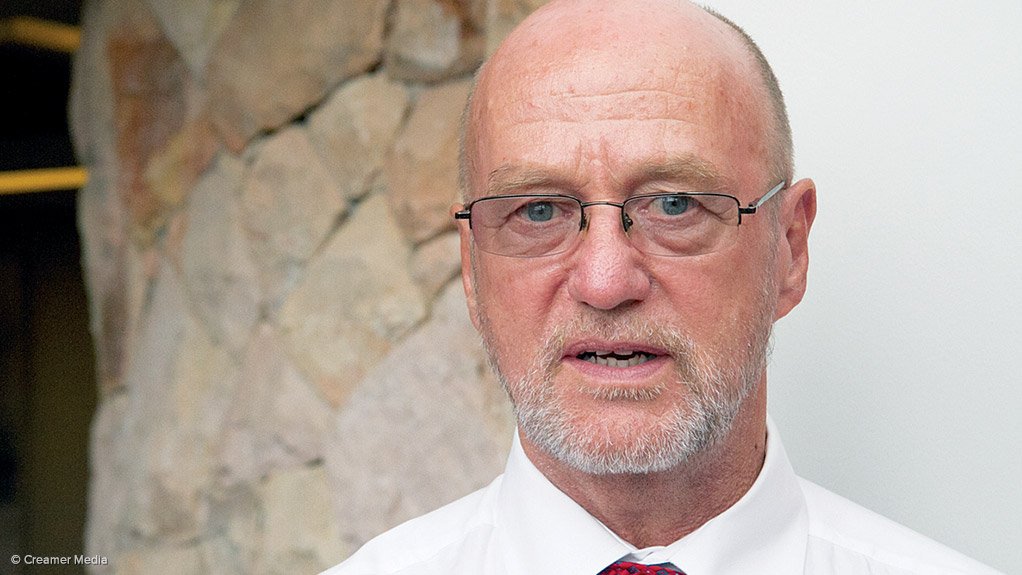
DEREK HANEKOM MeerKAT a demonstration of South African capabilities
Photo by Duane Daws
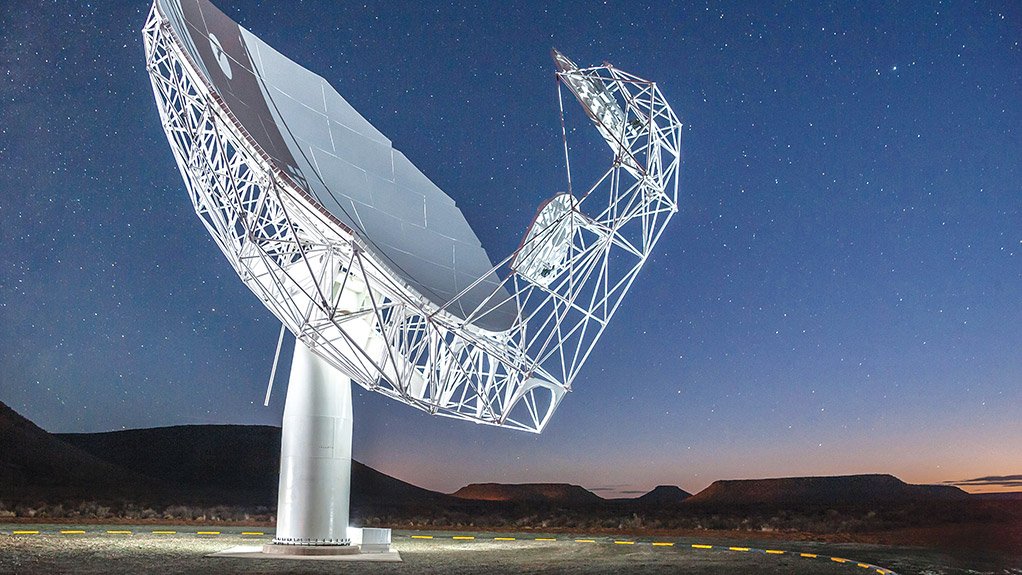
NOW TO BE TESTED: The first MeerKAT antenna, at sunset
Photo by SKA SA
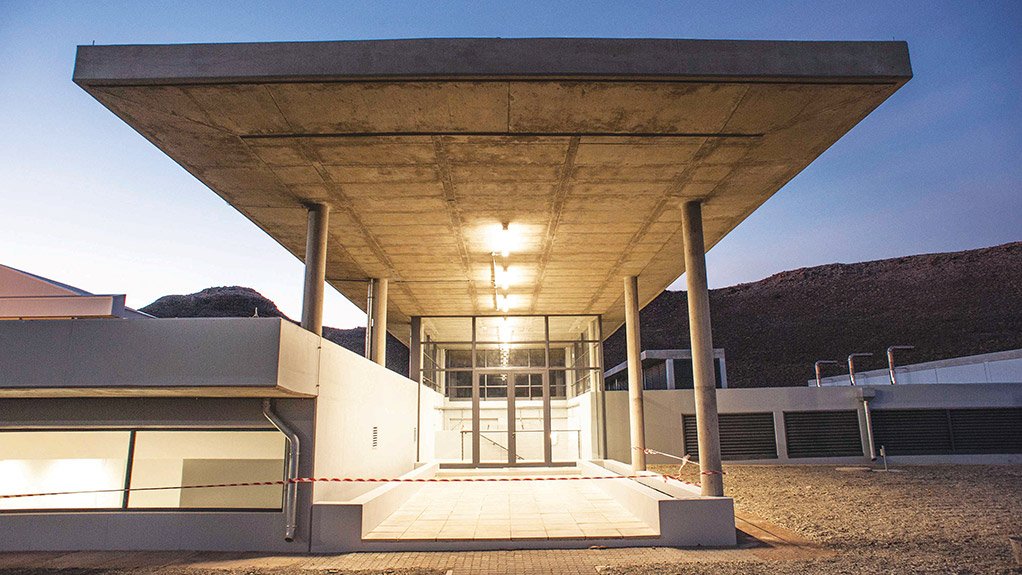
KEY INFRASTRUCTURE: The entrance to the Karoo Array Processor Building
Photo by SKA SA
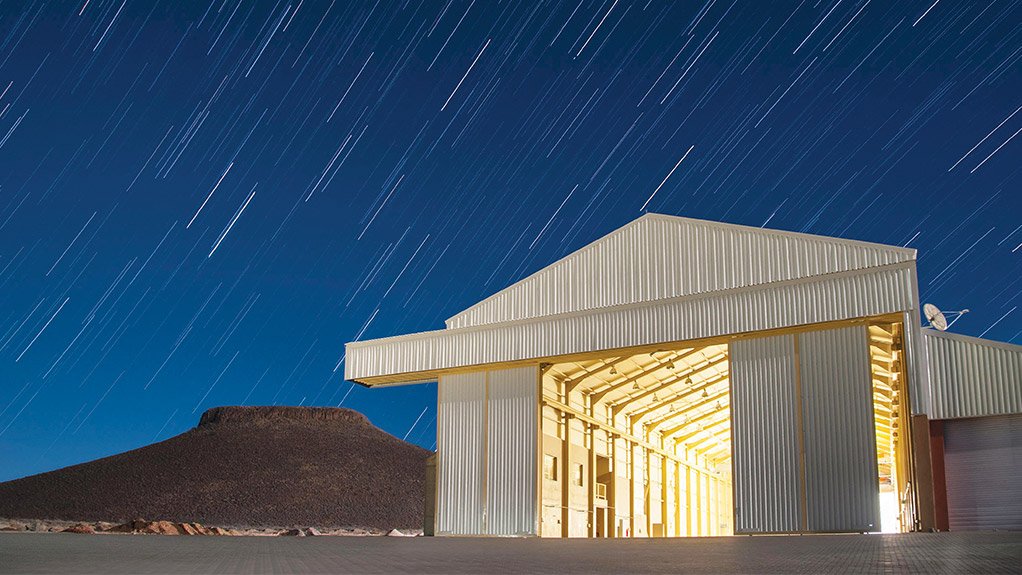
EXPANDED The on-site MeerKAT dish assembly shed
Photo by SKA SA
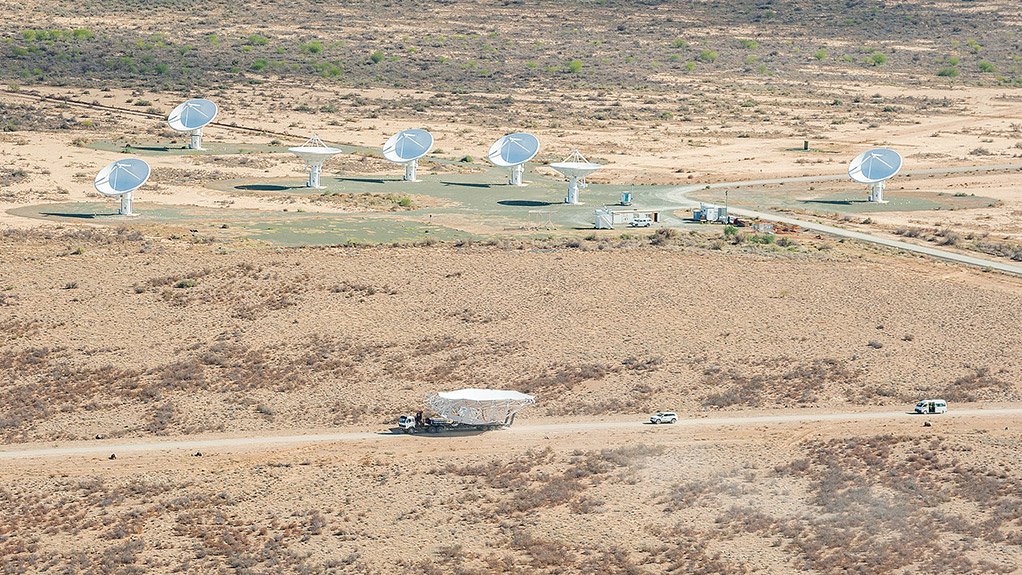
PRESENT AND FUTURE: A MeerKAT main reflector dish is driven past the KAT-7 radio telescope array
Photo by SKA SA




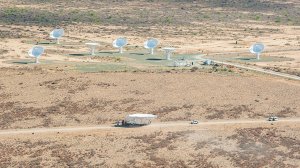


With the completion of the first dish for the MeerKAT radio telescope array, a key milestone in the development of South Africa’s greatest-ever scientific instrument has been reached. Very soon, the second antenna will also be completed and a new phase in the development of MeerKAT will begin. “We want to do a lot of testing on these two antennas before we go to full production,” explains SKA South Africa (SKA SA) associate director: science and engineering Professor Justin Jonas. MeerKAT is a precursor to the giant international Square Kilometre Array (SKA) radio telescope, which will be co-hosted by South Africa and Australia (see Engineering News January 17, 2014). (SKA SA is the agency responsible for the MeerKAT project as well as South Africa’s participation in the SKA.)
“This first phase of the roll-out of MeerKAT is the receptor test system, which starts now,” he adds. “This is a complete test for the first two receptors – the dishes, pedestals, correlators and so on: the whole system. It’s effectively an acceptance test stage in the project, really to test all of the individual subsystems and test their integration into a system as a whole. Once we’re satisfied all is working properly, we’ll go into full production of those subsystems.”
The first antenna was officially inaugurated on March 27 by Science and Technology Minister Derek Hanekom at a function at the MeerKAT site, some 90 km west of the small town of Carnarvon, in the Karoo region, in the Northern Cape province. “The MeerKAT is something concrete. It’s a wholly South African-designed and -funded project, but designed to integrate into the SKA,” he told Engineering News at the SKA Africa Ministerial Meeting in Pretoria the day before. “It was not funded on the assumption we’d get the SKA. We decided to go ahead with it anyway. MeerKAT will be the world’s largest [array] radio telescope when commissioned.”
“One of the important things is the learning it has given us,” he highlighted. “It is a demonstration of our own South African capabilities. That is not a small factor. We’re developing the confidence to put in credible bids for projects that will form part of the SKA. We’re always on track [with MeerKAT]. If anything, we’re slightly ahead of track. MeerKAT is real and now! The dishes are happening. In just over two years from now, 64 [MeerKAT] dishes will be standing there [in the Karoo].”
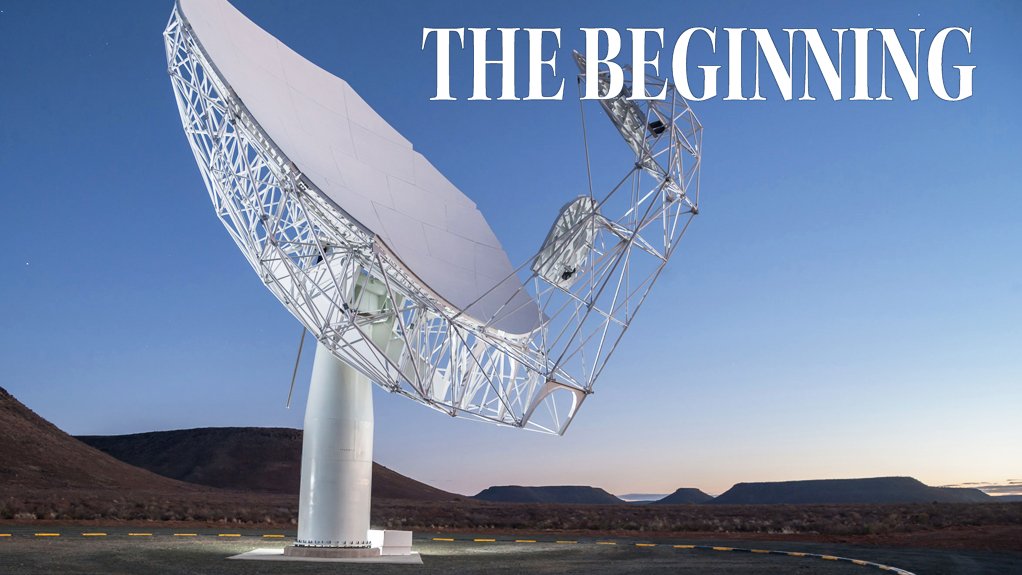
The MeerKAT dishes are of offset Gregorian design with a main reflector with a projected diameter of 13.5 m and a subreflector with a diameter of 3.8 m. The complete antenna is 19.5 m tall and weighs 42 t. The design obviates the need for struts over the dish, which could reduce or scatter incoming radio waves, thus increasing the sensitivity of the antenna and reducing unwanted spurious side lobes. When completed, all the MeerKAT dishes will be connected by 170 km of optical fibre cable and will be operated together as a single instrument from a control room in Cape Town.
Situation Report
“The infrastructure side of the project is almost complete now,” reports Jonas. The bulk supply systems – power, water, data lines – were finished months ago. The site’s road grid is complete. The airfield has been completed. The site has been given its own airstrip partly because using the airfield at Carnarvon adds two hours to every visit to the site and, so, being able to fly directly to it saves a lot of time. But another important reason is health and safety: the site is too far from Cape Town for a helicopter to make a direct flight, so any aeromedical evacuation would need to use a fixed wing aircraft. This is the reason the runway has an all-weather surface.
The on-site manufacturing facilities, espe- cially those for the dishes, have been expanded to meet the demand for MeerKAT and, afterwards, for Phase 1 of the SKA-mid array. All 64 dish antenna foundations are complete. Their construction absorbed nearly 5 000 m3 of concrete and more than 570 t of steel. The power cabling for all the antennas is in place. The ducting for the optical fibre lines for all the antennas are in place and the fibre cables are currently being installed in the ducts. (Both the power cables and optical fibre lines go to, and up through, the antenna foundations.) “All the major infrastructure elements are ready and waiting for the antennas,” he states.
All these cables and lines radiate to the antenna locations from another key piece of infrastructure, which was officially opened on the same day the first antenna was launched – the Karoo Array Processor Building (KAPB). This will function to deliver key services and support to the MeerKAT and, later, the SKA, while minimising radio frequency interference (RFI). Any and all electrical and electronic activity generates RFI, which is why radio telescopes are traditionally put in rural areas. But the MeerKAT will be extremely sensitive over a very wide frequency bandwidth (and the SKA even more so), so very low levels of RFI, which would not bother existing radio telescopes, would still be a problem for these instruments.
The KAPB provides power conditioning for the radio telescope through the use of three 1.25 MVA diesel-powered rotary uninterrupted power supplies (DRUPS) configured to provide N+1 redundancy. This will ensure a secure power supply for the MeerKAT, and for the SKA Phase 1 by the addition of two more DRUPS units. Space has been reserved to allow an expansion of the power system as the load increases. The building also houses the telescope’s data processing facility, which contains considerable computer capacity. In addition, there is the associated and essential air conditioning plant. There is also a room for people to work in with computers and laptops.
The KAPB minimises RFI in a number of ways. It is partly built below ground level (it is not under- ground, nor is it a bunker). The ground provides shielding against RFI and provides some degree of passive temperature control. The data processing facility is completely shielded, as is the scientists’ work room. Both are in ‘Faraday cages’ – basically, metal boxes that trap all the RFI generated by the computers (even RFI from laptops cannot be allowed). “It’s basically a buried generator, substation, data centre and laboratory, all in one,” sums up Jonas. “There’s a lot of high-tech stuff in there.”
Industrial Participation
A key element of the MeerKAT project is a contractual 75% local content and labour requirement. The prime contractor for the antennas is South African company Stratosat Datacom (part of Germany’s Schauenburg Group), with its technology partners, General Dynamics Satcom, of the US, and Vertex Antennentechnik, of Germany. The antenna pedestals and yokes are largely the work of Efficient Engineering, of Johannesburg. The backup structures for the dish are by Tricom Structures, of Pretoria. The main azimuth bearings are made by Titanus Slew Rings (better known as TSR) in Kempton Park, east of Johannesburg.
“These are all big, heavy engineering companies. MeerKAT is being built in South Africa,” affirms Jonas. “Most of the fabrication and even the integration happens in the factories in Gauteng. Entire pedestals are transported as whole units. The other elements are transported in large components. It’s really great to see South African industry taking up this kind of challenge. It will really set them up for future projects of a similar nature. MeerKAT will showcase the expertise of South African companies in markets they’ve never been in before. The taxpayers’ money is being leveraged very well through the localisation strategy being followed.”
Some components have been designed abroad, and their prototypes made there. Thus, aluminium panels for the dish reflector structure have been designed by General Dynamics and those for the first two dishes are being made in Estonia. The dish subreflector has been designed in Canada and the two prototypes are being manufactured there as well. (Shipping is by sea, to save cost.) The subreflectors are manu- factured of carbon composites. But, in the case of both the panels and subreflectors, the production units (for the other 62 antennas) will be built in South Africa.
“The only finicky thing that has to be done on site is the attachment of the aluminium panels to the reflector structure,” he reports. “There are 40 of these for each structure and their final placement has to have a positional accu- racy of better than 0.5 mm.”
A physically small but crucial component of the antenna is the receiver. This is where the antenna actually collects the radio waves gathered and focused by the reflector and subreflector. To eliminate (as far as possible) interference (“noise” in engineering jargon), radio telescope receivers are cryogenically cooled to very low temperatures. The MeerKAT’s receivers have been designed by EMSS Antennas, of Stellenbosch, in the Western Cape. The tender process for production units is currently under way and is restricted to South African companies.
Nevertheless, there are a couple of highly specialised components in the receivers which have been sourced overseas and will have to be imported – setting up local production would not be economically viable. These are the low-noise amplifiers, developed by the National Research Council of Canada, and the cryogenic cooling system, from Oxford Cryogenics, of the UK. However, in neither case are these off-the-shelf products. “We’ve worked very closely with these suppliers to ensure they meet our needs,” he says. Each MeerKAT dish will be fitted with four receivers, each covering different frequency bands. For initial testing, however, the first antenna will be fitted with only one receiver.
Staggering Complexity
A unique aspect of the MeerKAT is that the incoming radio signals will be digitised immediately after being collected by the receiver. The digitiser will be mounted directly behind the receiver. This immediate digitisation will ensure that the signal that is sent to the processors in the KAPB will be of the highest quality. This new digitiser has been developed in-house by the MeerKAT team.
“The complexity of the MeerKAT system is quite staggering,” reports Jonas. “So many different technologies are being integrated together. If it hadn’t been for our quite extensive systems engineering approach, we wouldn’t have been able to meet, and in some cases exceed, performance specifications and remain on schedule and on budget. You need to have that sort of process in place, otherwise you blow your budget and your schedule. MeerKAT is a precursor to the SKA – that role goes beyond being a physical part of the SKA. The expertise we’ve built up and the relationships with our suppliers, will be just as important to the SKA and to other international and national projects.”
Full production of all components and systems for the MeerKAT is expected to start by the end of this year. The commissioning of the instrument is scheduled for 2017. However, scientific research should start when 16 of its antennas have become operational, which should be in the middle of next year. In terms of layout, 48 of the 64 dishes will be concentrated in a central core with a diametrer of about 1 km, with the other 16 spread out for up to 4 km from this core.
Meanwhile, the KAT-7 radio telescope array, originally intended as an engineering prototype, is now fully active as a scientific instrument. Its seven dishes will, however, not be integrated into either MeerKAT or the SKA Phase 1. KAT-7 will be retired from active scientific use once MeerKAT is producing publishable science.
Article Enquiry
Email Article
Save Article
Feedback
To advertise email advertising@creamermedia.co.za or click here
Research Reports

Projects

Latest Multimedia
Latest News


Showroom

The SAIMM started as a learned society in 1894 after the invention of the cyanide process that saved the South African gold mining industry of the...
VISIT SHOWROOM
Multotec, recognised industry leaders in metallurgy and process engineering help mining houses across the world process minerals more efficiently,...
VISIT SHOWROOM

Press Office
Announcements
What's On
Subscribe to improve your user experience...
Option 1 (equivalent of R125 a month):
Receive a weekly copy of Creamer Media's Engineering News & Mining Weekly magazine
(print copy for those in South Africa and e-magazine for those outside of South Africa)
Receive daily email newsletters
Access to full search results
Access archive of magazine back copies
Access to Projects in Progress
Access to ONE Research Report of your choice in PDF format
Option 2 (equivalent of R375 a month):
All benefits from Option 1
PLUS
Access to Creamer Media's Research Channel Africa for ALL Research Reports, in PDF format, on various industrial and mining sectors
including Electricity; Water; Energy Transition; Hydrogen; Roads, Rail and Ports; Coal; Gold; Platinum; Battery Metals; etc.
Already a subscriber?
Forgotten your password?
Receive weekly copy of Creamer Media's Engineering News & Mining Weekly magazine (print copy for those in South Africa and e-magazine for those outside of South Africa)
➕
Recieve daily email newsletters
➕
Access to full search results
➕
Access archive of magazine back copies
➕
Access to Projects in Progress
➕
Access to ONE Research Report of your choice in PDF format
RESEARCH CHANNEL AFRICA
R4500 (equivalent of R375 a month)
SUBSCRIBEAll benefits from Option 1
➕
Access to Creamer Media's Research Channel Africa for ALL Research Reports on various industrial and mining sectors, in PDF format, including on:
Electricity
➕
Water
➕
Energy Transition
➕
Hydrogen
➕
Roads, Rail and Ports
➕
Coal
➕
Gold
➕
Platinum
➕
Battery Metals
➕
etc.
Receive all benefits from Option 1 or Option 2 delivered to numerous people at your company
➕
Multiple User names and Passwords for simultaneous log-ins
➕
Intranet integration access to all in your organisation

