Panel agrees mine technologies are immense ‘winning’ determinators of the present and future

Panel agrees mine technologies are immense ‘winning’ determinators of the present and future
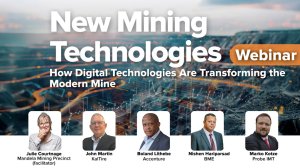


The single-biggest opportunity for modern mining companies to become sustainable and predictive is through technology, explosives manufacturer BME GM Nishen Haripersad told attendees of a webinar hosted by Creamer Media on mine technology on July 15.
He noted that technology was empowering the industry across various segments.
“For us, as an industry, we have to be conscious of how we want to ‘win’. Winning mines will not simply be those that buy the most technology, but those that best integrate technology into operational decision-making across the organisation, including in daily workflow, engineering departments and finance departments,” Haripersad stated.
He further pointed out that integrated technologies improved output and employees’ ability to do their jobs.
“The future is not just about autonomous and AI equipment, but about becoming a connected mine where geology, drilling, blasting, loading, hauling and processing are all optimised as one system.”
Haripersad recommended that service providers collaborate more often to integrate their technologies, to better empower the ecosystem of a mine.
Facilitator of the webinar, public-private mining company Mandela Mining Precinct executive director and environmental scientist Julie Courtnage, shared a similar sentiment in saying that companies risked placing too much reliance on digital technology, forgetting that success depended on the interaction between technology and people.
Global tire management and service provider Kal Tire Southern Africa VP and panel member John Martin said people would be surprised about the level of technology that was now available in the mining industry.
“Digital technologies are there to help the mining operations focus on fleet uptime by providing pre-emptive views of the mining conditions that affect equipment availability.
“By connecting tire data, for example, with haul road information and fleet management data, mining companies can better understand where risks are sitting or emerging,” Martin said, adding that this enabled not only more productive operations and cost savings on maintenance but improved safety for employees if major future incidents were mitigated.
Martin explained that real-time identification of risks and ultimately the predictability that came with technology improved the day-to-day operations of any mine, avoiding downtime and ensuring assets were sweated for maximum profitability.
“Previously mine operators relied on data that was undertaken by technicians at appointed times. Today’s systems provide constant feedback in real-time, giving operators a more broad and integrated view of performance and the ability to react immediately when safety incidents occur or will occur.”
Courtnage agreed that the mining landscape had changed from a static, predefined approach to a more dynamic, real-time opportunity to manage risks and improve safety, to which Martin added that technology was certainty also assisting with removing people from the mechanical interface with equipment.
Consultancy Accenture cybersecurity lead and panel member Boland Lithebe pointed out that cost factors and continued profitability were driving more investment into advancing mining technology, but warned that deploying autonomous vehicles and Internet-of-Things devices came with more risk – as more things needed to be tracked in the mining environment, particularly to ensure the safety of people.
“We need to be careful about the equipment and products we are choosing and how they can integrate,” Lithebe said.
Haripersad concurred, saying that change management was just as necessary as new technology adoption, since mining operated in increasingly complex and high-pressure environments. He suggested that mining companies start with a pilot programme to determine the best technology for integration in existing workflows and to include employees – and even communities – in those decisions.
On this point, Courtnage said community members were often auditors with digital interfaces, giving feedback to mines, which really started to expand the inclusivity of mining.
Haripersad circled back to the need determine the problem that mines are trying to solve when choosing technology and consider the value chain that it sat in.
Productivity and safety solutions company Probe IMT group chief technology officer and panel member Marko Kotzé mentioned that while collision avoidance systems and fatigue monitoring systems provided control over asset movement and performance, which contributed to safety, it was also important to track people in real-time.
“These complex environments we find ourselves in, including large openpits and underground mines, knowing where people are can assist during emergencies such as fall-of-ground.”
Kotzé said great value can be derived from understanding where safety, productivity and operational discipline intersect, including through vehicle interaction management, proximity detection and collision avoidance. “Mines can improve traffic flows where they see patterns of near-misses emerging.”
Additionally, Kotzé highlighted that, by identifying potential issues quicker using sensors and monitoring, maintenance teams could be deployed faster to avoid more serious safety issues later on.
“AI and advanced analytics can identify hidden patterns and risks that are not obvious through manual reporting.”
Courtnage said mining companies must not assume technology stood alone. She said mechanical, digital and all other systems of mining needed governance, an integrated “system of systems” mindset to get the most out of resources and investment.
Haripersad concluded by saying that the real opportunity lay in connecting technologies across the entire value chain. “We should stop optimising single processes but optimise the ecosystem to deliver on what we want and to achieve real value.”
Article Enquiry
Email Article
Save Article
Feedback
To advertise email advertising@creamermedia.co.za or click here

Projects
Latest Multimedia
Latest News
Showroom

Industrial Nozzles & Systems (Pty) Ltd (Est. 2000) exclusive representative in Southern Africa for LECHLER GmbH (Est. 1879) - Europe's leading...
VISIT SHOWROOM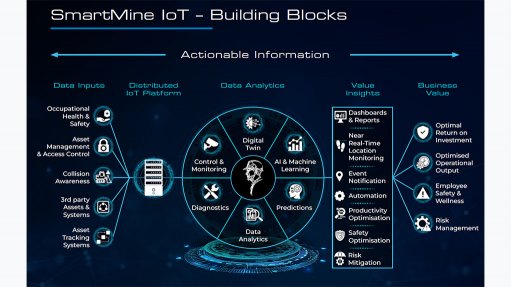
SmartMine IoT has been developed with the mining industry in mind, to provides our customers with powerful business intelligence and data modelling...
VISIT SHOWROOM
Press Office
Announcements
What's On
Subscribe to improve your user experience...
Option 1 (equivalent of R125 a month):
Receive a weekly copy of Creamer Media's Engineering News & Mining Weekly magazine
(print copy for those in South Africa and e-magazine for those outside of South Africa)
Receive daily email newsletters
Access to full search results
Access archive of magazine back copies
Access to Projects in Progress
Access to ONE Research Report of your choice in PDF format
Option 2 (equivalent of R375 a month):
All benefits from Option 1
PLUS
Access to Creamer Media's Research Channel Africa for ALL Research Reports, in PDF format, on various industrial and mining sectors
including Electricity; Water; Energy Transition; Hydrogen; Roads, Rail and Ports; Coal; Gold; Platinum; Battery Metals; etc.
Already a subscriber?
Forgotten your password?
Receive weekly copy of Creamer Media's Engineering News & Mining Weekly magazine (print copy for those in South Africa and e-magazine for those outside of South Africa)
➕
Recieve daily email newsletters
➕
Access to full search results
➕
Access archive of magazine back copies
➕
Access to Projects in Progress
➕
Access to ONE Research Report of your choice in PDF format
RESEARCH CHANNEL AFRICA
R4500 (equivalent of R375 a month)
SUBSCRIBEAll benefits from Option 1
➕
Access to Creamer Media's Research Channel Africa for ALL Research Reports on various industrial and mining sectors, in PDF format, including on:
Electricity
➕
Water
➕
Energy Transition
➕
Hydrogen
➕
Roads, Rail and Ports
➕
Coal
➕
Gold
➕
Platinum
➕
Battery Metals
➕
etc.
Receive all benefits from Option 1 or Option 2 delivered to numerous people at your company
➕
Multiple User names and Passwords for simultaneous log-ins
➕
Intranet integration access to all in your organisation