



Gauteng seeking ways to expand ‘golden goose’ automotive sector


To bolster the automotive industry’s contribution to Gauteng’s economic growth, Premier David Makhura has urged local vehicle manufacturers to limit imports of automotive parts, components and accessories from other countries.
Speaking at a recent engagement session with CEOs and other executives in the automotive industry at Toyota South Africa Motors’ (TSAM’s) offices, in Johannesburg, he pointed out that Gauteng-based automotive companies were estimated to spend R8-billion a year on such imports.
The Premier further stated that the local production of parts and components was an area that could be enhanced to increase the sector’s contribution to job creation and industrialisation. “We want to protect this [golden] goose,” he added.
“Over the years, the automotive industry [has] received considerable support from government in the form of incentives. “While this [has] contributed to building a formidable and competitive industry that has created many jobs, there is room to do more,” Makhura said in an earlier statement.
Only 35% of the components and parts used to manufacture vehicles in South Africa were manufactured locally, while 65% were imported.
The Premier noted that, as the province contributed 42% of total vehicle production in South Africa, the provincial government would be implementing key interventions to boost the automotive industry’s contribution to Gauteng’s economic growth.
“We are looking for opportunities to expand the automotive sector in [Pretoria]. “We are looking for investment in infrastructure to ensure that we unlock the full value of this sector,” he noted.
Gauteng Economic Development, Environment, Agriculture and Rural Development MEC Lebogang Maile added that the automotive industry played a central part in the province’s objective to reindustrialise the economy through local production.
“A competitive automotive industry is important for our vision to position Gauteng as a leading automotive investment destination through the creation of the biggest automotive city in the southern hemisphere, to transform Rosslyn [in the north of Gauteng] to a world-class automotive hub.
“Accordingly, we should all be worried about the high levels of import penetration in the sector, which undermines any objective to develop local component manufacturing and create jobs in the automotive value chain.
Minuscule Player“We are [aware] of the reality that the South African automotive industry is still a minuscule player in the global automotive industry, contributing less than 1% of global vehicle production. “It is crucial for our local industry to have world-class processes, skills and products to compete with what is available,” he stated.
Further, Maile noted that the automotive industry was the biggest contributor to the local manufacturing sector and that the province was home to four original-equipment manufacturers.
“There are [also] many small components manufacturers scattered across the industrial areas of the province in Alrode, Industria, Kempton Park and Wadeville. “The aim of this government is to not only make local component manufacturing competitive but to increase black participation and the integration of youth and women into the sector.
“We believe that this engagement is well timed and gives us an opportunity to ponder ways in which your industry can make a contribution towards the attainment of our vision as a province,” he said.
TSAM head and National Asso- ciation of Automobile Manufac-turers of South Africa (Naamsa) president Dr Johan van Zyl said the biggest issue facing the industry was how it could improve its competitiveness, linking this issue to infrastructure.
“As Naamsa, we would like to encourage Gauteng to continue its investment in infrastructure. Frankly speaking, without roads, without world-class infrastructure, our economy will not be able to develop,” he said.
He asked government to place greater emphasis on the supply of electricity to the various manufacturing hubs. “This is not an issue that will be solved in the short term, but industry, government and regional government need to work together to find solutions for this problem.”
“From our side, we want to give assurance that we will improve the efficiency of electricity use. “We have already reduced our electricity consumption dramatically, in some cases by more than 30%,” noted Van Zyl.
National Association of Automotive Component and Allied Manufacturers (Naacam) executive director Robert Houdet, meanwhile, said that, for the automotive components industry to survive, there needed to be stronger incentives to ensure that the price of catalytic converters from South Africa would be “substantially cheaper” than in the rest of the world.
“We want our catalytic converters to reach Europe or the US at 10% less than the customer price,” he added.
Houdet believed this could be achieved through government’s intervention, including through the introduction of a strategic production tax for platinum-group metals, the growth of the beneficiation industry through subsidies and a direct grant from the fiscus.
“Naacam is actively engaged with the Department of Trade and Industry, the Department of Mineral Resources, the Chamber of Mines and other stakeholders to ensure the growth and survival of our sector,” he said, adding that the association needed government’s support and engagement to push its agenda of having sufficient component production capacity to support the vehicle manufacturing sector in its aim to produce 1.2-million cars by 2020.
All parties called for better regulations with regards to the labour sector, as labour instability was posing a significant threat to industry.
“If we don’t have labour stability, all our efforts will come to nothing, investors will run away and we will not grow our industry. “There is a need to engage with all stakeholders to stabilise [industry],” Houdet added.
Article Enquiry
Email Article
Save Article
Feedback
To advertise email advertising@creamermedia.co.za or click here
Research Reports

Projects


Latest Multimedia

Latest News
Showroom
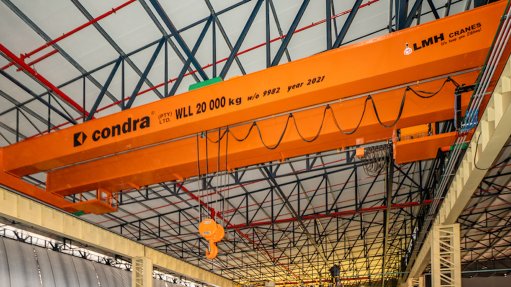
ISO-certified Condra manufactures overhead cranes, portal cranes, cantilever cranes and crane components: hoists, drives, end-carriages, brakes and...
VISIT SHOWROOM
For over 60 years, VEGA has provided industry-leading products for the measurement of level, density, weight and pressure. As the inventor of the...
VISIT SHOWROOM

Press Office
Announcements
What's On
Subscribe to improve your user experience...
Option 1 (equivalent of R125 a month):
Receive a weekly copy of Creamer Media's Engineering News & Mining Weekly magazine
(print copy for those in South Africa and e-magazine for those outside of South Africa)
Receive daily email newsletters
Access to full search results
Access archive of magazine back copies
Access to Projects in Progress
Access to ONE Research Report of your choice in PDF format
Option 2 (equivalent of R375 a month):
All benefits from Option 1
PLUS
Access to Creamer Media's Research Channel Africa for ALL Research Reports, in PDF format, on various industrial and mining sectors
including Electricity; Water; Energy Transition; Hydrogen; Roads, Rail and Ports; Coal; Gold; Platinum; Battery Metals; etc.
Already a subscriber?
Forgotten your password?
Receive weekly copy of Creamer Media's Engineering News & Mining Weekly magazine (print copy for those in South Africa and e-magazine for those outside of South Africa)
➕
Recieve daily email newsletters
➕
Access to full search results
➕
Access archive of magazine back copies
➕
Access to Projects in Progress
➕
Access to ONE Research Report of your choice in PDF format
RESEARCH CHANNEL AFRICA
R4500 (equivalent of R375 a month)
SUBSCRIBEAll benefits from Option 1
➕
Access to Creamer Media's Research Channel Africa for ALL Research Reports on various industrial and mining sectors, in PDF format, including on:
Electricity
➕
Water
➕
Energy Transition
➕
Hydrogen
➕
Roads, Rail and Ports
➕
Coal
➕
Gold
➕
Platinum
➕
Battery Metals
➕
etc.
Receive all benefits from Option 1 or Option 2 delivered to numerous people at your company
➕
Multiple User names and Passwords for simultaneous log-ins
➕
Intranet integration access to all in your organisation

