How obscure yttrium became a global flashpoint

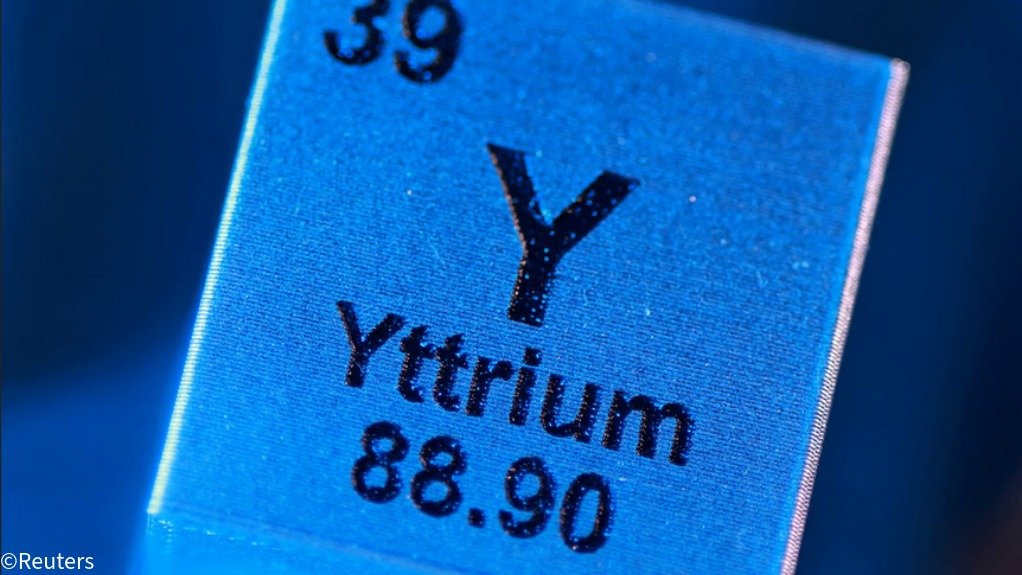


LONDON - If you want an insight into the state of the world right now, it's worth taking a look at yttrium.
This obscure member of the rare earths family is going to be high on the agenda when China's President Xi Jinping meets with US President Donald Trump later this month in Washington.
The US needs yttrium and China is the world's dominant supplier, just as it is across the critical minerals spectrum.
China didn't send any yttrium to the US over the middle of last year, and deliveries have since been highly sporadic.
The resulting shortage has roiled aerospace, energy and semiconductor sectors, revealing the extent to which little-known elements of the periodic table have seeped into modern manufacturing.
Yttrium's criticality renders it a powerful weapon in China's trade negotiation arsenal. It can also become a means of punishment, as Japan is finding out.
DARK METAL
Yttrium is a metallic curiosity. It's not technically a rare earth element, but is always found with them.
Indeed, its discovery near the Swedish village of Ytterby in the 18th century was the first step in unlocking the secrets of the rare earths universe.
Today, yttrium's usage ranges from screen displays to semiconductors to lasers. But its core criticality comes from its application in thermal barrier coatings to protect jet engines from extreme heat.
Hard figures about market size are few and far between.
Even the US Geological Survey, normally the bible of metallic information, isn't sure how much yttrium comes out of the ground. It estimates that global mine production last year was somewhere between 10 000 and 15 000 tons.
Just about all the world's yttrium comes from China, and the authorities don't disclose any public information about mining or separation production quotas.
DRIP FEED
What we do know is that China imposed export controls on yttrium along with six other rare earths in April last year, causing overseas shipments to grind to a halt.
The US received none at all until October, when the tap was turned back on ahead of a meeting between Xi and Trump in the South Korean city of Busan.
Beijing agreed to defer by a year even tougher restrictions on rare earths and magnets but kept the original controls on yttrium in place.
These require exporters to prove the metal will be used only for civilian purposes, transforming yttrium into a precision weapon for deployment against specific trade partners and Western companies.
Despite what Trump hailed as an "amazing" summit, the flow of yttrium dried up again after the October meeting. By February, an acute shortage was causing production stoppages along the US coating supply chain.
China made a bumper 60-ton shipment of yttrium oxide to the US in March after what seems to have been a direct intervention by the White House on behalf of a major US company that was struggling to secure an export licence.
A couple of months later, US Trade Representative Jamieson Greer lamented the slow pace of Chinese yttrium exports and admitted, "There are times when we have to go and make our point."
Despite another summit in May, after which Beijing said it would work with the US to address "reasonable" concerns about rare earth shipments, the export tap was turned off again until July, when 29 tons were shipped.
It's clear that Beijing is using yttrium as a pressure point in its broader trade standoff with the US, drip-feeding enough supply to avoid a full-on confrontation but not enough to alleviate supply-chain stresses.
PUNISHMENT
Japan has hardly received any yttrium since November, when Prime Minister Sanae Takaichi enraged Beijing with comments about defending Taiwan.
Supplies of other critical metals such as gallium, terbium and dysprosium have also been cut off in what looks like a repeat of 2010, when China restricted rare earth exports after a diplomatic spat with Japan over disputed islands in the East China Sea.
Since then Japan has diversified its supply chain and stockpiled rare earths, but remains highly dependent on China.
What is in effect an unofficial embargo is starting to take a toll on corporate Japan, with multiple Japanese companies warning about the impact in their filings to the Tokyo Stock Exchange.
Prior to this year, rare earths typically got fewer than 40 mentions per month as a cause of concern.
But in May and June, more than two-thirds of nearly 200 filings that mentioned rare earths said export controls were affecting their business negatively or could do so in the future.
CARROT OR STICK?
Will Europe get the yttrium carrot or the yttrium stick?
Much depends on how aggressively it tackles its widening trade gap with China.
European Trade Commissioner Maros Sefcovic has called for China to commit to tackling the issue by October "or there will be huge political pressure to look for other solutions."
Sefcovic also wants talks on, you guessed it, China's critical mineral export controls. Yttrium will almost certainly feature.
This obscure metal now sits at the heart of global politics and it's going to remain there as long as Beijing controls its supply to everyone else.
Article Enquiry
Email Article
Save Article
Feedback
To advertise email advertising@creamermedia.co.za or click here
Research Reports

Projects
Latest Multimedia
Latest News
Showroom
For over 30 years, Werner South Africa Pumps & Equipment (PTY) LTD has been designing, manufacturing, supplying and maintaining specialist...
VISIT SHOWROOM
Tsurumi Pumps Africa is a specialist supplier of Japanese-engineered submersible pumping solutions, serving customers across the African continent.
VISIT SHOWROOM
Press Office
Announcements
What's On
Subscribe to improve your user experience...
Option 1 (equivalent of R125 a month):
Receive a weekly copy of Creamer Media's Engineering News & Mining Weekly magazine
(print copy for those in South Africa and e-magazine for those outside of South Africa)
Receive daily email newsletters
Access to full search results
Access archive of magazine back copies
Access to Projects in Progress
Access to ONE Research Report of your choice in PDF format
Option 2 (equivalent of R375 a month):
All benefits from Option 1
PLUS
Access to Creamer Media's Research Channel Africa for ALL Research Reports, in PDF format, on various industrial and mining sectors
including Electricity; Water; Energy Transition; Hydrogen; Roads, Rail and Ports; Coal; Gold; Platinum; Battery Metals; etc.
Already a subscriber?
Forgotten your password?
Receive weekly copy of Creamer Media's Engineering News & Mining Weekly magazine (print copy for those in South Africa and e-magazine for those outside of South Africa)
➕
Recieve daily email newsletters
➕
Access to full search results
➕
Access archive of magazine back copies
➕
Access to Projects in Progress
➕
Access to ONE Research Report of your choice in PDF format
RESEARCH CHANNEL AFRICA
R4500 (equivalent of R375 a month)
SUBSCRIBEAll benefits from Option 1
➕
Access to Creamer Media's Research Channel Africa for ALL Research Reports on various industrial and mining sectors, in PDF format, including on:
Electricity
➕
Water
➕
Energy Transition
➕
Hydrogen
➕
Roads, Rail and Ports
➕
Coal
➕
Gold
➕
Platinum
➕
Battery Metals
➕
etc.
Receive all benefits from Option 1 or Option 2 delivered to numerous people at your company
➕
Multiple User names and Passwords for simultaneous log-ins
➕
Intranet integration access to all in your organisation