Developing skills - Technology is only as advanced as the people supporting it

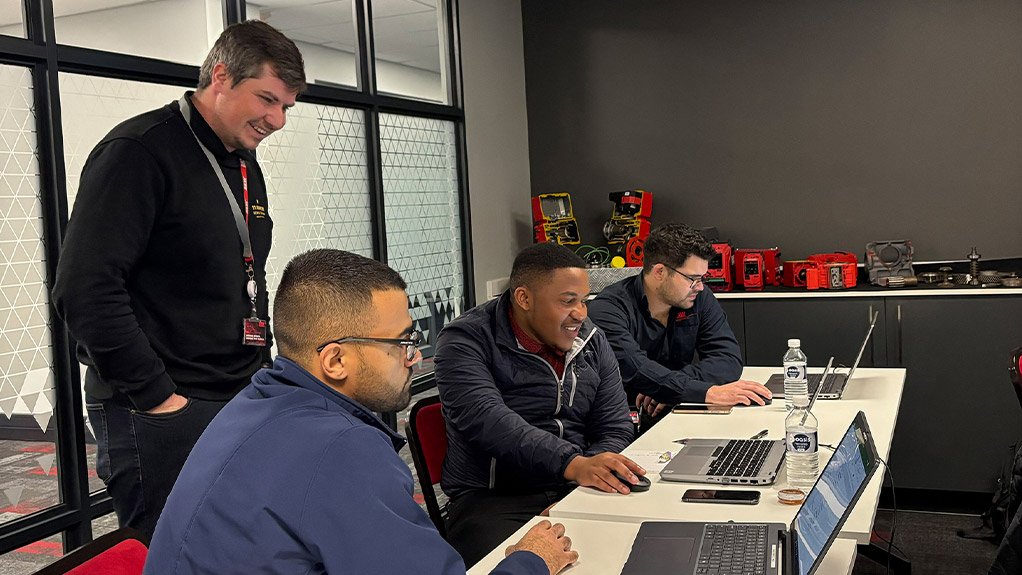


One of the clearest indicators of how far industrial drive technology has advanced is what the technician now needs to know. A conventional mechanical drive requires an understanding of gearing, bearings, lubrication, alignment and loading. Add variable speed control and the technician must understand electrical behaviour and drive parameters. Add servo motion, communications and automation, and software enters the picture. Add digital condition monitoring, and maintenance personnel increasingly need to interpret data as well as inspect machinery.
The technology has become more sophisticated, and the skills required to support it have had to keep pace. This was the reason behind the establishment of SEW-EURODRIVE South Africa’s DriveAcademy® in 2011.
Its beginnings were modest – a prefabricated room outside the Aeroton facility. The reason for creating it was considerably more important than the building itself.
By then, the South African operation was supporting geared motors, industrial gear units, electronics and increasingly sophisticated mechatronic technology. Informal knowledge transfer – learning whatever an experienced colleague happened to have time to explain – was no longer sufficient.
Technical complexity had outgrown the training model, says national sales and marketing manager Jonathan McKey, adding that the DriveAcademy® has developed around function-specific learning rather than generic corporate training
“Someone working in assembly needs different depth from a sales engineer. A service technician requires practical fault-finding capability. An engineer specifying industrial gear units must understand application loads and design logic. Automation personnel need to understand how electronic control interacts with mechanical behaviour,” he explains.
This kind of training also explains why knowledge transfer is an important component of localisation. A product assembled locally but understood only by engineers elsewhere remains dependent on overseas expertise.
McKey says true technical localisation requires the knowledge to diagnose, configure, commission, maintain and improve the product to exist locally as well.
The DriveAcademy® has developed substantially since those early years. By 2026, it moved into expanded purpose-built space within the Service and Repair Centre.
The teaching methods have also evolved. Augmented reality and holographic overlays allow trainees to examine internal gearbox operation in ways that are difficult to replicate with conventional diagrams. Practical assessment remains an important part of the programme.
The SEW-EURODRIVE DriveAcademy® operates to common global training standards, with theoretical and practical evaluation forming part of competency assessment. “Attendance alone does not demonstrate industrial competence; being familiar with terminology is different from being able to diagnose a problem,” says McKey.
The company’s internal career history reinforces the same approach. Many senior employees progressed through different functions of the organisation, building technical and commercial understanding over time. Internal sales repeatedly acted as a grounding environment where employees learned products and customers before moving into more direct market-facing positions.
Leadership too, has frequently developed from within. The underlying principle is that technical knowledge builds over time. An experienced engineer carries lessons from previous installations into the next design. A technician who has stripped and inspected failed equipment begins to recognise failure patterns. A sales engineer with genuine application knowledge asks better questions before anything is quoted.
These capabilities cannot be downloaded with new technology, stresses McKey. “They are built over years and then deliberately transferred.”
Article Enquiry
Email Article
Save Article
Feedback
To advertise email advertising@creamermedia.co.za or click here




Latest Multimedia
Latest News
Showroom
AirNox (Pty) Ltd is a level 1 BBBEE manufacturer of complete AdBlue® solutions for operators of SCR diesel engines and AUS40 across South Africa...
VISIT SHOWROOM
The Aluminium Federation of South Africa (AFSA), is the voice of the South African aluminium industry.
VISIT SHOWROOM

Press Office
Announcements
What's On
Subscribe to improve your user experience...
Option 1 (equivalent of R125 a month):
Receive a weekly copy of Creamer Media's Engineering News & Mining Weekly magazine
(print copy for those in South Africa and e-magazine for those outside of South Africa)
Receive daily email newsletters
Access to full search results
Access archive of magazine back copies
Access to Projects in Progress
Access to ONE Research Report of your choice in PDF format
Option 2 (equivalent of R375 a month):
All benefits from Option 1
PLUS
Access to Creamer Media's Research Channel Africa for ALL Research Reports, in PDF format, on various industrial and mining sectors
including Electricity; Water; Energy Transition; Hydrogen; Roads, Rail and Ports; Coal; Gold; Platinum; Battery Metals; etc.
Already a subscriber?
Forgotten your password?
Receive weekly copy of Creamer Media's Engineering News & Mining Weekly magazine (print copy for those in South Africa and e-magazine for those outside of South Africa)
➕
Recieve daily email newsletters
➕
Access to full search results
➕
Access archive of magazine back copies
➕
Access to Projects in Progress
➕
Access to ONE Research Report of your choice in PDF format
RESEARCH CHANNEL AFRICA
R4500 (equivalent of R375 a month)
SUBSCRIBEAll benefits from Option 1
➕
Access to Creamer Media's Research Channel Africa for ALL Research Reports on various industrial and mining sectors, in PDF format, including on:
Electricity
➕
Water
➕
Energy Transition
➕
Hydrogen
➕
Roads, Rail and Ports
➕
Coal
➕
Gold
➕
Platinum
➕
Battery Metals
➕
etc.
Receive all benefits from Option 1 or Option 2 delivered to numerous people at your company
➕
Multiple User names and Passwords for simultaneous log-ins
➕
Intranet integration access to all in your organisation