Balancing MEPS compliance, motor reliability in underground mining

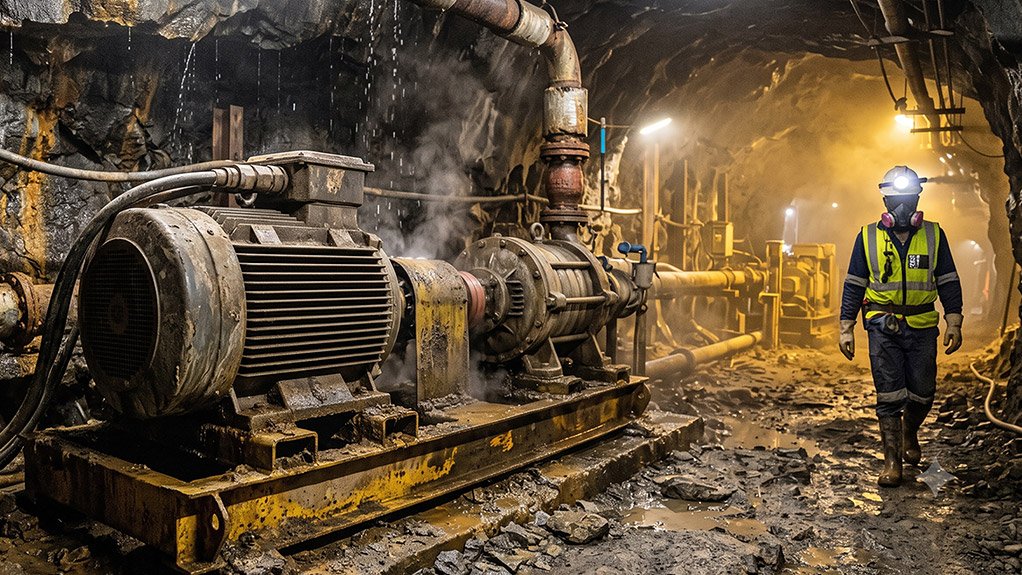
A heavy-duty, electric motor drives a multistage dewatering pump on a steel skid inside a rugged, wet underground mine tunnel, surrounded by atmospheric steam and harsh environmental conditions.



Across Southern Africa, the mining sector is navigating a critical and highly demanding transition. The region is currently witnessing a massive revitalisation of the Central African Copperbelt, with significant capital flowing into deep-level operations. Historic dewatering projects—such as the massive pumping efforts required to reclaim flooded underground workings at the Kamoa-Kakula complex in the Democratic Republic of the Congo, and Luanshya in Zambia—are actively moving millions of litres of water to safely restore critical copper production. Simultaneously, South African mining operations are adapting to the newly mandated Minimum Energy Performance Standards (MEPS) under the VC 9113 regulation.
This strict legislation has understandably pushed heavy industry to rapidly adopt IE3 premium efficiency electric motors to optimise grid power and reduce operational energy costs amidst ongoing regional power constraints. While reducing energy consumption is a vital objective for any modern mine, an engineering oversight is emerging across the sector: the prioritisation of electrical efficiency over environmental reliability in hostile underground atmospheres.
Submersibles vs. Atmospheric Motors
When combatting rising water tables or expanding deep-level infrastructure, mines use two distinctly different engineering approaches. Heavily flooded zones naturally rely on IP68 submersible pumps, which operate entirely underwater and depend on mechanical seals to keep moisture out of the windings.
However, most continuous underground work—driving massive dry-pit dewatering pumps, ventilation fans, and lengthy conveyor networks—is handled by air-cooled, surface-mounted electric motors operating in underground pump stations and shafts. It is here that procurement managers frequently specify standard IP55 commercial-grade industrial motors, focusing primarily on kilowatt ratings and IE3 compliance. This overlooks the realities of the underground working environment, which is consistently characterised by elevated ambient heat, high condensing humidity, and the pervasive, highly corrosive threat of acid mine drainage (AMD) suspended in the air.
The Impact of AMD and Condensation
Underground moisture is rarely chemically neutral. As groundwater interacts with oxidised sulphide minerals, such as pyrite, it generates sulphuric acid carrying dissolved heavy metals. Standard Totally Enclosed Fan Cooled IP55 motors rely on this ambient air for cooling. A common engineering misconception is that these standard surface motors are entirely sealed. In reality, they inherently "breathe" during their normal thermal cycling.
As a massive dry-installed motor runs under a heavy shift load, the internal air heats up and expands. When the water pumps or conveyors cycle off, the motor cools down. According to Gay-Lussac's Law, this rapid temperature drop within a fixed volume creates a slight internal vacuum. In a wet underground pump chamber, this vacuum effect actively pulls the highly acidic, moisture-laden ambient air through the bearing housings, cable glands, and terminal box joints directly into the stator frame.
Once inside, this corrosive AMD condensation attacks the standard Class F resin insulation covering the copper windings. The low-pH moisture steadily degrades the dielectric varnish. The moment the motor is switched back on, the compromised insulation fails, resulting in a phase-to-phase or phase-to-ground short circuit. The outcome is a burnt-out winding, necessitating expensive electric motor repairs and bringing critical extraction operations to a halt.
IP66 Ratings and Advanced Resin Impregnation
To prevent chronic failures in dry-installed underground equipment, mechanical durability must parallel electrical efficiency. Mining operations must specify robust motor architectures capable of surviving severe atmospheric environments over the long term.
This strategy requires upgrading from standard IP55 enclosures—which only protect against low-pressure water and limited dust—to severe-duty IP66-rated housings. An IP66 rating provides exceptional protection against fine dust ingress and can withstand heavy water saturation and direct jets, ensuring the internal electrical components remain completely isolated from the acidic atmosphere of the mine shaft.
Internally, the defence must be uncompromising. Premium mining motors, such as the severe-duty WEG motors, utilise highly advanced insulation systems to combat internal moisture.
Rather than relying on basic varnish dips, these motors employ advanced engineering techniques. WEG protects its standard low-voltage W22 IE3 range using its patented WISE® (WEG Insulation System Evolution) technology. These random-wound motors undergo a continuous resin flow process using solvent-free, Class H-rated epoxy resins to bolster the standard Class F insulation system. This advanced technique completely fills the microscopic spaces of the copper windings, solidifying them into a highly durable, moisture-resistant block that effectively prevents capillary wicking and acidic short-circuiting. (For highly specialised high-voltage applications, WEG deploys full Vacuum Pressure Impregnation for absolute dielectric integrity).
Fortifying Against Mechanical Overload
Beyond chemical threats, underground motors face immense mechanical wear. High-torque start-ups and the continuous vibration generated by heavy, direct-coupled multistage pumps rapidly destroy inferior motor housings. Severe-duty motors must be specified with rigid cast-iron frames and robust end shields that prevent structural warping under kinetic loads, ensuring the precision-machined drive-end ball bearings remain perfectly aligned.
Further, these vital bearings must be firmly protected by advanced sealing systems—such as WEG's W3-Seal or regreasable labyrinth technology—to permanently lock out airborne contaminants. To further protect this equipment, mines are investing heavily in specialised variable speed drives. These controllers manage starting currents and operational torque, extending the lifespan of both the motor and the driven equipment. Additionally, mounting these robust motors and pumps on custom-engineered pump skids or heavy-duty structural pump base plates ensures proper alignment and vibration damping, which is crucial for long-term mechanical reliability.
Supporting Operations
As mining activities modernise, securing reliable supply chains for specialised engineering equipment has never been more important. Whether supporting deep-level gold and platinum mines in South Africa or large-scale copper dewatering projects further north, having direct access to durable pumping and motorised solutions is critical.
Through streamlined export services, including dedicated logistics and support for Zambia, Botswana, and Zimbabwe, operations can ensure they receive the exact severe-duty equipment required to handle specific regional challenges. Partnering with suppliers who offer tailored engineering solutions ensures that every motor, pump and control panel is perfectly suited to the environmental and mechanical demands of the site.
The transition to IE3 electrical efficiency under regulations like VC 9113 is a positive step for the African mining sector. However, energy savings cannot come at the expense of operational reliability. By distinguishing between submerged requirements and the unique atmospheric stresses placed on dry-installed surface motors, engineers can make highly informed decisions. Specifying severe-duty IP66 motors with advanced resin protection ensures that mines achieve both their energy efficiency targets and their production goals.
Article Enquiry
Email Article
Save Article
Feedback
To advertise email advertising@creamermedia.co.za or click here

Projects
Latest Multimedia
Latest News
Showroom
As a reticulator, Egoli Gas provides natural gas to homes and businesses via underground pipes.
VISIT SHOWROOM
Astore Keymak is one of South Africa’s leading suppliers of high-quality Thermoplastic Pipeline Systems, with branches in the major provinces.
VISIT SHOWROOM
Press Office
Announcements
What's On
Subscribe to improve your user experience...
Option 1 (equivalent of R125 a month):
Receive a weekly copy of Creamer Media's Engineering News & Mining Weekly magazine
(print copy for those in South Africa and e-magazine for those outside of South Africa)
Receive daily email newsletters
Access to full search results
Access archive of magazine back copies
Access to Projects in Progress
Access to ONE Research Report of your choice in PDF format
Option 2 (equivalent of R375 a month):
All benefits from Option 1
PLUS
Access to Creamer Media's Research Channel Africa for ALL Research Reports, in PDF format, on various industrial and mining sectors
including Electricity; Water; Energy Transition; Hydrogen; Roads, Rail and Ports; Coal; Gold; Platinum; Battery Metals; etc.
Already a subscriber?
Forgotten your password?
Receive weekly copy of Creamer Media's Engineering News & Mining Weekly magazine (print copy for those in South Africa and e-magazine for those outside of South Africa)
➕
Recieve daily email newsletters
➕
Access to full search results
➕
Access archive of magazine back copies
➕
Access to Projects in Progress
➕
Access to ONE Research Report of your choice in PDF format
RESEARCH CHANNEL AFRICA
R4500 (equivalent of R375 a month)
SUBSCRIBEAll benefits from Option 1
➕
Access to Creamer Media's Research Channel Africa for ALL Research Reports on various industrial and mining sectors, in PDF format, including on:
Electricity
➕
Water
➕
Energy Transition
➕
Hydrogen
➕
Roads, Rail and Ports
➕
Coal
➕
Gold
➕
Platinum
➕
Battery Metals
➕
etc.
Receive all benefits from Option 1 or Option 2 delivered to numerous people at your company
➕
Multiple User names and Passwords for simultaneous log-ins
➕
Intranet integration access to all in your organisation