As sales to industrial customers slump by 22.5%, Eskom targets new sources of demand



Eskom reports that it is aiming to stabilise yearly sales at the 178 TWh level reported in its 2026 financial year, which represented another 6.1% year-on-year fall.
The State-owned utility has recorded an ongoing decline in sales for more than ten years, having reported sales of more than 224 TWh in its 2012 financial year.
Despite the fall in sales, Eskom reported a big rise in profits to R30.3-billion in 2026, from a restated R14-billion in the prior year.
The group reported revenue of R354.7-billion, up from R340.8-billion in 2025, on the back of tariff increases and more stable operations. The latter development also enabled it to reduce its spending on diesel to R7-billion from R18-billion. The figure was above R36-billion two years ago.
The progressive fall in the utility’s sales has coincided with steep tariff increases and supply disruptions, which Eskom has since brought under control.
It also coincided with reforms in the electricity market that resulted in large consumers entering into power purchase agreements with independent power producers and traders for electricity, including electricity wheeled through Eskom and municipal networks. Installations of behind-the-meter solar PV have also surged.
Eskom’s 2026 sales slump was particularly pronounced among industrial customers, where sales fell by 9.7 TWh, or 22.5% year-on-year; a performance that Eskom attributed largely to a fall in demand from the country’s remaining ferrochrome smelters.
The State-owned utility has since extended a 62c/kWh discounted tariff to support the resumption of production by smelters owned by Samancor Chrome and by the Glencore-Merafe Chrome Venture, as well as an undisclosed discounted negotiated pricing agreement with Manganese Metal Company.
Eskom has confirmed that it will not make a profit on these sales, but has argued that the agreements will allow it to cover its variable costs and make a contribution to its fixed costs.
It also insists that standard-tariff customers are not subsidising the sales to the smelters and that the decision to “monetise” its 2 GW to 3 GW surplus to supply the smelters and potentially attract new demand is based on a cost-benefit analysis that points to benefits for Eskom from sustaining the baseload demand in a context of ongoing take-or-pay coal contracts.
The duration of this surplus could hinge partly on the outcome of Eskom’s coal decommissioning review.
No update was provided on Eskom’s decommissioning schedule, but the utility indicated during the release of its financial results, which were again qualified, that an announcement would be made during the third quarter of 2026.
Part of the qualification of its latest annual financial statements related to the lack of compliance of its coal fleet with air and water quality standards, alongside a finding that its irregular-expenditure disclosure remained incomplete.
DATA CENTRE & CROSS-BORDER SALES IN FOCUS
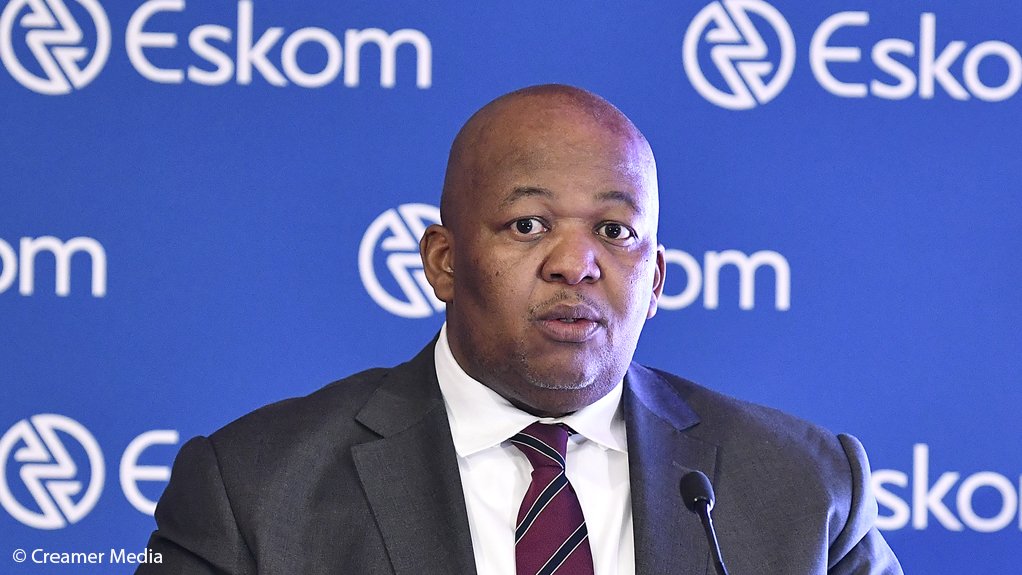
CEO Dan Marokane indicated that Eskom was assessing various demand retention and growth initiatives to shore up sales, including targeting additional load through data centres, attracting flexible load in the form of a Bitcoin-mining pilot, and rolling out electric vehicle charging infrastructure.
It would also seek to develop South Africa’s role as a regional electricity hub to grow export sales. However, international sales during 2026 fell by 1.2 TWh, or 8.3%.
A slide in Eskom’s results presentation also stated that, even if customers self-generate or buy from alternative suppliers, Eskom would retain revenue through network charges, customer wheeling and revised tariff structures that separate energy charges from the recovery of fixed costs.
Electricity and Energy Minister Dr Kgosientsho Ramokgopa said the fall in Eskom sales should be seen against the background of the efforts taken under the Energy Action Plan to tackle the loadshedding crisis.
He said it was “common sense” for Eskom’s sales to have fallen when that plan included specific actions to diversify supply and to facilitate the entry of rooftop solar.
He said the actions had helped “derisk” the electricity sector from monopoly complacency and had sent a message to Eskom that part of its future lay outside of South Africa.
The slump in sales was not highlighted as the main risk facing Eskom, however, with the ongoing rise in municipal arrear debt, which had increased to R119-billion, fingered instead.
Nevertheless, it does raise warning signs of a potential ‘utility death spiral’, whereby increases in tariffs are used to cover the sales shortfall that, in turn, risks further defections.
Eskom reiterated its commitment to single-digit tariff hikes in future, while indicating that its current focus was on “optimising costs, stabilising municipal arrear debt, arresting the sales decline and diversifying revenue streams”.
Outgoing CFO Calib Cassim said that, despite the positive results, Eskom was not yet “out of the woods” from a financial sustainability perspective.
The utility continued to trade with support from the taxpayer, in the form of ongoing injections under the R230-billion debt-relief programme that is scheduled to begin tapering, with a residual of R10-billion remaining.
During the year to March 31, 2026, Eskom received R80-billion in the form of a shareholder loan, up from R56-billion in the prior year; an injection that proved crucial to ensuring a positive cash position and to reducing debt.
These loans, including the most recent R80-billion, have been converted into equity.
Total borrowings had fallen from R424-billion in 2023 to R320-billion in 2026, which helped lower Eskom’s debt-to-equity ratio to 0.93 from 1.46 and lower its gross debt-to-earnings before interest, taxes, depreciation, and amortisation ratio to 4.6 from 4.9. Net finance costs also fell to R31-billion from R34-billion.
CASSIM’S PARTING SHOT
Cassim also used his final results presentation to outline how Eskom could return to financial sustainability without further recourse to the taxpayer, which had supported Eskom to the tune of R480-billion cumulatively over the past ten years.
Having been at Eskom for 24 years, nine of them as CFO and with a stint as acting CEO, Cassim stressed the importance of resolving the R119-billion municipal-debt problem, while stemming electricity theft and shoring up sales.
He said that some R46-billion in revenue had been foregone in the 2026 financial year alone as a result of the municipal debt problem and the theft of 13 TWh of electricity, which equated to nearly R30-billion based on an average tariff of R2.20/kWh.
“If we can secure 50% of that going forward, that gives you a starting point of more than R20-billion per annum that we never had before,” Cassim said, describing it as the basis for future sustainability, alongside the delivery of clean audits from 2027 onwards.
Transitioning to financial sustainability, he argued, would now hinge on collecting revenue owed to Eskom to secure the cash it needed, embedding operational reliability and proactive maintenance, and expanding the grid to connect new generation.
“The cash gives us strength. Reliability gives South Africans confidence. The grid connects us to the future,” Cassim said in a parting shot.
Meanwhile, he announced that Eskom had extended until its 2028 financial year the period during which it would not approach the capital markets for further funding, so as to strengthen its balance sheet.
Its R54-billion capital expenditure this year would, thus, be from its own resources, funding on offer from development finance institutions, and public-private partnerships.
Article Enquiry
Email Article
Save Article
Feedback
To advertise email advertising@creamermedia.co.za or click here


Latest Multimedia
Latest News
Showroom
Multotec, recognised industry leaders in metallurgy and process engineering help mining houses across the world process minerals more efficiently,...
VISIT SHOWROOM
Complete range of security sealing solutions including security seals bags and labels.
VISIT SHOWROOM

Announcements
What's On
Subscribe to improve your user experience...
Option 1 (equivalent of R125 a month):
Receive a weekly copy of Creamer Media's Engineering News & Mining Weekly magazine
(print copy for those in South Africa and e-magazine for those outside of South Africa)
Receive daily email newsletters
Access to full search results
Access archive of magazine back copies
Access to Projects in Progress
Access to ONE Research Report of your choice in PDF format
Option 2 (equivalent of R375 a month):
All benefits from Option 1
PLUS
Access to Creamer Media's Research Channel Africa for ALL Research Reports, in PDF format, on various industrial and mining sectors
including Electricity; Water; Energy Transition; Hydrogen; Roads, Rail and Ports; Coal; Gold; Platinum; Battery Metals; etc.
Already a subscriber?
Forgotten your password?
Receive weekly copy of Creamer Media's Engineering News & Mining Weekly magazine (print copy for those in South Africa and e-magazine for those outside of South Africa)
➕
Recieve daily email newsletters
➕
Access to full search results
➕
Access archive of magazine back copies
➕
Access to Projects in Progress
➕
Access to ONE Research Report of your choice in PDF format
RESEARCH CHANNEL AFRICA
R4500 (equivalent of R375 a month)
SUBSCRIBEAll benefits from Option 1
➕
Access to Creamer Media's Research Channel Africa for ALL Research Reports on various industrial and mining sectors, in PDF format, including on:
Electricity
➕
Water
➕
Energy Transition
➕
Hydrogen
➕
Roads, Rail and Ports
➕
Coal
➕
Gold
➕
Platinum
➕
Battery Metals
➕
etc.
Receive all benefits from Option 1 or Option 2 delivered to numerous people at your company
➕
Multiple User names and Passwords for simultaneous log-ins
➕
Intranet integration access to all in your organisation