



Vandalism, cable theft major worries as TFR seeks to increase rail corridor capacity

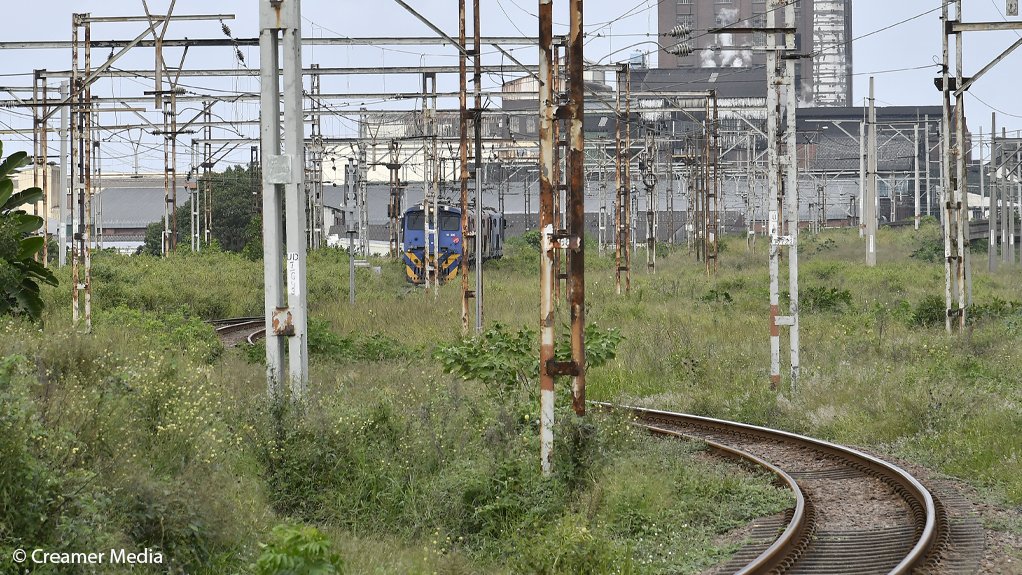
An electric Transnet locomotive makes its way on a rail line in the Bayhead area of Transnet Freight Rail’s Durban container complex
Photo by Creamer Media's Donna Slater


In light of plans to increase the cargo-handling capability at the Port of Durban and to ease congestion by having fewer trucks on the road near the port, Transnet needs to improve its rail capacity, as well as ensure the infrastructure is safe and secure.
Transnet Freight Rail (TFR) container corridor managing executive Rudzani Ligege says there are plans to expand the port’s handling capacity from its current 2.9-million units a year to 11-million units a year.
“The essence of the growth of the port will need to be supported by rail. Rail plays a huge role in that growth.”
For this reason, TFR’s container corridor – which stretches over 700 km, from the Port of Durban to City Deep in Johannesburg and Rosslyn in Pretoria – plays a critical role in bulk logistics.
Ligege notes that the eThekwini municipality “has made it very clear” that any growth at the Port of Durban should not be at the expense of tourism to the region – by having vast numbers of trucks crowding into Durban, especially around the harbour.
Operational activity on the KwaZulu-Natal rail cluster is predominantly for container, automotive, fuel and grain products.
However, TFR is being plagued by rampant destruction, vandalism and theft of mainly electrical infrastructure, including copper cables, signalling equipment, electricity itself and even rail-fastening devices.
Without electrical infrastructure, and especially without the overhead contact cable (which powers electric locomotives), TFR cannot operate electric locomotives. Even operating diesel-electric locomotives becomes severely compromised without elecrical signalling equipment, as manual authorisations become laborious and significantly reduce train speeds on the network.
On April 7, TFR hosted an oversight trip at its Durban Container Terminal and surrounds. Engineering News & Mining Weekly witnessed first-hand the impacts of the lack of infrastructure.
For about 45 minutes, a TFR diesel-powered trolley had to wait, sitting idle on the track, before permission was granted to enter the network at Bayhead (not far from the Port of Durban).
Although the overhead electrical network was in place at the time, signalling and train-monitoring and tracking equipment was dysfunctional, requiring the trolley operator to phone the TFR central train-operating control centre, informing it where the trolley was and where it intended heading. This process was repeated at every signal junction, which was every few hundred metres.
The process of manual authorisation severely limits train speeds and serves to distract locomotive drivers from their task – driving and operating a several-thousand-tonne train transporting valuable cargo.
The issue of dysfunctional signalling and track monitoring equipment means that trains passing through the Durban container complex take about four hours to do so, instead of the 30 minutes this is meant to take.
“We [are] supposed to be taking 18 hours from Durban to Johannesburg. [But] we [are currently] taking 36 hours, mainly due to [signals] not working and [cables] being stolen,” says Ligege.
So destructive is the issue of cable theft and electric trains sitting idle that TFR is seeking to completely de-electrify some routes, with plans to only rely on diesel-electric locomotives.
However, vast sections of the Durban-to-Johannesburg container corridor cannot be de-electrified as a result of several lengthy tunnels, in which diesel engines are starved of oxygen. This means electric locomotives still have a critical role to play in terms of getting cargo to and from Durban and Johannesburg and cannot simply be replaced by diesel locomotives, he explains.
Meanwhile, TFR is employing drones, as well as ground security personnel, to monitor crime hot spots.
Other issues disrupting its ability to operate efficiently and safely are settlement encroachments, community unrest, pedestrians and livestock walking on rail lines and the theft of nonelectrical infrastructure.
TFR has identified several areas where people have entered the rail reserves (15 m either side of a rail line), which creates safety and integrity hazards for trains and the informal settlers.
On the April 7 tour, Engineering News & Mining Weekly witnessed such an informal settlement encroachment near the Bayhead area, in Durban, as well as livestock and people being present on rail lines. These incidents, too, distract drivers and slow train speeds. They also raise safety and security issues for TFR, as drainage systems are blocked by litter and water fails to properly discharge from the rail reserve as a result, while people regularly cross rail lines and livestock stands on rail lines.
Article Enquiry
Email Article
Save Article
Feedback
To advertise email advertising@creamermedia.co.za or click here
Research Reports

Projects
Latest Multimedia
Latest News
Showroom
Established in 1983, the ASTPM is an industry association and representative body of the welded carbon steel tube and pipe manufacturers of South...
VISIT SHOWROOM
AirNox (Pty) Ltd is a level 1 BBBEE manufacturer of complete AdBlue® solutions for operators of SCR diesel engines and AUS40 across South Africa...
VISIT SHOWROOM
Announcements
What's On
Subscribe to improve your user experience...
Option 1 (equivalent of R125 a month):
Receive a weekly copy of Creamer Media's Engineering News & Mining Weekly magazine
(print copy for those in South Africa and e-magazine for those outside of South Africa)
Receive daily email newsletters
Access to full search results
Access archive of magazine back copies
Access to Projects in Progress
Access to ONE Research Report of your choice in PDF format
Option 2 (equivalent of R375 a month):
All benefits from Option 1
PLUS
Access to Creamer Media's Research Channel Africa for ALL Research Reports, in PDF format, on various industrial and mining sectors
including Electricity; Water; Energy Transition; Hydrogen; Roads, Rail and Ports; Coal; Gold; Platinum; Battery Metals; etc.
Already a subscriber?
Forgotten your password?
Receive weekly copy of Creamer Media's Engineering News & Mining Weekly magazine (print copy for those in South Africa and e-magazine for those outside of South Africa)
➕
Recieve daily email newsletters
➕
Access to full search results
➕
Access archive of magazine back copies
➕
Access to Projects in Progress
➕
Access to ONE Research Report of your choice in PDF format
RESEARCH CHANNEL AFRICA
R4500 (equivalent of R375 a month)
SUBSCRIBEAll benefits from Option 1
➕
Access to Creamer Media's Research Channel Africa for ALL Research Reports on various industrial and mining sectors, in PDF format, including on:
Electricity
➕
Water
➕
Energy Transition
➕
Hydrogen
➕
Roads, Rail and Ports
➕
Coal
➕
Gold
➕
Platinum
➕
Battery Metals
➕
etc.
Receive all benefits from Option 1 or Option 2 delivered to numerous people at your company
➕
Multiple User names and Passwords for simultaneous log-ins
➕
Intranet integration access to all in your organisation

