



Southern Africa part of Germany’s platinum-boosting green hydrogen strategy

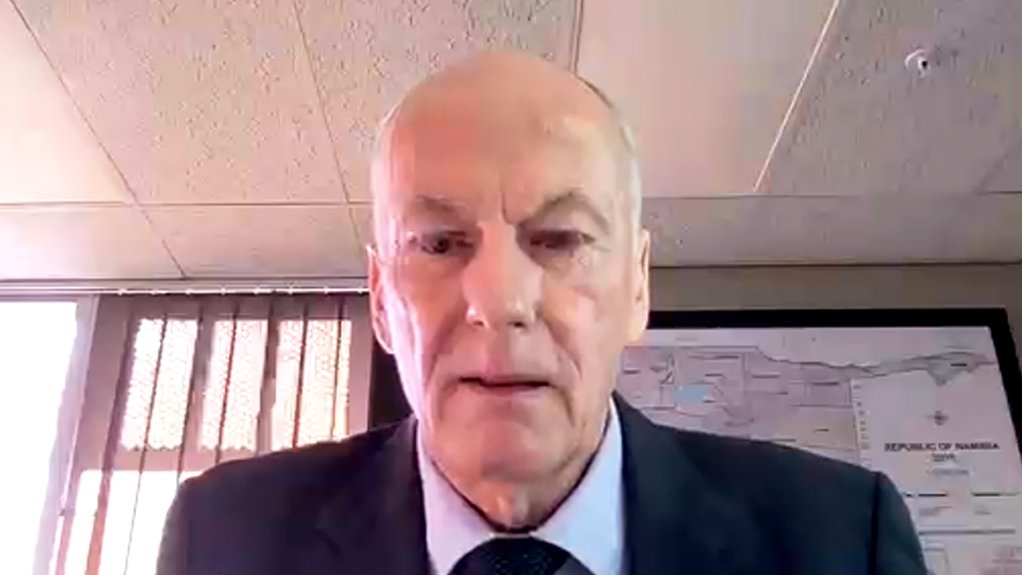
Green Hydrogen Atlas Africa data validation workshop covered by Mining Weekly’s Martin Creamer. Video: Darlene Creamer.
German Ambassador to Namibia Herbert Beck
Photo by Creamer Media



Green hydrogen, which can be generated and then used with the help of Southern Africa’s platinum group metals (PGMs), is a topic that has gained a lot of importance in recent months in the context of limiting global warming and meeting the world’s decarbonisation goals.
In Germany, the increased level of ambition in climate policy has made it necessary to re-estimate electricity consumption.
German Economics Minister Peter Altmaier presented this on July 13. Instead of 590 terawatt hours (TWh), Germany will consume, for example, owing to more electric cars and heat pumps, an estimated 645 TWh to 665 TWh of electricity in 2030.
To meet these requirements, green hydrogen will probably play an increasing role, not only to achieve Germany’s climate and energy targets by 2030 but also those of the European Union.
But the quantities of green hydrogen needed to meet production targets cannot be produced locally in Germany.
“The German government’s national hydrogen strategy, therefore, explicitly includes the development of training and logistics systems for green hydrogen and cooperation with developing and newly industrialised countries in establishing a global hydrogen economy,” German ambassador to Namibia Herbert Beck told the Hydrogen Atlas Africa Southern Africa regional data validation workshop this month.
The Go Green Go Africa data validation workshop was organised by Southern African Science Service Centre for Climate Change and Adaptive Land Management (Sasscal) executive director Dr Jane Olwoch, who also moderated the virtual event.
Beck said Germany’s national hydrogen strategy also includes a hydrogen partnership with Africa to export green hydrogen to Germany.
Following the development of a hydrogen atlas for West Africa being drafted within the framework of Sasscal’s West African sister organisation, the West African Science Service Centre on Climate Change and Adapted Land Use (Wascal), this month’s Southern African workshop served to compile and process the data for Southern Africa within the framework of Sasscal.
“There are two things that I want to emphasise. First, the German national hydrogen strategy is not a standalone project but explicitly links to existing energy partnerships and cooperations. However, the topic of hydrogen is to be given greater consideration in these.
“Second, Germany’s national hydrogen strategy is not only about its own security of supply and promoting the German economy due to our technological competence in the field of green hydrogen production.
“The German government is also concerned with supporting economic development in partner countries by supporting the build-up of a hydrogen industry both for export and to develop its own industries, while reducing dependence on fossil fuels,” Beck said.
In addition, in the medium term, Germany is aiming at creating an international market for green hydrogen and its derived products, which include platinum-catalysed fuel cells and platinum group metals- (PGMs-) using electrolysers.
“The more efficient this international market is, the more cost-effectively green hydrogen and its downstream products can be produced,” added Beck. Fuel-cell downstream development is already taking shape at the OR Tambo Special Economic Zone, in Gauteng, where fuel cell components manufacturer Isondo Precious Metals is installing PGMs beneficiation capability.
Asked by Engineering News & Mining Weekly when the atlas and the hot spots would be available for all to see, Olwoch replied that the data that had been collected from the 12 national team members would be validated shortly.
“They have already done their initial validation. The regional technical committee will look at it more critically . . . and from there we will have more engagements,” she added
In response to the same question, H2Atlas Project Coordinator Dr Solomon Agbo said: “What we are doing now in terms of the data validation is the first step in implementing the data for the atlas to be generated. After this phase, we will receive the data within our research centre here in Julich (Germany) and then we will have to implement within our algorithm and then generate the relevant information in the form of the atlas,” Agbo said.
SA Urged to Take Bold Decisions
In an article in a recent edition of the Sunday Times, Germany’s willingness to partner with South Africa in the production of green hydrogen is mentioned by former German ambassador to South Africa Martin Schäfer, who recently finished his second stint in the country.
The writer, Caiphus Kgosana, quotes Schäfer as urging the South African government to take bold decisions towards the energy transition, which could even make South Africa a net exporter of energy, while also creating a significant number of jobs.
Southern Africa’s hydrogen atlas project, which began in August last year, involves the 12 Southern African Development Community (SADC) countries of Angola, Botswana, eSwatini, the Democratic Republic of Congo, Malawi, Mauritius, Mozambique, Namibia, South Africa, Tanzania, Zambia and Zimbabwe.
Funded €5.7-million by the German Federal Ministry of Education and Research (BMBF), the aim is integrating the SADC region ahead of the opening up of a trillion-dollar-plus market going into the future.
Sasscal, the SADC’s implementation organisation for the promotion of the Paris Agreement and the reduction of greenhouse-gas emissions, is looking with conviction to the day when green hydrogen is in widespread use across SADC countries and the world as part of the global fight against climate change.
Article Enquiry
Email Article
Save Article
Feedback
To advertise email advertising@creamermedia.co.za or click here
Research Reports

Projects
Latest Multimedia
Latest News
Showroom
Established in 1983, the ASTPM is an industry association and representative body of the welded carbon steel tube and pipe manufacturers of South...
VISIT SHOWROOM
AirNox (Pty) Ltd is a level 1 BBBEE manufacturer of complete AdBlue® solutions for operators of SCR diesel engines and AUS40 across South Africa...
VISIT SHOWROOM

Announcements
What's On
Subscribe to improve your user experience...
Option 1 (equivalent of R125 a month):
Receive a weekly copy of Creamer Media's Engineering News & Mining Weekly magazine
(print copy for those in South Africa and e-magazine for those outside of South Africa)
Receive daily email newsletters
Access to full search results
Access archive of magazine back copies
Access to Projects in Progress
Access to ONE Research Report of your choice in PDF format
Option 2 (equivalent of R375 a month):
All benefits from Option 1
PLUS
Access to Creamer Media's Research Channel Africa for ALL Research Reports, in PDF format, on various industrial and mining sectors
including Electricity; Water; Energy Transition; Hydrogen; Roads, Rail and Ports; Coal; Gold; Platinum; Battery Metals; etc.
Already a subscriber?
Forgotten your password?
Receive weekly copy of Creamer Media's Engineering News & Mining Weekly magazine (print copy for those in South Africa and e-magazine for those outside of South Africa)
➕
Recieve daily email newsletters
➕
Access to full search results
➕
Access archive of magazine back copies
➕
Access to Projects in Progress
➕
Access to ONE Research Report of your choice in PDF format
RESEARCH CHANNEL AFRICA
R4500 (equivalent of R375 a month)
SUBSCRIBEAll benefits from Option 1
➕
Access to Creamer Media's Research Channel Africa for ALL Research Reports on various industrial and mining sectors, in PDF format, including on:
Electricity
➕
Water
➕
Energy Transition
➕
Hydrogen
➕
Roads, Rail and Ports
➕
Coal
➕
Gold
➕
Platinum
➕
Battery Metals
➕
etc.
Receive all benefits from Option 1 or Option 2 delivered to numerous people at your company
➕
Multiple User names and Passwords for simultaneous log-ins
➕
Intranet integration access to all in your organisation

