



South African mining returns to profitability, despite challenging environment – PwC

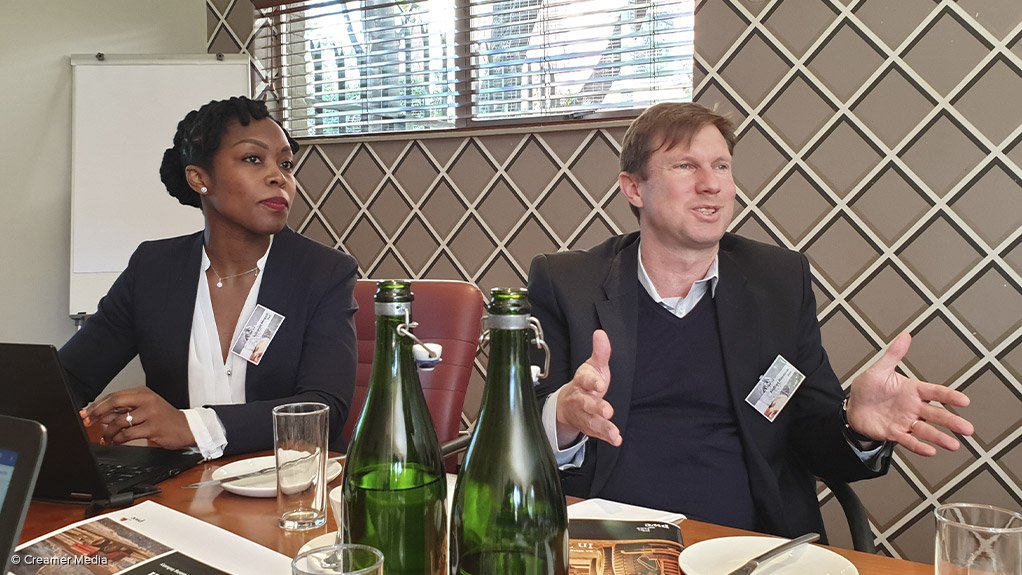
PwC partner and the report’s project leader Luyanda Mngadi (left) and PwC Africa energy utilities and resources leader Andries Rossouw (right) at the launch of the report
Photo by Creamer Media's Simone Liedtke


The South African mining industry returned to profitability this year, despite a challenging operating environment attributable to regulatory uncertainty, energy constraints, labour disputes, illegal mining activities and a skills shortage, PwC’s eleventh ‘SA Mine’ edition, published last week, shows.
PwC Africa energy utilities and resources leader Andries Rossouw said during a briefing that the industry reported a good performance during the year in spite of the speed of technological advance, climate change, sustainable operations and the changing of consumer behaviour defining some of the industry’s key risks.
While these should be “top of mind” for mining companies, he added that operating performance, investor sentiment and the global attractiveness of the industry continued to erode, with investors questioning whether the industry could create sustainable value for its stakeholders.
Because of this situation, Rossouw urged miners to “find a balance between stakeholder needs and long-term sustainable operations in their capital allocation decisions”.
He said that, in order to restore faith in an industry experiencing challenges, mining leaders would need to show that they were at the forefront of creating sustainable value for all stakeholders.
“By aligning financial and sustainable strategies to prioritise green-, customer- and community-focused strategies, further enabled by technology, [the industry] will help build a long-term vision of growth, access, equality, innovation and trust.”
PwC’s report highlights that, in 2019, South African miners’ total market capitalisation increased to R884-billion, well above the R482-billion market capitalisation of the prior year.
This was mainly due to the increase in market capitalisation of companies within the platinum group metals (PGMs) and gold sectors.
Gold and PGMs benefited from the improved rand price environment and continued to dominate the market capitalisation of the companies analysed and included in the report.
Total market capitalisation for gold increased by 133%, while market capitalisation for PGMs increased by 129%.
Despite a R65-billion increase in the market capitalisation of iron-ore miners and a R29-billion increase in the market capitalisation of diversified miners, the report laments that these increases were not enough to retain these segments’ proportionate share of market capitalisation.
The total revenue generated by the South African mining industry for the year ended June 30 was R529-billion. According to PwC, this was largely driven by increased PGM, iron-ore and manganese revenues.
However, gold revenue decreased as the higher rand gold price was not able to offset the decline in production.
According to Rossouw, this decline in gold production was “terminal” and was likely to continue, owing to miners not being able to keep up with increasing costs. This, he added, was also why South Africa had seen several mine closures recently.
Unless it becomes “easier and cheaper to mine”, Rossouw says, this downhill trajectory will continue.
Coal remained the biggest revenue generator, despite changing global consumer sentiment and contributed 28% of mining revenue for the year.
Capital expenditure increased by 10% year-on-year, mainly as a result of a weaker rand exchange rate. The gold sector was the largest contributor, with R34-million in capital expenditure in the current year, compared with R20-million in the platinum sector.
However, Rossouw noted that, while currency did play a “massive role” in revenue, the weaker rand did not support the long-term viability of the industry, and was considered only a short-term cash injection into the South African economy.
Meanwhile, operating costs increased by 8% year-on-year, driven by marginal increases in production, higher electricity and labour costs and inflationary increases in consumables and mining supplies.
According to the report, labour remains the largest cost driver in the sector and continues to grow as labour cost increases remain above inflation.
The average earnings before interest, taxes, depreciation and amortisation (Ebitda) margin of the 26 companies was 25%, which is marginally higher than the previous year’s 23%. Only six of the 26 companies have an Ebitda margin in excess of the average margin.
The total impairment amounted to about R22-billion, half of last year’s impairment, mainly as a result of ongoing platinum and gold impairments. Despite improved prices, the increased cost base of deep-level mines is still putting pressure on mines, the report states.
Additionally, in terms of production, the report highlights that manganese, iron-ore and chrome are the only commodities that have seen real production growth over the last 15 years. Iron-ore showed a decline during the year, while gold production experienced ongoing decline, despite the higher rand gold prices.
In turn, PwC said this mirrored the challenges of productivity in deep-level mining, which, Rossouw suggested, could be resolved by switching to a more mechanised and technological approach moving forward.
According to the report, there are several opportunities for companies that embrace and harness new technologies. Although investment in new technologies is costly, renewable energy to power mining operations is increasingly being recognised as a viable technology.
Consequently, this reduces emissions and could even lead to financial benefit as the cost of renewables is rapidly decreasing.
Coal production, meanwhile, saw a marginal increase on the prior year.
Investor Value
During the 2018 and 2019 financial period, mining companies continued to create value for their stakeholders on many fronts. This, PwC said, was done through distributions to shareholders, payments to suppliers of goods and services, royalties and taxes.
Value creation to shareholders grew to 12% in the current period, mainly as a result of the increased iron-ore prices and resultant dividends from iron-ore producers. Direct corporate taxes to governments decreased, owing to the timing of specific payments in the prior year.
According to PwC partner and the report’s project leader, Luyanda Mngadi, overall, mining companies were more exposed to the scrutiny of their stakeholders, owing to the significant impact their operations had on the communities in which they operated and society, in general.
“Mining companies need to keep creating the value they are known for and consider how their brand is communicated, especially considering their pervasive and key socioeconomic impact in rural communities,” she elaborated.
Reputation is key to mining’s social licence to operate, the report notes, adding that mining companies often operate in some of the most politically and socially challenging parts of the world, where the industry remains an important driver of economic growth.
In many cases, this results in mining companies and the local communities competing for the same resources, such as water and energy, the report adds.
It highlights that mining companies of the future will need to consider the viability of the minerals they mine, their mining and processing technologies, as well as energy sources for their operations.
They should also consider a two-pronged approach to climate change to ensure their businesses remain resilient and relevant, according to the report. The first is the need to reduce the current carbon-intensive areas of their businesses, while the second is the need for climate change adaptation.
Article Enquiry
Email Article
Save Article
Feedback
To advertise email advertising@creamermedia.co.za or click here
Research Reports

Projects
Latest Multimedia
Latest News
Showroom
The SAIMM started as a learned society in 1894 after the invention of the cyanide process that saved the South African gold mining industry of the...
VISIT SHOWROOM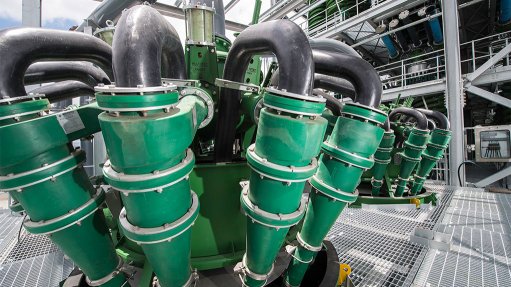
Multotec, recognised industry leaders in metallurgy and process engineering help mining houses across the world process minerals more efficiently,...
VISIT SHOWROOM
Press Office
Announcements
What's On
Subscribe to improve your user experience...
Option 1 (equivalent of R125 a month):
Receive a weekly copy of Creamer Media's Engineering News & Mining Weekly magazine
(print copy for those in South Africa and e-magazine for those outside of South Africa)
Receive daily email newsletters
Access to full search results
Access archive of magazine back copies
Access to Projects in Progress
Access to ONE Research Report of your choice in PDF format
Option 2 (equivalent of R375 a month):
All benefits from Option 1
PLUS
Access to Creamer Media's Research Channel Africa for ALL Research Reports, in PDF format, on various industrial and mining sectors
including Electricity; Water; Energy Transition; Hydrogen; Roads, Rail and Ports; Coal; Gold; Platinum; Battery Metals; etc.
Already a subscriber?
Forgotten your password?
Receive weekly copy of Creamer Media's Engineering News & Mining Weekly magazine (print copy for those in South Africa and e-magazine for those outside of South Africa)
➕
Recieve daily email newsletters
➕
Access to full search results
➕
Access archive of magazine back copies
➕
Access to Projects in Progress
➕
Access to ONE Research Report of your choice in PDF format
RESEARCH CHANNEL AFRICA
R4500 (equivalent of R375 a month)
SUBSCRIBEAll benefits from Option 1
➕
Access to Creamer Media's Research Channel Africa for ALL Research Reports on various industrial and mining sectors, in PDF format, including on:
Electricity
➕
Water
➕
Energy Transition
➕
Hydrogen
➕
Roads, Rail and Ports
➕
Coal
➕
Gold
➕
Platinum
➕
Battery Metals
➕
etc.
Receive all benefits from Option 1 or Option 2 delivered to numerous people at your company
➕
Multiple User names and Passwords for simultaneous log-ins
➕
Intranet integration access to all in your organisation

