


Sibanye looks forward to ‘more positive’ second half performance

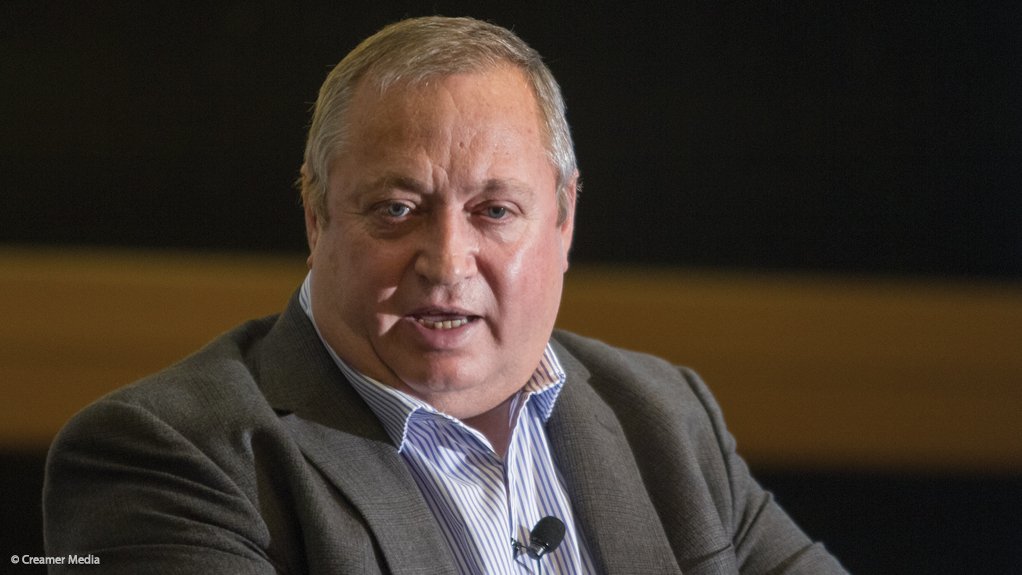


JOHANNESBURG (miningweekly.com) – Considering the impact of the extended strike at dual-listed Sibanye-Stillwater’s South African gold operations, which significantly disrupted operations during the six months to June 30, CEO Neal Froneman said the company had achieved “sound” operating and financial results for the interim period.
Improved results from the South African and US platinum group metals (PGM) operations had offset the losses from the South African gold operations.
Froneman on Thursday said the company had “successfully navigated” its way through a series of challenges in the interim period and had emerged in a stronger position.
Post the gold strike, a more measured and prolonged build-up at its South African gold operations was required to make operations production ready again, while ensuring these could safely resume operations.
Despite production for the second quarter of the year having increasing by 41% compared with the first quarter, Sibanye’s second-quarter financial performance improved only marginally owing to full labour costs and other overheads having been incurred in May and June.
With production having normalised from August, a turnaround in the financial performance of the South African gold operations is anticipated in the second half of this year, which Sibayne believes will enhance its financial performance, if the spot rand gold price persists at its current levels.
The hedging programme, which was initiated in the fourth quarter of 2017, to manage downside financial risk at the South African gold operations, was suspended in early June, following the suspension of the strike.
About 7 790 kg, or 250 545 oz, or 23% of normalised production over a 12-month period, had been hedged through zero cost collars with a floor price of R610 400/oz, and a cap price of R668 300/kg.
About 40% of the hedged production is due for delivery during the third quarter of this year, with the remaining 60% due over the following three quarters, providing about 90% exposure to the spot rand gold price from the third quarter of the year.
The South African gold operations are expected to produce between 16 000 kg and 17 000 kg, or between 514 411 oz and 546 562 oz, of gold at all-in sustaining costs (AISC) of between R590 000/kg and R630 000/kg, or between $1 350/oz and $1 450/oz for the second half of the year.
Production for the full-year is expected to be between 24 000 kg and 25 000 kg, or between 771 617 oz and 803 768 oz.
Capital expenditure (capex) for the South African gold operations for the full-year is forecast at about R2.3-billion, which includes about R220-million of project capital.
About R1.9-billion of the capex will be spent in the second half of the year.
Sibanye’s South African PGM operations, meanwhile, delivered steady operating results, with solid cost management delivering significant leverage to the increased rand PGM basket price and boosting financial results, Froneman remarked.
A 34% increase in the average rand PGMs basket price resulted in a 106% year-on-year increase in adjusted earnings before interest, taxes, depreciation and amortisation (Ebitda) to just over R2-billion, with the average adjusted Ebitda margin having increased to 33%.
Including the estimated adjusted Ebitda from the Rustenburg operations, pro-forma adjusted Ebitda from the South African PGM operations would have been R202-million higher at R2.2-billion.
Adjusted Ebitda and cash flow from the South African PGM operations for the second half of this year are likely to be substantially higher, Froneman noted, with the spot rand PGM basket price for platinum, palladium, rhodium and gold (4E) over R20 000/oz of 4E currently 15% higher than for the first half of the year.
The average rand basket price was R17 377/oz of 4E, compared with R12 941/oz in the prior comparable period, while the dollar basket price averaged $1 224/oz of 4E, compared with $1 051/oz in the prior comparable period.
PGM production from South Africa, excluding Marikana, remains unchanged, although yearly production is expected to be at the upper guidance of between one-million ounces and 1.1-million ounces.
AISC is forecast to be within the yearly guidance of between R12 500/oz and R13 200/oz of 4E.
Sibanye will invest about R1.4-billion in capex at the South African PGM operations for the full-year.
Touching on the ongoing platinum wage negotiations in South Africa, Froneman, during a webcast on Thursday afternoon, said that Sibanye would continue negotiating "in good faith" for fair wages which "enable the sustainability and retention of jobs".
Throughout the process, the miner intends on ensuring the use of a secret ballot to ensure that mine employees can express their wishes "without fear and intimidation", which is "critical", according to Froneman.
About 80% of Sibanye's PGM operations work force is represented by trade union Association of Mineworkers and Construction Union, who, in June, announced that it would be seeking a basic wage of R17 000 for its members.
Meanwhile, the US PGM operations delivered another robust and improved financial result and continued to provide valuable diversification benefits for the group, Sibanye reported on Thursday.
Despite a slow operational start to the year, adjusted Ebitda increased by 36% year-on-year to R2.9-billion.
A comprehensive plan to address the operational issues, which constrained production during the first quarter of the year, had been implemented, Sibanye said, adding that, with the operational performance for the second quarter, operations were much improved.
Further improvements are expected in the second half of the year.
At Blitz, the introduction of additional support in the form of cable anchors and shotcreting has resulted in the temporary slowdown in development and advance rates, negatively impacting on productivity.
As a result, Blitz is expected to remain behind plan for the remainder of the year.
Owing to the challenging ground conditions at Blitz, yearly production is now forecast to be between 625 000 oz of platinum and palladium (2E) and 640 000 oz of 2E, and marginally below the previous guidance range with AISC of between $740/2Eoz and $755/2Eoz.
The Fill-the-Mill (FTM) project remains on schedule, which together with the production build-up at Blitz, is expected to continue driving revenue higher and costs lower over the next two years.
Capex is expected to be at the lower end of guidance of between $235-million and $245-million.
Blitz’s operational challenges are expected to be temporary, and are not expected to impact on the production build-up at Blitz to about 300 000 oz of 2E by 2022, or the FTM project, which is forecast to add 45 000 oz of 2E to yearly production in 2021.
MARATHON PROJECT
In June, Sibanye announced that it had entered into agreement with Generation Mining (Gen Mining) for the further development of the Marathon PGM/copper project, in northern Ontario, Canada.
Sibanye-Stillwater received upfront proceeds of $3-million in cash and 11-million shares at a price of $0.2714 a share in Gen Mining, representing an equity interest of 12.9%, on closing of the transaction.
Gen Mining acquired a 51% interest in the Marathon project and formed an unincorporated joint venture (JV) with Stillwater Canada, a wholly-owned subsidiary of Sibanye-Stillwater.
The JV will enable Gen Mining to advance the Marathon project and to conclude further economic studies towards the development of the asset.
MARIKANA OPERATIONS
Meanwhile, Sibanye’s buyout of Lonmin provides the company’s South African PGM operations with full “mine-to-market” capability.
However, substantial work is required to address productivity levels at the Marikana underground operations, with production well below plan and operating costs unsustainably high, Froneman noted.
A review of the entire business, including the first-generation shafts slated for closure by Lonmin in December 2017, is under way and will be concluded during the third quarter of this year.
The Lonmin operations, referred to as the Marikana operations since acquisition, have been consolidated into the operating and financial results for the period, and will continue to be consolidated in the second half of the year.
This is expected to have a positive impact on production and financial metrics, as well as platinum and palladium reserves and resources.
OUTLOOK
The outlook for precious metal prices remains robust, with gold having broken decisively through major multiyear resistance levels at around $1 350/oz close to the end of the second quarter of the year, Froneman commented.
He added that palladium prices had also remained resilient “despite repeated pullbacks from speculative surges and platinum staging a modest recovery”.
He further noted that the rhodium price had continued to rise during the six months under review, reaching levels last seen a decade ago, owing to a sustained structural deficit in the market.
“Importantly, these developments are occurring in a relatively strong dollar environment, and have enabled the rand gold price to exceed the all-time record levels set in 2016 in a much weaker rand climate,” Froneman pointed out.
However, despite the potential risks to global growth arising from ongoing trade hostilities between the US and China, Froneman believes the fundamentals of the precious metal commodity markets remain structurally positive.
Under the current supportive precious metals price environment and with a more positive operational outlook, driven by the return to profitability of the South African gold operations, continued production growth at the US PGM operations, no major operational disruptions and the realisation of synergies from the Marikana operations, Froneman averred that Sibanye was positioned to generate significantly higher earnings and cash flow in the second half of the year and beyond.
In turn, this would facilitate rapid deleveraging.
Article Enquiry
Email Article
Save Article
Feedback
To advertise email advertising@creamermedia.co.za or click here
Research Reports

Projects

Latest Multimedia

Latest News
Showroom

For over 15 years, Lilak Aluminium, a trusted leader in architectural extrusion supply, has delivered excellence to businesses like yours.
VISIT SHOWROOM
ISO-certified Condra manufactures overhead cranes, portal cranes, cantilever cranes and crane components: hoists, drives, end-carriages, brakes and...
VISIT SHOWROOM

Announcements
What's On
Subscribe to improve your user experience...
Option 1 (equivalent of R125 a month):
Receive a weekly copy of Creamer Media's Engineering News & Mining Weekly magazine
(print copy for those in South Africa and e-magazine for those outside of South Africa)
Receive daily email newsletters
Access to full search results
Access archive of magazine back copies
Access to Projects in Progress
Access to ONE Research Report of your choice in PDF format
Option 2 (equivalent of R375 a month):
All benefits from Option 1
PLUS
Access to Creamer Media's Research Channel Africa for ALL Research Reports, in PDF format, on various industrial and mining sectors
including Electricity; Water; Energy Transition; Hydrogen; Roads, Rail and Ports; Coal; Gold; Platinum; Battery Metals; etc.
Already a subscriber?
Forgotten your password?
Receive weekly copy of Creamer Media's Engineering News & Mining Weekly magazine (print copy for those in South Africa and e-magazine for those outside of South Africa)
➕
Recieve daily email newsletters
➕
Access to full search results
➕
Access archive of magazine back copies
➕
Access to Projects in Progress
➕
Access to ONE Research Report of your choice in PDF format
RESEARCH CHANNEL AFRICA
R4500 (equivalent of R375 a month)
SUBSCRIBEAll benefits from Option 1
➕
Access to Creamer Media's Research Channel Africa for ALL Research Reports on various industrial and mining sectors, in PDF format, including on:
Electricity
➕
Water
➕
Energy Transition
➕
Hydrogen
➕
Roads, Rail and Ports
➕
Coal
➕
Gold
➕
Platinum
➕
Battery Metals
➕
etc.
Receive all benefits from Option 1 or Option 2 delivered to numerous people at your company
➕
Multiple User names and Passwords for simultaneous log-ins
➕
Intranet integration access to all in your organisation

