Refractometry allows for advanced development

CREATING STABILITY As unstable instruments lose their calibration throughout operation and can be difficult to recalibrate without sending them back to the manufacturer, achieving long-term stability through built-in drift control measures is a critical goal for process analytical instruments


Although the generation of green hydrogen using water electrolysis represents an exciting decarbonisation opportunity, the performance of electrolysers is heavily affected by the characteristics and stability of the electrolyser’s components, says measurement instruments manufacturer Vaisala.
As such, a group of engineers in Germany – including representatives from engineering services provider iChemAnalytics, electroplating specialist firm Dr.–Ing. Max Schlötter and coating service provider WHW Hillebrand – are developing a test bench for alkaline electrolysis.
A key factor affecting the success of the project is to accurately and reliably monitor electrolytes in an extremely aggressive solution. Following a global search for suitable technologies, the researchers found that Vaisala’s inline refractometers were suitable for the application.
“Durability of materials is a key consideration, since it determines the lifetime of the electrolyser and that, in turn, directly affects the return on investment for an electrolyser plant,” Vaisala product line manager Antti Heikkilä explains.
Any unplanned maintenance interruptions, Heikkilä points out, decrease plant uptime and, therefore, hydrogen production, while increasing operational costs, thereby decreasing profitability from a potential sales and cost perspective.
Achieving long-term stability is the “hardest part”, as unstable instruments that lose their calibration throughout the operation are difficult to recalibrate to ensure true readings without sending them back to the manufacturer. Returning the instruments for recalibration is not possible in most scenarios; therefore, achieving stability through built-in drift control measures is a critical goal for process analytical instruments.
“Another challenge is in the material selection and construction of wetted parts, since alkaline electrolytes are harsh chemicals. A simple transmitter with no moving parts and a minimal, easily cleaned contract surface with the liquid is preferrable over complex analyser systems,” Heikkilä states.
Measurement Technology
As each side of the membrane in the test bench electrolyser contains a potassium hydroxide (KOH) solution – a highly concentrated, strong and corrosive alkaline liquid that is typically 30% KOH and 70% water by weight – the KOH percentage on either side of the membrane changes during the electrolysis process.
This has adverse effects on the service life of the components and the phase boundary reactions within the cells, which has a direct influence on overall cell voltage, ageing rates and reaction efficiency.
Consequently, the project team conducted a global search for a technology that would could operate in such a challenging environment while delivering accurate and reliable KOH measurements.
The solution had to operate in 30% KOH at up to 80 °C and up to 5 bar – mounted in-line. These specifications ruled out most of the options, leaving either manual laboratory analysis or a small number of technologies based on refractometry or ultrasonics.
“Laboratory analysis was ruled out immediately because of the time taken to derive results, which would render process control, and, therefore, efficiency, impossible to achieve,” iChemAnalytics COO Kristian Macke explains.
The team evaluated continuous measurement options, and was particularly impressed by the support from Vaisala’s distributor, components and systems solution manufacturer Bühler Technologies.
Macke adds that the company had lent a Vaisala refractometer for a short period so that the project team could conduct a test in their laboratory.
Bühler Technologies also provided computer aided design files to help integrate the Vaisala device into the project team’s test bench, in addition to providing written confirmation that the refractometer is permanently resistant to KOH.
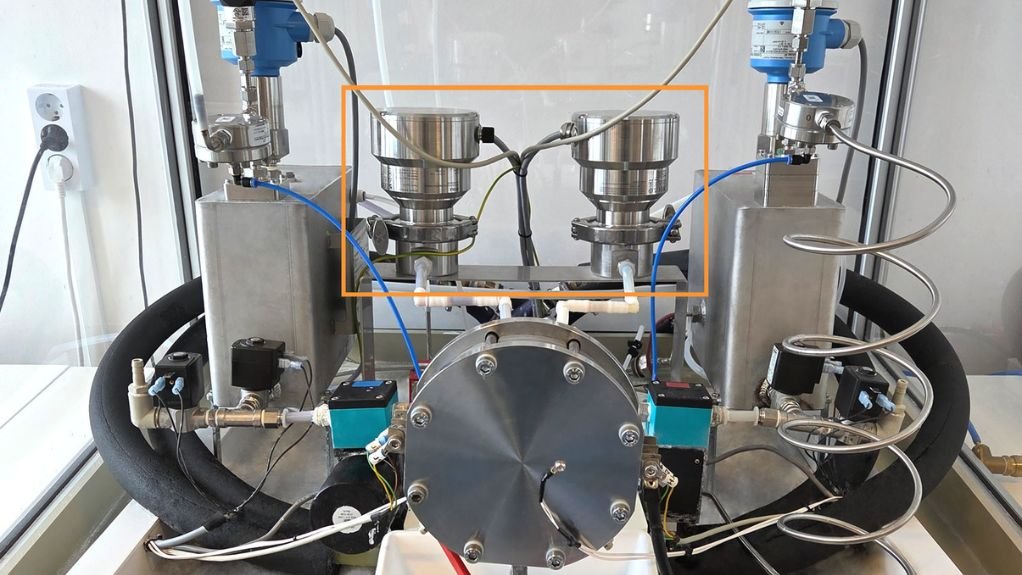
Following the confirmation, two Vaisala PR53AC inline refractometers were installed on the test bench, providing real-time KOH concentration measurements on both sides of the membrane.
“This was a significant investment for us, but we have been absolutely delighted with the performance of the Vaisala probes. They were delivered factory-calibrated and were almost plug-and-play. All we had to do was integrate their 4-20 mA output with our programmable logic controller,” says Macke.
Vaisala’s refractometers measure the angle of refraction of light in the process medium using an LED light source, while a sensor continually detects the critical angle at which the total reflection of light starts. This has a direct relationship with KOH concentration, Heikkilä explains.
In addition to operating in harsh conditions, one of the refractometers' main advantages is that they are not affected by suspended particles, bubbles or colour and, if employing an automatic prism wash with steam or high-pressure hot water, are also unaffected by scaling or fouling.
Project Progression
The development of a reliable test bench has enabled the project team to focus on the main objectives: to develop new high-performance electrolyser stacks with high-performance surface coatings. To that end, the test bench allows for accelerated stress testing, in a range of temperatures using different electrode coatings and electrode solutions.
“As more sustainable coatings are being developed, the new fully automated test bench will enable the team to optimise electrolysis equipment, materials and conditions in the pursuit of process efficiency,” Heikkilä states.
Further, Macke says KOH concentration measurement using the Vaisala refractometers is performing a “critically important role” in the test bench.
In line with the ultimate goal of developing new electrolyser stacks, another key objective is ensuring that the KOH ratio is automatically monitored and controlled, as this will be essential for optimising electrolyser components and efficiency.
“This project showcases how advanced measurement technology supports innovation in clean energy and accelerates the transition toward low-carbon solutions,” Heikkilä concludes.
Article Enquiry
Email Article
Save Article
Feedback
To advertise email advertising@creamermedia.co.za or click here
Research Reports

Latest Multimedia
Latest News
Showroom
ECG provides specialised electrical engineering services to the Mining, Utilities, Materials Handling and Industrial industries, with extensive and...
VISIT SHOWROOM
Mitsubishi Chemical Advanced Materials South Africa (Pty) Ltd is a leading manufacturer of high-performance engineering plastics for the mining...
VISIT SHOWROOM
Press Office
Announcements
What's On
Subscribe to improve your user experience...
Option 1 (equivalent of R125 a month):
Receive a weekly copy of Creamer Media's Engineering News & Mining Weekly magazine
(print copy for those in South Africa and e-magazine for those outside of South Africa)
Receive daily email newsletters
Access to full search results
Access archive of magazine back copies
Access to Projects in Progress
Access to ONE Research Report of your choice in PDF format
Option 2 (equivalent of R375 a month):
All benefits from Option 1
PLUS
Access to Creamer Media's Research Channel Africa for ALL Research Reports, in PDF format, on various industrial and mining sectors
including Electricity; Water; Energy Transition; Hydrogen; Roads, Rail and Ports; Coal; Gold; Platinum; Battery Metals; etc.
Already a subscriber?
Forgotten your password?
Receive weekly copy of Creamer Media's Engineering News & Mining Weekly magazine (print copy for those in South Africa and e-magazine for those outside of South Africa)
➕
Recieve daily email newsletters
➕
Access to full search results
➕
Access archive of magazine back copies
➕
Access to Projects in Progress
➕
Access to ONE Research Report of your choice in PDF format
RESEARCH CHANNEL AFRICA
R4500 (equivalent of R375 a month)
SUBSCRIBEAll benefits from Option 1
➕
Access to Creamer Media's Research Channel Africa for ALL Research Reports on various industrial and mining sectors, in PDF format, including on:
Electricity
➕
Water
➕
Energy Transition
➕
Hydrogen
➕
Roads, Rail and Ports
➕
Coal
➕
Gold
➕
Platinum
➕
Battery Metals
➕
etc.
Receive all benefits from Option 1 or Option 2 delivered to numerous people at your company
➕
Multiple User names and Passwords for simultaneous log-ins
➕
Intranet integration access to all in your organisation