


RBCT ready to boost junior coal exports in partnership with Transnet


The private-sector-owned Richards Bay Coal Terminal (RBCT) is keen to boost the export potential of emerging black coal juniors in close partnership with South Africa’s State-owned rail company, Transnet.
RBCT CEO Nosipho Siwisa-Damasane tells Mining Weekly that the RBCT is ready to work with Transnet in an “open-minded” way to ensure that an additional 19-million tons of coal export capacity is made available to South Africa’s emerging black coal mining juniors.
Transnet Freight Rail (TFR) last year transported more than 70-million tons of coal from inland mines to the coastal terminal, and Transnet National Ports Authority (TNPA) provided marine services to 730 vessels that called at the terminal to ship South African coal to users around the world.
“We would like to work with Transnet to come up with a model that satisfies everyone, [including] the emerging miners,” Siwisa-Damasane commented to Mining Weekly in the company of her eight-person executive team – six of them previously disadvantaged South Africans.
Currently able to export 91-million tons of coal a year, the RBCT has a prefeasibility study under way to increase the terminal’s capacity by another 19-million tons to 110-million tons for the express purpose of accommodating coal juniors.
Mining Weekly observed during its visit last week that Transnet and RBCT personnel already sit side by ide at the RBCT to optimise operational efficiency.
“In a supply chain, you can’t work in silos, and our biggest winner is that we’re communicating more operationally,” the RBCT CEO commented.
“Co-location”, which involves TFR personnel and RBCT personnel working collaboratively on train movements, has been under way as a 12-hour service for some time and may soon move to a 24-hour service.
The joint operational planning with TFR is providing touch points that enable personnel to analyse past shortcomings and plot future improvements.
Export targets are arrived at jointly and knowledge of what is being railed from mines can be rewarded by the terminal’s bypass facility, which allows incoming trains to bypass the standard system to get coal on ships faster.
The bypass advantage is expected to be taken up more frequently once train visibility is stepped up.
Currently, up to 14% of the coal arriving at the RBCT is “bypassed”directly on to waiting ships.
Issues that need to be dealt with include the better alignment of capital expenditure (capex) for future growth and operational expenditure for greater efficiencies in order to retain South Africa as a preferred coal source.
With its proposed Phase 6 expansion to 110- million tons yearly, the RBCT is in a position to avoid the big-ticket expenditure of an additional berth and make fuller use of existing berths and rail infrastructure, which will minimise capex.
Infrastructure that will be required for the increase to a 110-million-ton-a-year capacity includes an additional tippler, one more ship- loader, stockyard expansion and the reconfigur-ation of an existing substation.
This would meet the requirements of all aspirant coal exporters and give the RBCT a bulk-handing efficiency fillip.
TFR’s Shongololo rail service, launched in July, has reduced locomotive cycle times from 58 hours to 41 hours and wagon cycle times from 63 hours to 48 hours, all in the interests of getting the rail capacity to rise to the port’s higher export capacity.
Although 14 trains, each with 200 wagons, arrive at the terminal daily, the RBCT uses a 100-wagon yardstick and thus works on 28 trains of 100 wagons arriving daily.
According to that yardstick, 32 trains of 100 wagons each – or 250 000 t – are required to arrive daily to take up the 91-million-ton terminal capacity that the RBCT already has available for the South African coal-mining industry.
The terminal achieved the level of 250 000 t a day during the recent nine-day power outage period, proving that it can handle 35 trains of 100 wagons each daily.
The RBCT has reduced its 75-million-ton export target to 73-million tons as a result of the blackout.
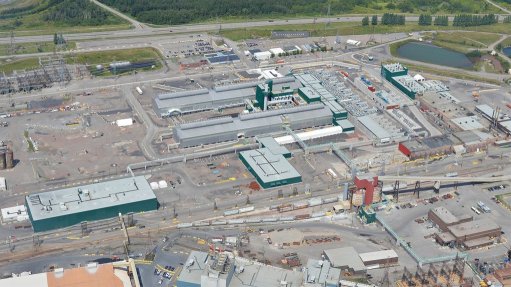
The 38-year-old terminal operates R7-billion worth of assets on a 276 ha site within the Port of Richards Bay.
The terminal has grown more than sevenfold since opening as a 12-million-ton-a-year facility in 1976.
Its 2.2-km-long quay has six berths and four shiploaders, which are supplied from a yard that is able to stock 8.2-million tons of coal and accommodate 38 different grades of coal.
Phase 6 plans cater for an additional 14 ha stockyard area and may accommodate additional grades, should the market demand it.
Trains are scheduled to the terminal from 49 loadout points in the Kwazulu-Natal and Mpumalanga provinces.
The RBCT’s five tipplers, which offload rail wagons at a rate of 5 500 t an hour, can unload a 100-wagon train in less than two hours.
Some 50 km of 2.2-m-wide belt conveyors, moving at a rate of up to 22 km an hour, transport most of the coal directly to 92 individual stock areas, where yard machines stockpile the coal at a rate of up to 6 000 t an hour.
Coal is reclaimed from the stockpiles at the same rate into four silos and then onto ships.
One shiploader can achieve a loading rate of 12 000 t an hour, a second is able to do 10 000 t an hour and the remaining two have a maximum load rate of 8 500 t an hour.
The RBCT’s centralised control system is in a 42-m-high control tower, from which stockyard machines are coordinated.
On the marine side, a new service-level agreement with TNPA is being forged.
Siwisa-Damasane’s significantly transformed general management team is made up of Alan Waller (finance), Jabu Mdaki (operations), Judith Nzimande (human resources), Bill Murphy (engineering), Kubendren Naidoo (maintenance), Zanele Mthiyane (health, safety, environment and community) and Casper Mbuyazi (legal, risk and compliance).
The 527-employee RBCT has a bursary scheme and GM Naidoo, who was a bursar, has risen up the ranks to become a member of the RBCT’s executive committee.
Mbuyazi runs a mathematics class for Grade 12, in which one of his students achieved a 100% pass.
Several women, who started as cleaners, are now working in the operations, with one becoming the terminal’s first female to be appointed senior operations manager.
“Transformation is our passion and we’re driving it,” Siwisa-Damasane said to Mining Weekly.
Environmentally, the terminal is virtually dust-free, which is a major feather in its cap.
Article Enquiry
Email Article
Save Article
Feedback
To advertise email advertising@creamermedia.co.za or click here
Research Reports

Projects

Latest Multimedia
Latest News
Showroom
For over 30 years, Werner South Africa Pumps & Equipment (PTY) LTD has been designing, manufacturing, supplying and maintaining specialist...
VISIT SHOWROOM
Your global lifecycle technology & service partner for materials & minerals processing equipment for coal, iron ore, copper, manganese & other...
VISIT SHOWROOM

Announcements
What's On
Subscribe to improve your user experience...
Option 1 (equivalent of R125 a month):
Receive a weekly copy of Creamer Media's Engineering News & Mining Weekly magazine
(print copy for those in South Africa and e-magazine for those outside of South Africa)
Receive daily email newsletters
Access to full search results
Access archive of magazine back copies
Access to Projects in Progress
Access to ONE Research Report of your choice in PDF format
Option 2 (equivalent of R375 a month):
All benefits from Option 1
PLUS
Access to Creamer Media's Research Channel Africa for ALL Research Reports, in PDF format, on various industrial and mining sectors
including Electricity; Water; Energy Transition; Hydrogen; Roads, Rail and Ports; Coal; Gold; Platinum; Battery Metals; etc.
Already a subscriber?
Forgotten your password?
Receive weekly copy of Creamer Media's Engineering News & Mining Weekly magazine (print copy for those in South Africa and e-magazine for those outside of South Africa)
➕
Recieve daily email newsletters
➕
Access to full search results
➕
Access archive of magazine back copies
➕
Access to Projects in Progress
➕
Access to ONE Research Report of your choice in PDF format
RESEARCH CHANNEL AFRICA
R4500 (equivalent of R375 a month)
SUBSCRIBEAll benefits from Option 1
➕
Access to Creamer Media's Research Channel Africa for ALL Research Reports on various industrial and mining sectors, in PDF format, including on:
Electricity
➕
Water
➕
Energy Transition
➕
Hydrogen
➕
Roads, Rail and Ports
➕
Coal
➕
Gold
➕
Platinum
➕
Battery Metals
➕
etc.
Receive all benefits from Option 1 or Option 2 delivered to numerous people at your company
➕
Multiple User names and Passwords for simultaneous log-ins
➕
Intranet integration access to all in your organisation

