



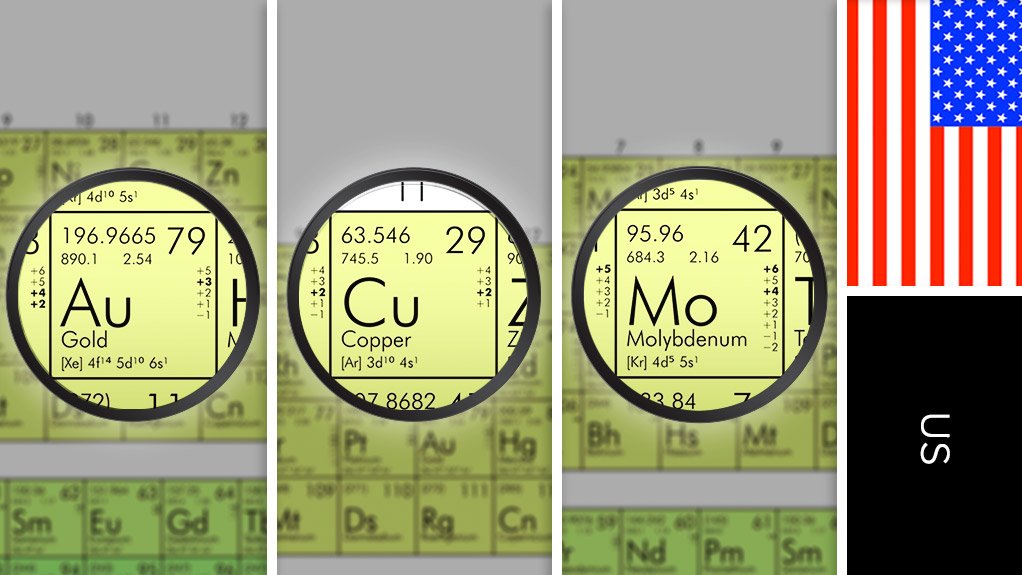
Pebble copper/gold/molybdenum project, US



Name of the Project
Pebble copper/gold/molybdenum project.
Location
South-west Alaska, US.
Project Owner/s
Pebble Limited Partnership (PLP), wholly owned by Northern Dynasty Minerals.
Project Description
The Pebble project is the world’s largest undeveloped copper and gold resource. The project’s tonnes, grade, metallurgy and geometry have the potential to support a modern, long-life mine.
The project’s current resource estimate includes 6.44-billion tonnes in the measured and indicated categories containing 57-billion pounds of copper, 70-million ounces of gold, 3.4-billion pounds of molybdenum and 344-million ounces of silver. The inferred category of 4.46-billion tonnes contains 24.5-billion pounds of copper, 37-million ounces of gold, 2.2-billion pounds of molybdenum and 170-million ounces of silver. The deposit also contains palladium and rhenium.
The PLP is proposing to develop the Pebble copper/gold/molybdenum porphyry deposit as an openpit mine, with associated on- and off-site infrastructure, including:
• a 230 MW power plant located at the mine site,
• a 134 km transport corridor from the mine site to a port site on the west side of Cook Inlet,
• a permanent, year-round port facility near the mouth of Amakdedori Creek on Cook Inlet, and
• a 303 km natural gas pipeline from the Kenai Peninsula to the Pebble project site.
The proposed mine will operate for about 20 years. This includes 14 years of mining using conventional drill-blast-shovel operations, followed by six years of milling material from a low-grade-ore stockpile. The mining rate will average 90-million tons a year, with 58-million tons of mineralised material being processed through the mill every year for an extremely low life-of-mine waste-to-ore ratio of 0.1:1.
Mine site facilities will include an openpit mine, tailings storage facilities (TSFs), a low-grade-ore stockpile, overburden stockpiles, quarry sites, water management ponds, milling and processing facilities, as well as supporting infrastructure such as the power plant, water treatment plants, camp facilities and storage facilities.
The openpit will be developed in stages and will eventually be 1 981 m long, 1 676 m wide and between 405 m and 533 m deep. A total of 1.2-billion tons of material will be mined, including 1.1-billion tons to be processed through the mill and 100-million tons of waste rock.
Nonpotentially acid-generating (non-PAG) waste rock will be used as construction material for on-site roads and TSFs embankments.
A small amount of waste rock considered non-PAG will be stored in a lined low-grade-ore stockpile until mine closure, at which time it will be back-hauled to the openpit for permanent subaqueous storage.
Mineralised material will be processed using conventional froth flotation. On average, the process plant will produce about 600 000 t/y of copper/gold concentrate containing an estimated 287-million pounds of copper, 321 000 oz of gold, 1.6-million ounces of silver and 15 000 t/y of molybdenum concentrate containing about 13-million pounds of molybdenum.
A TSF, located in the North Fork Koktuli drainage, will store 1.1-billion tons of tailings generated over 20 years of mine operations. About 88% will be non-PAG bulk tailings; the remaining 12% will be pyritic PAG tailings, which will be stored subaqueously in a separate, fully lined cell within the TSF. Four TSF embankments, ranging from 18.3 m (east embankment) to 183 m (main embankment) in height, will be developed, with centre-line or downstream construction methods used for all external embankments. A conservative 2.6:1 (horizontal:vertical) slope is targeted to ensure safety and stability under all operating conditions, including for maximum possible flood and seismic events.
Potential Job Creation
The Pebble project will directly employ about 2 000 workers during its four-year construction phase and an estimated 850 workers during its 20-year operations phase.
Net Present Value/Internal Rate of Return
Not stated.
Capital Expenditure
Capital expenditure on Pebble is estimated at between $6-billion and $8-billion.
Planned Start /End Date
Not stated.
Latest Developments
John Shively, who has returned as the CEO of the Pebble Partnership after Tom Collier resigned following the Pebble Tapes controversy, has said that his focus will be on earning back the trust that has been shattered.
Acknowledging that it is a long haul, Shively has said the journey will begin with small steps and has noted that Alaskans will ultimately respond to the mining company’s actions.
In the tapes, released by an environmental activist group, Collier and other mining executives discussed their influence over Republican Governor Mike Dunleavy and Alaskan politicians. In the conversations, company officials suggested that while they were seeking a permit for a 20-year operation, Pebble might expand for as long as 180 years.
Responding to questions about how long mining will take place, Shively noted that the mine is one of the most significant mineral discoveries in the world and that the company has been clear from the outset that there will be opportunities beyond the 20-year plan taken into permitting.
“. . . any future development at Pebble would have to go through its own full and robust permitting process,” he has emphasised, and has pointed out that there are no specific future plans currently contemplated.
Besides restoring trust, Shively will work to finalise the federal record of decision (ROD).
One of the key elements necessary for the US Army Corp of Engineers (USACE) to finalise the ROD was a mitigation plan.
The USACE in August said that the Pebble project could not be permitted without a wetlands mitigation plan, as the mine would have substantial environmental impacts within the Bristol Bay watershed.
Shively has confirmed that the company is on track to deliver a plan that meets the USACE’s requirements.
“Mining can be done at Pebble without harm to the Bristol Bay fishery. The final environmental impact statement reinforces this point. My fundamental principle when I started as CEO for Pebble in 2008 was that the project had to operate without harming the fishery or water resources of the region. I have sat through hundreds of hours of discussion and presentations that gave me the confidence the project can meet that goal,” Shively notes.
Opponents to the project say it will permanently damage the Bristol Bay watershed, an ecosystem that supports the world's largest salmon runs.
Key Contracts, Suppliers and Consultants
Wardrop Engineering (preliminary assessment report).
Contact Details for Project Information
PLP, tel +1 907 339 2600, fax +1 877 450 2600 or email receptionist@pebblepartnership.com.
Article Enquiry
Email Article
Save Article
To advertise email advertising@creamermedia.co.za or click here
Research Reports

Projects

Latest Multimedia
Latest News
Showroom
Sika South Africa is a trusted partner for the nation’s infrastructure, commercial, residential, and industrial sectors.
VISIT SHOWROOM
ECG provides specialised electrical engineering services to the Mining, Utilities, Materials Handling and Industrial industries, with extensive and...
VISIT SHOWROOM

Announcements
What's On
Subscribe to improve your user experience...
Option 1 (equivalent of R125 a month):
Receive a weekly copy of Creamer Media's Engineering News & Mining Weekly magazine
(print copy for those in South Africa and e-magazine for those outside of South Africa)
Receive daily email newsletters
Access to full search results
Access archive of magazine back copies
Access to Projects in Progress
Access to ONE Research Report of your choice in PDF format
Option 2 (equivalent of R375 a month):
All benefits from Option 1
PLUS
Access to Creamer Media's Research Channel Africa for ALL Research Reports, in PDF format, on various industrial and mining sectors
including Electricity; Water; Energy Transition; Hydrogen; Roads, Rail and Ports; Coal; Gold; Platinum; Battery Metals; etc.
Already a subscriber?
Forgotten your password?
Receive weekly copy of Creamer Media's Engineering News & Mining Weekly magazine (print copy for those in South Africa and e-magazine for those outside of South Africa)
➕
Recieve daily email newsletters
➕
Access to full search results
➕
Access archive of magazine back copies
➕
Access to Projects in Progress
➕
Access to ONE Research Report of your choice in PDF format
RESEARCH CHANNEL AFRICA
R4500 (equivalent of R375 a month)
SUBSCRIBEAll benefits from Option 1
➕
Access to Creamer Media's Research Channel Africa for ALL Research Reports on various industrial and mining sectors, in PDF format, including on:
Electricity
➕
Water
➕
Energy Transition
➕
Hydrogen
➕
Roads, Rail and Ports
➕
Coal
➕
Gold
➕
Platinum
➕
Battery Metals
➕
etc.
Receive all benefits from Option 1 or Option 2 delivered to numerous people at your company
➕
Multiple User names and Passwords for simultaneous log-ins
➕
Intranet integration access to all in your organisation

