



Nersa urged to reject Eskom’s ‘business as usual’ tariff application

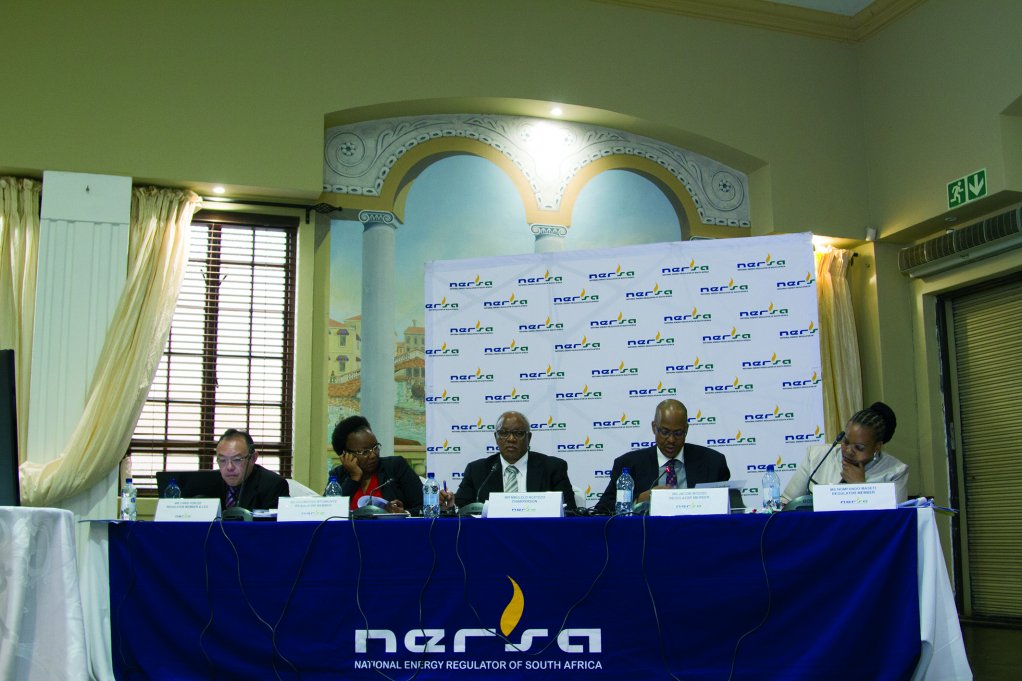
THE ADJUDICATORS Nersa's Chris Forlee, Khomotso Mthimunye, Mbulelo Ncetezo, Jacob Modise and Nomfundo Maseti at the Gauteng hearings
Photo by Duane Daws


The ‘business as usual’ stance adopted by Eskom in its application for another double-digit increase in tariffs for 2018/19 came under sustained attack during the Gauteng leg of the National Energy Regulator of South Africa’s (Nersa’s) public hearings.
Eskom interim CEO Sean Maritz kicked off the hearings with an appeal for the utility’s application for allowable revenue of R219.5-billion to be reviewed on its merits, rather than the “negative information that currently drives public opinion” about the utility. He described the application as an “honest representation” of the business and what was required for it to remain on a firm operational footing.
However, both Nersa panel members and presenter after presenter expressed deep unhappiness with Eskom’s failure to make material adjustments to its business model in a context of falling sales and a rising surplus, which was set to widen further with the introduction of new coal-fired capacity.
Falling Sales
The utility again revised its sales forecast for 2018/19, lowering it to 211 TWh, from the 216 TWh presented in its original application. Both forecasts represent a marked deviation from the 244 TWh of sales assumed by 2018 in the third multiyear price determination, or MYPD3.
As a consequence of the lower sales, Eskom acting CFO Calib Cassim indicated that, even with no increase in the allowable revenue, rebasing for the “more realistic” sales figure translated into a 9.4% tariff increase for 2018/19.
However, Eskom was also applying for an increase in its allowable revenue of R14.3-billion to cover higher operating, primary-energy, and independent power producer costs, as well as to cater for international power purchases.
Nersa chairperson Jacob Modise asked whether it was fair for consumers, and potentially the taxpayer (owing to Eskom’s solvency risks and a debt burden that would peak at R500-billion), to bear the burden of Eskom continuing on a business-as-usual trajectory.
He also questioned whether, in light of a surplus that could rise to close to above 8 000 MW, the utility should not be considering the decommissioning of expensive generation and even the curtailment of some of its capital projects.
Accelerated Decommissioning?
Such a scenario was presented in a new study by Meridian Economics, which argued that Eskom could make immediate costs savings, without undermining security of supply, by accelerating the decommissioning of three of its older coal-fired power stations and by halting construction of units 5 and 6 at the Kusile project, in Mpumalanga.
Meridian MD Dr Grové Steyn said the early decommissioning of Grootvlei, Hendrina and Komati and putting a halt to Kusile units 5 and 6, could yield net financial savings of between R15-billion and R17-billion.
At the hearings, several presenters also called for the utility to save costs by accelerating the decommissioning of expensive coal-fired generation and possibly by curtailing its build programme in light of indications that Eskom would be running a sizeable electricity surplus for the foreseeable future.
However, in its concluding remarks, Eskom showed little sign that it had been moved by appeals – made through 23 000 submissions to Nersa and oral presentations at hearings held in just about all the nine provinces
It did make some adjustments to its application in relation to expected sales volumes and costs associated with independent power producers (IPPs).
Eskom is now forecasting ‘standard tariff’ sales of only 188 TWh and ‘total sales’ of 211 TWh, as opposed to 216 TWh in its original application. It has also removed 6 305 GWh of IPP purchases, worth R7.1-billion in its revenue application, owing to delays in the introduction of renewables projects procured in 2015, but where contracts remained unsigned.
As a result, the tariff application has been moderated by R6.6-billion, lowering Eskom’s calculation of allowable revenue to R212.8-billion, from R219.5-billion in the original application. However, the lower standard tariff sales would still mean an average hike of 18.9% from April 1 and municipal increases of 26.9% from July 1.
However, the utility defended its decision not to accelerate the decommissioning of Camden, Hendrina, Komati and Grootvlei on the basis that it would not be prudent to withdraw the capacity until Medupi and Kusile were fully operational. It would only begin placing some of the station into cold reserve during 2019/20.
It also argued that it made “no business sense” to curtail construction of Medupi and Kusile, which had reached 84.7% and 82.6% project completion respectively.
Cassim stressed, too, that, as a State-owned company, Eskom’s business model was determined by policy. “Therefore, we don’t have the latitude to pursue only profitable customers or stop supplying nonpaying customers.”
The defence of the business model came in response to arguments by Business Unity South Africa (Busa) and the Energy Intensive Users Group that its operating model was “no longer fit for purpose” and was presenting a risk to both the economy and the national fiscus.
“Eskom is arguably the greatest risk to South Africa’s fiscal sustainability and its poor performance is increasing the risk of triggering a further ratings downgrade,” Busa’s Martin Kingston said.
He noted the concern expressed in the recent Medium-Term Budget Policy Statement that a failure by Eskom to secure a tariff increase would necessitate government assistance. “Such assistance will have a significant negative impact on the fiscus and the South African economy at large.”
Nevertheless, Busa did not believe the 19.9% hike to be justified, particularly in light of insufficient cost cutting by the utility to date.
Inflation-Linked Hike
“An inflation-linked increase may be justified, provided it can be motivated and that poor governance, mismanagement and corruption at Eskom are addressed, and a new board and competent and credible management are appointed,” Kingston said. Likewise, Sibanye-Stillwater senior VP Peter Turner said Eskom should immediately engage in aggressive cost-cutting and that Nersa should limit any increase to the rate of inflation.
The gold and platinum miner represents 2.9%, or 665 MW, of Eskom’s national demand and is one of the utility’s top five private customers.
“Electricity is a significant and growing portion of our operating cost and has contributed to the closing down of four shafts and 8 702 direct job losses in the last four years,” Turner reported. He added that a further double-digit hike would directly result in three additional shafts becoming loss- making.
However, Eskom rejected calls for its 2018/19 tariff to be capped at the level of inflation.
The utility argued that such a move would be financially unsustainable, as it would result in a revenue reduction, which would further squeeze its liquidity and could place the country’s credit rating at further risk.
Nersa full-time regulatory member for electricity Mbulelo Ncetezo described the decision ahead of the regulator as being a “very difficult one”. However, he promised that all submissions would be considered in coming to a determination.
Nersa expects to announce its decision on December 7.
Article Enquiry
Email Article
Save Article
Feedback
To advertise email advertising@creamermedia.co.za or click here
Research Reports

Projects
Latest Multimedia
Latest News
Showroom
ZF Aftermarket is the after-sales division of the world-renowned German ZF group, a global leader in mobility technology.
VISIT SHOWROOM
Complete range of security sealing solutions including security seals bags and labels.
VISIT SHOWROOM
Announcements
What's On
Subscribe to improve your user experience...
Option 1 (equivalent of R125 a month):
Receive a weekly copy of Creamer Media's Engineering News & Mining Weekly magazine
(print copy for those in South Africa and e-magazine for those outside of South Africa)
Receive daily email newsletters
Access to full search results
Access archive of magazine back copies
Access to Projects in Progress
Access to ONE Research Report of your choice in PDF format
Option 2 (equivalent of R375 a month):
All benefits from Option 1
PLUS
Access to Creamer Media's Research Channel Africa for ALL Research Reports, in PDF format, on various industrial and mining sectors
including Electricity; Water; Energy Transition; Hydrogen; Roads, Rail and Ports; Coal; Gold; Platinum; Battery Metals; etc.
Already a subscriber?
Forgotten your password?
Receive weekly copy of Creamer Media's Engineering News & Mining Weekly magazine (print copy for those in South Africa and e-magazine for those outside of South Africa)
➕
Recieve daily email newsletters
➕
Access to full search results
➕
Access archive of magazine back copies
➕
Access to Projects in Progress
➕
Access to ONE Research Report of your choice in PDF format
RESEARCH CHANNEL AFRICA
R4500 (equivalent of R375 a month)
SUBSCRIBEAll benefits from Option 1
➕
Access to Creamer Media's Research Channel Africa for ALL Research Reports on various industrial and mining sectors, in PDF format, including on:
Electricity
➕
Water
➕
Energy Transition
➕
Hydrogen
➕
Roads, Rail and Ports
➕
Coal
➕
Gold
➕
Platinum
➕
Battery Metals
➕
etc.
Receive all benefits from Option 1 or Option 2 delivered to numerous people at your company
➕
Multiple User names and Passwords for simultaneous log-ins
➕
Intranet integration access to all in your organisation

