



Mining BEE ownership to be tested in court – Minister

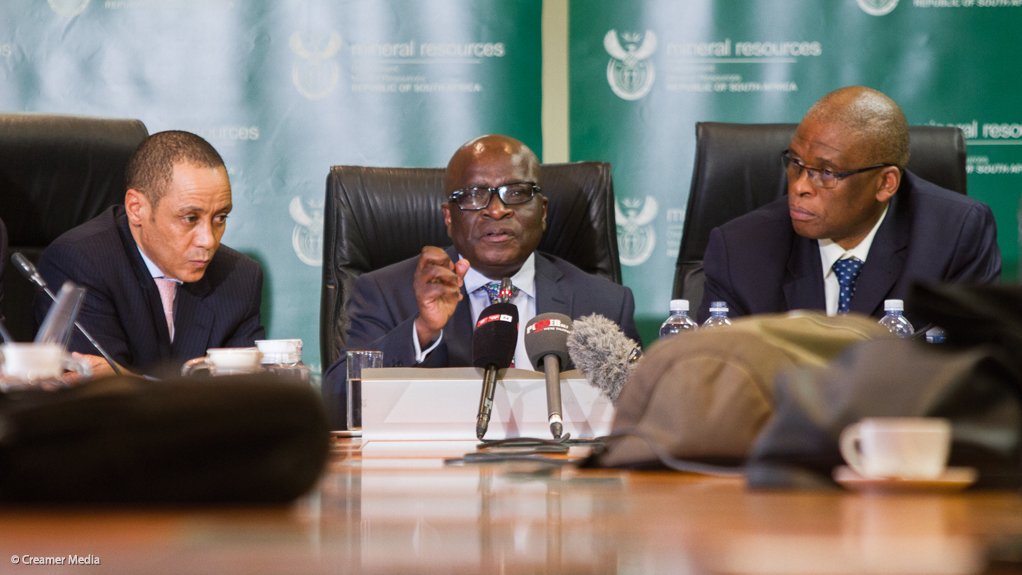
Minister Ngoako Ramatlhodi (centre), chamber's Mike Teke (left) and DMR DG Dr Thibedi Ramontja
Photo by Duane Daws


Government, organised mining and organised labour have agreed to work collaboratively to obtain a court ruling on the crucial issue of black economic-empowerment (BEE) ownership of mines, the only sticking point of last week’s Mining Charter deadline.
In an interim announcement on the outcome of government’s Mining Charter audit, Minerals Minister Ngoako Ramatlhodi told a packed media conference at the Department of Mineral Resources (DMR), in which Creamer Media’s Mining Weekly participated, that the ‘once empowered, always empowered’ principle would be the one charter aspect that would be tested in court.
Chamber of Mines president Mike Teke told the media conference that the chamber’s members, which represented 90% of South African mining output, were committed to seeing the court order being pursued.
“And we’ll be guided by it,” Teke assured, while reiterating the chamber’s commitment to growth and transformation.
“We welcome the Minister’s collaborative approach and are pleased that the DMR and the chamber have agreed to seek a declaratory order to resolve the difference of opinion relating to the ownership element of the charter,” Anglo American CEO Mark Cutifani said.
Harmony Gold, Anglo American Platinum and Kumba Iron Ore also put out statements wholeheartedly supporting the Minister.
The Minister reasoned that it was better to seek the wisdom of the courts than to impose a unilateral decision on a contentious issue.
“My sense is why not work collaboratively and agree. This is the shortest route to certainty,” Ramatlhodi commented during question time.
Making the announcement with representatives of labour and business on either side of him, the Minister said that the sole sticking point of a process that had indicated overwhelming industry support for transformation had been the issue of whether or not companies that were once BEE empowered remained BEE empowered in perpetuity.
The example was given of pre-2010-amendment BEE groupings deciding to sell their shares in companies and to move on, and of companies then being left with the dilemma of having to decide whether they were obliged to engage in another 26% BEE transaction in terms of the legislative amendment of 2010, or whether the ‘once empowered, always empowered’ principle applied.
The department wanted the court to clarify the ‘once empowered, always empowered’ 26% ownership position and also the 2010 amendment against the positioning 2004, when many BEE deals had already been entered into but with some BEE groupings then subsequently deciding to sell out, leaving the company with BEE credential queries.
“So, effectively, we’re dealing with two interpretations of what was meant in 2004 and what is meant now and that is the point of law to be clarified,” Ramatlhodi said during question time.
”Once the court gave its ruling, the ideal would be to negotiate outcomes to mitigate the possibilities of appeal.
“But I don’t think any one of us can guarantee that there won’t be any appeals because the industry is made up of individual mines and we are going to have to manage the outcome.
From the Ministerial side, the court ruling would enable the Ministry to discharge its obligations and allow it to show that South Africa had a justiciable Constitution and that it did not operate outside the law.
Ramatlhodi said that the process would have to move at speedily.
“We expect to approach the courts, probably next week, and perhaps even tomorrow,” he said.
There were deep interests, as evidenced by the creation of the Mining Industry Growth, Development and Employment Task Team, which none of the parties wanted hurt.
“Nobody wants to see the country bleed and I am hopeful that, in the midst of disagreements, everyone is looking for the middle of the road,” the Minister commented.
Consultative, collaborative and conclusive was the way to go, as government, business and labour were not adversaries but in many ways collaborators in the process of building the South African economy.
The final Mining Charter report was expected by the end of April and that was why the court was being approached on an urgent basis.
Mining companies that had not completed the online charter template were small in number and size, and unlikely to have the capacity to come up with transformation targets.
The chamber said its members had made considerable progress on all charter elements, including creating access to ownership, procurement and enterprise development, employment equity, human resource development, mine community development, improving living and housing conditions, and creating sustainable development in the mining industry by improving the environmental safety and health performance of the mining industry. The extent of change is profound and irreversible.
The only area of difference was the understanding of the ownership element.
The DMR’s understanding of this element indicates that empowerment transactions concluded after 2004 – where the BEE ownership level had fallen owing to BEE disposal of assets or for other reasons – should not be included in the calculation of progress made, which means that the DMR might find certain components of the mining sector not to have achieved the ownership target by definition.
The chamber, on the other hand, believes that previous deals should be included in the ownership calculation, as they represent meaningful economic participation by historically disadvantaged South African (HDSA) beneficiaries since before 2002.
The industry believes the charter does not require mining companies to maintain a 26% HDSA ownership once it has been achieved.
The exclusion of past HDSA transactions would result in a material misrepresentation of all the meaningful economic HDSA participation facilitated by mining companies in good faith and with the approval of the DMR.
The DMR, in issuing mining rights, had agreed to the transformation plans of the companies. In addition, the industry had met the original spirit and intent of the charter by broadening ownership and transferring significant value to BEE groups. The fact that various BEE companies had sold their assets in mining, or that the global financial crisis had materially impacted on the share price performance of companies should not be used to penalise the efforts of the mining companies to meet the objectives of the charter. From the chamber’s perspective, the mining industry had achieved the Mining Charter ownership targets, having provided meaningful economic participation for HDSAs represented through identifiable beneficiaries, substantial cash flow and full shareholder rights. In order to break the impasse, and to avert any confusion that might be damaging to investor perceptions, there had been a joint agreement that the court be approached to seek clarity on the matter. This would be done through a declaratory order, which would provide a ruling on the relevant legislation pertaining to the continuing consequences of the matter. “This is a proactive and necessary step to promote regulatory certainty for the mining industry and shows that both the DMR and the chamber recognise the need for the court to provide certainty,” the chamber added. The chamber fully supported the declaratory order process and would work with the DMR to get the court process under way as soon as possible. The industry invested significantly in transforming the sector, as agreed in the charter process that started in 2002, and believes that the transformational change has been both profound and substantial, and that the process towards normalising the country’s economic landscape is now irreversible.Article Enquiry
Email Article
Save Article
Feedback
To advertise email advertising@creamermedia.co.za or click here
Research Reports

Projects


Latest Multimedia


Latest News
Showroom
ZF Aftermarket is the after-sales division of the world-renowned German ZF group, a global leader in mobility technology.
VISIT SHOWROOM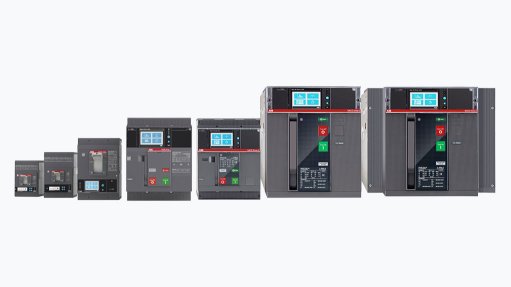
Electrifying the world in a safe, smart, and sustainable way, ABB Electrification is a global technology leader in electrical distribution and...
VISIT SHOWROOM

Announcements
What's On
Subscribe to improve your user experience...
Option 1 (equivalent of R125 a month):
Receive a weekly copy of Creamer Media's Engineering News & Mining Weekly magazine
(print copy for those in South Africa and e-magazine for those outside of South Africa)
Receive daily email newsletters
Access to full search results
Access archive of magazine back copies
Access to Projects in Progress
Access to ONE Research Report of your choice in PDF format
Option 2 (equivalent of R375 a month):
All benefits from Option 1
PLUS
Access to Creamer Media's Research Channel Africa for ALL Research Reports, in PDF format, on various industrial and mining sectors
including Electricity; Water; Energy Transition; Hydrogen; Roads, Rail and Ports; Coal; Gold; Platinum; Battery Metals; etc.
Already a subscriber?
Forgotten your password?
Receive weekly copy of Creamer Media's Engineering News & Mining Weekly magazine (print copy for those in South Africa and e-magazine for those outside of South Africa)
➕
Recieve daily email newsletters
➕
Access to full search results
➕
Access archive of magazine back copies
➕
Access to Projects in Progress
➕
Access to ONE Research Report of your choice in PDF format
RESEARCH CHANNEL AFRICA
R4500 (equivalent of R375 a month)
SUBSCRIBEAll benefits from Option 1
➕
Access to Creamer Media's Research Channel Africa for ALL Research Reports on various industrial and mining sectors, in PDF format, including on:
Electricity
➕
Water
➕
Energy Transition
➕
Hydrogen
➕
Roads, Rail and Ports
➕
Coal
➕
Gold
➕
Platinum
➕
Battery Metals
➕
etc.
Receive all benefits from Option 1 or Option 2 delivered to numerous people at your company
➕
Multiple User names and Passwords for simultaneous log-ins
➕
Intranet integration access to all in your organisation

