



Laser alignment solves the problem of shaft misalignment quickly and easily.



It’s estimated that more than one-third of all bearing failures – and up to half the cost of downtime – is caused by misaligned shafts in rotating machines and it’s all for the sake of a few microns. Such a tiny misalignment – either angular or offset – can introduce vibration, wear and failure in bearings and seals. It affects just about every type of machine, from motors and gearboxes to pumps and couplings.
Ensuring accurate shaft alignment will help to overcome this – and engineers are increasingly choosing to replace traditional methods such as straight edges and dial indicators with more accurate laser alignment systems.
Shaft misalignment comes in two forms: angular – in which the two shafts coupled together do not line up in parallel; and offset, in which the shafts are parallel but not in a straight line. In either case, the machine’s efficiency is reduced. There is also a third form of misalignment – a combination of both angular and parallel.
For this reason, it’s critical to align the shafts, and this can be done in a number of ways.
The cheapest and simplest – though also the least accurate – is the straight edge method, in which the couplings are aligned by laying a straight edge on top of them. Feeler gauges are used to measure the gap at the top and bottom of the coupling.
Dial indicators - which measure any offset between the halves of a coupling - can be used as the basis of several alignment methods, including: rim and face, which is generally applied to systems where only one shaft can be rotated; cross dial, which mounts two dial indicators 180 degrees apart to take shaft-to-shaft readings; and the similar reverse dial, which differs only in that the indicators are in the same plane.
In each case, dial indicators give accurate readings but can be complicated to use. Unless indicator stems are precisely positioned, errors can occur. Errors can also be introduced through coupling backlash, looseness and indicator bracket sag.
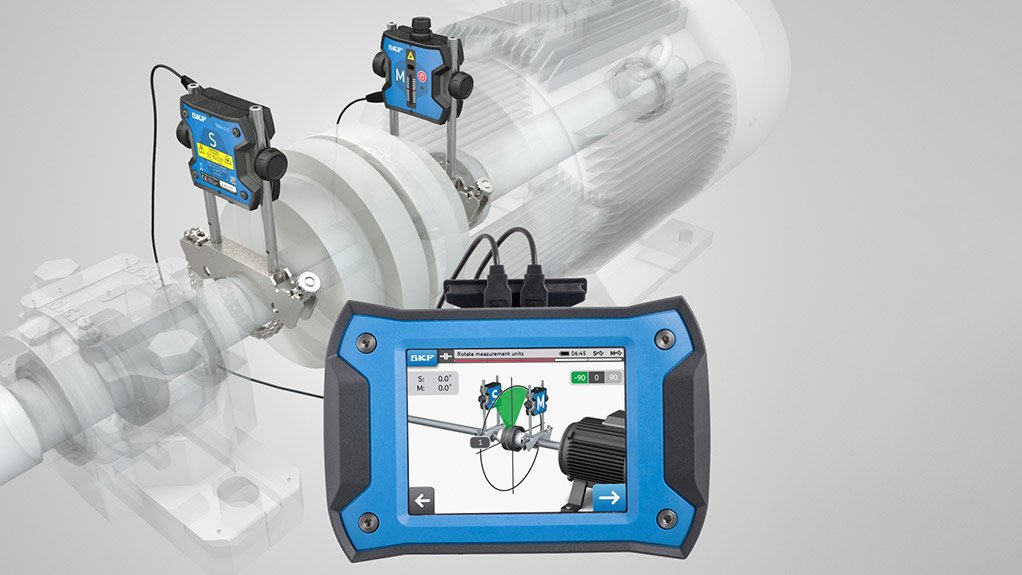
The latest laser alignment systems can help to overcome these problems, as they are highly accurate and easy to use. In principle, they work the same way as dial indicators. The system is mounted on both shafts, or to both sides of the coupling, and the shaft assessed in three separate positions. The laser measures the distance to the reference bar in each position, as it would with dial indicators. Misalignment causes this distance to change, and can be quantified.
Laser systems boast several advantages over traditional shaft alignment methods, including higher accuracy and greater ease of use. In general, they are intuitive to use – especially when used in conjunction with an app – and produce results that require no calculation.
These systems can be imbued with wireless communication to improve instrument handling. And, while more expensive than their traditional counterparts, this will quickly be offset by the reduction in a host of common problems: increased friction (and energy consumption); premature failure of bearings, seals, shafts and couplings; excessive seal lubricant leakage; and high levels of vibration and noise.
An example is the SKF shaft alignment tool TKSA 11, which incorporates a special app that guides a technician through the stages needed to correct the imbalance. It indicates what shims are needed to correct vertical alignment, and which movements are needed to make horizontal alignment corrections. A live view helps to achieve accurate positioning quickly. Results can then be shared for reference keeping or operator-driven reliability programmes. Variants of the system – for harsh environments, or with enhanced measurement and reporting – are also available.
If upgrading to a laser alignment system, it is tempting to look at the top of the range and a model that has wide functionality. But while laser systems are more expensive than traditional systems, they are available from entry level to high end.
Before purchasing a system, buyers should identify the exact applications where it is to be used – and draw up a list of requirements. Buying an expensive system that can handle virtually every eventuality is likely to prove a costly mistake, because technicians must be skilled in using it. A typical alignment task involves a horizontally placed electric motor with a pump or fan, joined using a single coupling. This needs to be quick and easy to use, with minimal set-up time – which a well-chosen laser alignment system will satisfy.
Article Enquiry
Email Article
Save Article
Feedback
To advertise email advertising@creamermedia.co.za or click here
Research Reports

Projects


Latest Multimedia


Latest News


Showroom

Established on 1 March, 2000, by Barries Barnard, Advanced Fire Suppression Technologies (AFST) and the Advanced Group stands as Sub-Saharan...
VISIT SHOWROOM
As one of South Africa's leading manufacturers, Bell Equipment distributes and exports its wide range of heavy equipment globally to mining,...
VISIT SHOWROOM


Announcements
What's On
Subscribe to improve your user experience...
Option 1 (equivalent of R125 a month):
Receive a weekly copy of Creamer Media's Engineering News & Mining Weekly magazine
(print copy for those in South Africa and e-magazine for those outside of South Africa)
Receive daily email newsletters
Access to full search results
Access archive of magazine back copies
Access to Projects in Progress
Access to ONE Research Report of your choice in PDF format
Option 2 (equivalent of R375 a month):
All benefits from Option 1
PLUS
Access to Creamer Media's Research Channel Africa for ALL Research Reports, in PDF format, on various industrial and mining sectors
including Electricity; Water; Energy Transition; Hydrogen; Roads, Rail and Ports; Coal; Gold; Platinum; Battery Metals; etc.
Already a subscriber?
Forgotten your password?
Receive weekly copy of Creamer Media's Engineering News & Mining Weekly magazine (print copy for those in South Africa and e-magazine for those outside of South Africa)
➕
Recieve daily email newsletters
➕
Access to full search results
➕
Access archive of magazine back copies
➕
Access to Projects in Progress
➕
Access to ONE Research Report of your choice in PDF format
RESEARCH CHANNEL AFRICA
R4500 (equivalent of R375 a month)
SUBSCRIBEAll benefits from Option 1
➕
Access to Creamer Media's Research Channel Africa for ALL Research Reports on various industrial and mining sectors, in PDF format, including on:
Electricity
➕
Water
➕
Energy Transition
➕
Hydrogen
➕
Roads, Rail and Ports
➕
Coal
➕
Gold
➕
Platinum
➕
Battery Metals
➕
etc.
Receive all benefits from Option 1 or Option 2 delivered to numerous people at your company
➕
Multiple User names and Passwords for simultaneous log-ins
➕
Intranet integration access to all in your organisation

