Incentives key to formalising artisanal gold mining

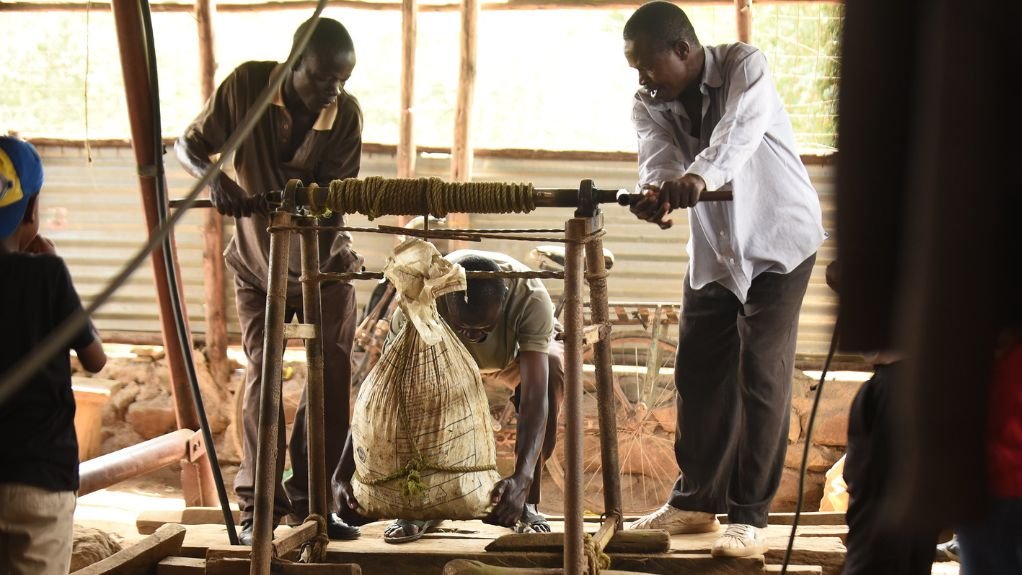

MINERS' VULNERABILITIES Artisanal and small scale mining often takes place in areas characterised by extreme poverty, weak legal frameworks and limited infrastructure, creating vulnerabilities for miners and exposing them to organised crime, armed groups and other illicit ongoings
JOHN MULLIGAN The Global Coalition for Action on Artisanal and Small-scale Gold Mining aims to develop scalable good practices that can be applied across different jurisdictions despite the wide variation in how artisanal mining is conducted



Creating incentives that allow artisanal and small-scale miners of gold to earn more from their work while improving environmental and social practices is central to efforts to formalise the sector, says market development organisation World Gold Council (WGC) sustainability strategy head John Mulligan.
Artisanal and small scale mining- (ASM-) linked gold mining has expanded significantly as rising gold prices have increased the value of the activity, especially in regions where alternative livelihoods are limited, he explains.
ASM often takes place in areas characterised by extreme poverty, weak legal frameworks and limited infrastructure, creating vulnerabilities for miners and exposing them to organised crime, armed groups and other illicit ongoings, adds Mulligan.
Because the ASM sector supports more people than legitimate mining does, Mulligan says the associated challenges have also grown.
“There have to be efforts to improve conditions in the sector and this begins with identifying what responsible artisanal and small-scale mining looks like in environments where regulation and enforcement capacity may be limited,” he explains.
As such, Mulligan says a key priority of these efforts is creating incentives that encourage ASM miners to adopt better practices while ensuring they receive fair value for their gold.
Here, one of the approaches being explored involves centralised processing facilities, where miners can bring ore for treatment rather than using mercury to extract gold in the field themselves, and in so doing reducing health and safety risks for both the miners and the environment around them.
Mercury-based minerals extraction is also inefficient, recovering only about 40% to 50% of the gold contained in ore, while modern industrial processing facilities can recover about 95%.
“The higher recovery rates provide miners with a direct financial incentive to use centralised facilities, while also reducing mercury pollution – a significant contributor to global mercury contamination,” he says.
Moreover, linking the ASM sector to formal markets and processing facilities helps ASM miners secure fairer prices for their gold and also provides a mechanism to encourage improved environmental and safety practices, says Mulligan.
In establishing the ASM and formal sector linkage, he says central banks can and need to play a bigger role, purchasing domestically produced ASM gold through formal buying programmes that could be used to exert positive influence at the point of collection by requiring miners to meet certain standards before their gold can be purchased.
However, Mulligan says achieving meaningful progress in these approaches requires solutions that can be implemented at scale.
Formalisation Initiatives
While ASM formalisation such as Fairtrade Gold, Fairmined Gold and Swiss Better Gold have sought to improve conditions in ASM, Mulligan says that they have generally remained limited in scope and have not yet succeeded in bringing significant volumes of artisanal gold into mainstream global trading systems.
To address this, the WGC has helped establish the Global Coalition for Action on Artisanal and Small-scale Gold Mining, alongside the World Bank and the Intergovernmental Forum on Mining.
This coalition aims to develop scalable good practices that can be applied across different jurisdictions despite the wide variation in how ASM is conducted.
However, because some artisanal operations consist of individuals working with basic tools, while others are highly mechanised and resemble industrial mining operations, standardisation of operations becomes difficult.
The challenges associated with ASM also contribute to illicit gold flows, which Mulligan says pose reputational risks for the broader gold market, as gold functions both as a mined commodity and a monetary asset, meaning maintaining trusted chains of custody and market confidence are essential.
This factor complicates matters, as illicit gold flows can lead policymakers and governments to view the gold market differently if ASM product enters formal channels, despite the existence of formal, regulated supply chains that operate under transparent responsible mining standards.
Because of historic and stubborn remaining linkages between ASM and criminal groups, any long-term investment and sustainability initiatives can be undermined as a result of the associated creation of instability and uncertainty in such sectors, he says. In turn, this instability can affect the ability of responsible mining companies to invest in ASM infrastructure, renewable-energy projects and other initiatives intended to support local economic development and community resilience.
Therefore, addressing ASM challenges requires a combination of local solutions, formal purchasing mechanisms and international collaboration to encourage responsible practices while creating viable economic opportunities for miners, concludes Mulligan.
Article Enquiry
Email Article
Save Article
Feedback
To advertise email advertising@creamermedia.co.za or click here
Research Reports

Projects
Latest Multimedia

Latest News


Showroom
We partner growth of our select clients through our comprehensive and competitive integrated international logistics, trade finance and information...
VISIT SHOWROOM
Occupational health services, mobile clinics, wellness campaigns, aviation.
VISIT SHOWROOM

Press Office
Announcements
What's On
Subscribe to improve your user experience...
Option 1 (equivalent of R125 a month):
Receive a weekly copy of Creamer Media's Engineering News & Mining Weekly magazine
(print copy for those in South Africa and e-magazine for those outside of South Africa)
Receive daily email newsletters
Access to full search results
Access archive of magazine back copies
Access to Projects in Progress
Access to ONE Research Report of your choice in PDF format
Option 2 (equivalent of R375 a month):
All benefits from Option 1
PLUS
Access to Creamer Media's Research Channel Africa for ALL Research Reports, in PDF format, on various industrial and mining sectors
including Electricity; Water; Energy Transition; Hydrogen; Roads, Rail and Ports; Coal; Gold; Platinum; Battery Metals; etc.
Already a subscriber?
Forgotten your password?
Receive weekly copy of Creamer Media's Engineering News & Mining Weekly magazine (print copy for those in South Africa and e-magazine for those outside of South Africa)
➕
Recieve daily email newsletters
➕
Access to full search results
➕
Access archive of magazine back copies
➕
Access to Projects in Progress
➕
Access to ONE Research Report of your choice in PDF format
RESEARCH CHANNEL AFRICA
R4500 (equivalent of R375 a month)
SUBSCRIBEAll benefits from Option 1
➕
Access to Creamer Media's Research Channel Africa for ALL Research Reports on various industrial and mining sectors, in PDF format, including on:
Electricity
➕
Water
➕
Energy Transition
➕
Hydrogen
➕
Roads, Rail and Ports
➕
Coal
➕
Gold
➕
Platinum
➕
Battery Metals
➕
etc.
Receive all benefits from Option 1 or Option 2 delivered to numerous people at your company
➕
Multiple User names and Passwords for simultaneous log-ins
➕
Intranet integration access to all in your organisation