



How Clean Is Your Fuel?

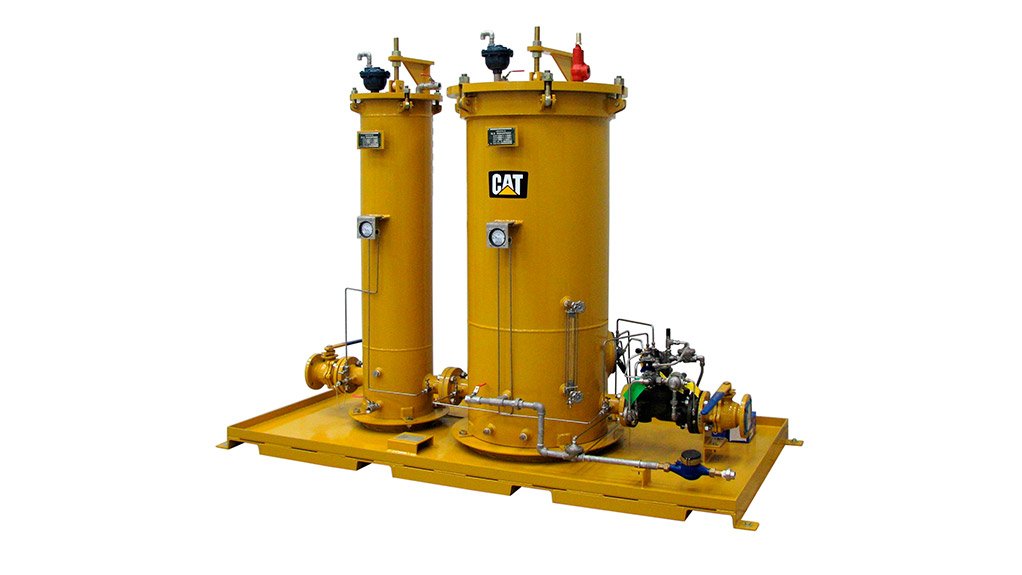


Company Announcement - The importance of effective bulk storage practices and filtration. Fuel represents the largest operating expense on any mine site, so its correct storage and cleanliness needs to be carefully managed to ensure that it remains free of contaminants caused, typically, by dirt or water ingress. Dirty fuel, for example, causes accelerated wear and failure of fuel injectors, leading to unscheduled and costly downtime for their replacement. In contrast, injectors in engines using clean fuel typically last through the full engine life cycle to overhaul. Distilled fuel leaves the refinery very clean. However, fuel picks up contaminants during shipment and storage between the refinery and the time it is consumed.
“Fuel quality can also be severely degraded after it is delivered to the user’s storage tank if there is evidence of poor tank design or maintenance practices,” explains Barloworld Equipment group product specialist, Reuben Phasha. (Barloworld Equipment is the Cat dealer for southern Africa.)
Coalescers: an essential quality gateway
In order to keep most of the contaminants out, fuel should be filtered as it goes into the storage tank. Coalescer filtration systems are the ideal solution, and have been the standard method to clean large volumes of fuel in the airline and petroleum industry for more than 40 years. Caterpillar offers a specially designed line of coalescers in four different capacities, namely 190, 379, 757 and 1135 litres per minute. Each unit is skid mounted, self-contained, and requires no electrical power. They are designed to remove solid particles and water with single pass filtration, matching the flow requirements of the fuel delivery system.
Machine filtration
The second line of defence is the machine’s onboard filtration system. The standard fuel filtration arrangement on machines is designed to act as a final cleaning step for moderately clean supply fuel of ISO 18/16/13 or cleaner, with water content of 0.05% (500 ppm) or less. The standard fuel filtration arrangement is not designed to clean very dirty or water-laden fuel. If diesel is to be cleaned by the machine fuel system (in the absence of a coalescer) additional filtration capacity must be added. This includes a water separator and additional filters. The amount of additional filtration required depends on the level of fuel contamination and the risk of filter plugging between scheduled service intervals. Standard filtration arrangements on machines vary. A typical standard arrangement on a Cat 3500 series diesel engine would contain the following:
• Two 10 micron absolute primary filters in parallel; and
• Two 4 micron absolute secondary filters in parallel
Additional filtration may include changing the primary filters to combination primary filter / water separators. However, these are barrier type separators that capture only large water droplets, which accumulate in the bottom of the filter housing. The filter must be periodically drained in order to prevent the water level from reaching the filter media. “If this occurs, fuel flow will push the water through the media and cause fuel injector damage or failure,” says Phasha. “The amount of water in the fuel determines how often the separators need to be drained or how many separators need to be added.” Either way, draining the machine’s fuel tank of particulates and water routinely according to the Cat Operation and Maintenance Manual is an important preventative maintenance practice. “How often this needs to be done will depend on the cleanliness and handling of bulk fuel,” he adds.
Article Enquiry
Email Article
Save Article
Feedback
To advertise email advertising@creamermedia.co.za or click here
Research Reports

Projects
Latest Multimedia


Latest News
Showroom

CMTS is a leading, well-established EC&I contractor with 37+ years of mining and industrial experience. We execute full-scope EC&I projects with...
VISIT SHOWROOM
ZF Aftermarket is the after-sales division of the world-renowned German ZF group, a global leader in mobility technology.
VISIT SHOWROOM
Announcements
What's On
Subscribe to improve your user experience...
Option 1 (equivalent of R125 a month):
Receive a weekly copy of Creamer Media's Engineering News & Mining Weekly magazine
(print copy for those in South Africa and e-magazine for those outside of South Africa)
Receive daily email newsletters
Access to full search results
Access archive of magazine back copies
Access to Projects in Progress
Access to ONE Research Report of your choice in PDF format
Option 2 (equivalent of R375 a month):
All benefits from Option 1
PLUS
Access to Creamer Media's Research Channel Africa for ALL Research Reports, in PDF format, on various industrial and mining sectors
including Electricity; Water; Energy Transition; Hydrogen; Roads, Rail and Ports; Coal; Gold; Platinum; Battery Metals; etc.
Already a subscriber?
Forgotten your password?
Receive weekly copy of Creamer Media's Engineering News & Mining Weekly magazine (print copy for those in South Africa and e-magazine for those outside of South Africa)
➕
Recieve daily email newsletters
➕
Access to full search results
➕
Access archive of magazine back copies
➕
Access to Projects in Progress
➕
Access to ONE Research Report of your choice in PDF format
RESEARCH CHANNEL AFRICA
R4500 (equivalent of R375 a month)
SUBSCRIBEAll benefits from Option 1
➕
Access to Creamer Media's Research Channel Africa for ALL Research Reports on various industrial and mining sectors, in PDF format, including on:
Electricity
➕
Water
➕
Energy Transition
➕
Hydrogen
➕
Roads, Rail and Ports
➕
Coal
➕
Gold
➕
Platinum
➕
Battery Metals
➕
etc.
Receive all benefits from Option 1 or Option 2 delivered to numerous people at your company
➕
Multiple User names and Passwords for simultaneous log-ins
➕
Intranet integration access to all in your organisation

