Energy Uncertainty in 2026: What Rising Tariffs and Slow Grid Reform Mean for Supply Chains


This article has been supplied and will be available for a limited time only on this website.
South Africa may have largely moved beyond the sustained phases of loadshedding that defined recent years, but energy costs continue to climb. In March 2026, the National Energy Regulator of South Africa (NERSA) approved electricity tariff increases of 8.76% for Eskom direct customers and 9.01% for municipal customers for the 2026/27 financial year, adding further pressure to businesses already grappling with rising operating and logistics costs.
For procurement and supply chain leaders, the challenge in 2026 is no longer simply keeping operations running during scheduled power outages. It is managing the growing cost, reliability and risk implications of an energy system that remains under pressure.
"Energy uncertainty has not disappeared; it has evolved," says Paul Vos, Regional Managing Director of the Chartered Institute of Procurement & Supply (CIPS) Southern Africa.
"Today, organisations are increasingly dealing with infrastructure failures, maintenance backlogs and localised network disruptions, particularly at municipal level, that are often less predictable than loadshedding itself. From a supply chain perspective, unpredictability creates significant operational risk."
The impact is being felt across supplier networks. Electricity tariffs continue to rise above inflation, while fuel costs remain a major concern for transport, logistics and backup generation requirements.
"This creates a double cost pressure," explains Vos. "Suppliers are facing higher energy costs and higher logistics costs simultaneously. As a result, procurement teams are seeing greater pricing volatility, more requests for contract adjustments and increased pressure on budgets."
The sectors most exposed include heavy manufacturing, food production and processing, cold-chain logistics and refrigeration-based supply chains, mining, chemicals, water infrastructure and other energy-intensive industries that underpin essential goods supply chains.
Many manufacturers have attempted to absorb a portion of these increases through efficiency improvements and operational adjustments. However, there are limits to what businesses can absorb before costs begin filtering through the value chain.
"We continue to see gradual price increases across a range of products and services," says Vos. "Ultimately, a significant portion of energy-related cost escalation finds its way to customers and consumers."
In response, organisations are adopting more proactive procurement strategies focused on resilience rather than cost alone. Supplier diversification, nearshoring, regional sourcing, scenario planning and enhanced cost modelling are becoming increasingly common.
"Procurement is shifting from a transactional function to a resilience enabler," says Vos. "Energy risk is increasingly being built into supplier selection and sourcing decisions, alongside traditional supplier evaluation criteria such as quality, delivery and price."
Renewable energy is also emerging as a critical part of the solution.
Businesses are increasingly exploring power purchase agreements (PPAs), embedded solar generation, battery storage and hybrid energy models to reduce reliance on grid infrastructure while improving long-term cost predictability.
"The conversation around renewable energy has changed," says Vos. "For many organisations, it is no longer primarily a sustainability initiative. It is a business continuity and resilience strategy."
Contract management is becoming equally important.
According to Vos, procurement contracts need to evolve to reflect a more volatile operating environment. Mechanisms such as energy-linked escalation clauses, agreed pricing thresholds, open-book costing models, risk-sharing mechanisms and structured review periods can help both buyers and suppliers manage risk more effectively.
"The objective is to ensure that risk is allocated fairly and managed transparently across the supply chain," he explains.
Looking ahead, CIPS Southern Africa believes procurement leaders must treat energy insecurity as a strategic business issue rather than an operational concern.
Short-term priorities include conducting energy-risk assessments across supplier networks, identifying high-exposure categories and strengthening supplier engagement. Longer term, organisations will need to embed energy risk into category strategies, build stronger supplier partnerships and align procurement decisions with broader energy-transition objectives.
"Energy is no longer simply a facilities issue," says Vos. "It has become a core supply chain risk that requires coordinated leadership across procurement, finance and operations."
As South Africa's energy challenges evolve, the organisations best positioned for long-term success will be those that embed resilience into procurement decisions, supplier strategies and operational planning, rather than treating energy risk as a standalone operational concern.
Article Enquiry
Email Article
Save Article
Feedback
To advertise email advertising@creamermedia.co.za or click here
Research Reports

Projects
Latest Multimedia
Latest News
Showroom
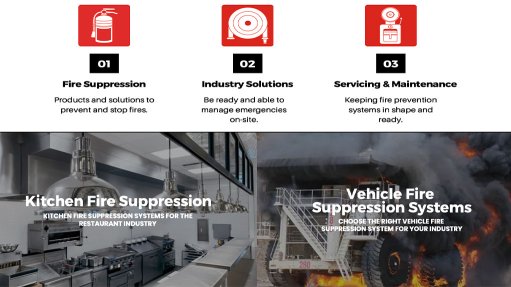
Established on 1 March, 2000, by Barries Barnard, Advanced Fire Suppression Technologies (AFST) and the Advanced Group stands as Sub-Saharan...
VISIT SHOWROOM
Press Office
Announcements
What's On
Subscribe to improve your user experience...
Option 1 (equivalent of R125 a month):
Receive a weekly copy of Creamer Media's Engineering News & Mining Weekly magazine
(print copy for those in South Africa and e-magazine for those outside of South Africa)
Receive daily email newsletters
Access to full search results
Access archive of magazine back copies
Access to Projects in Progress
Access to ONE Research Report of your choice in PDF format
Option 2 (equivalent of R375 a month):
All benefits from Option 1
PLUS
Access to Creamer Media's Research Channel Africa for ALL Research Reports, in PDF format, on various industrial and mining sectors
including Electricity; Water; Energy Transition; Hydrogen; Roads, Rail and Ports; Coal; Gold; Platinum; Battery Metals; etc.
Already a subscriber?
Forgotten your password?
Receive weekly copy of Creamer Media's Engineering News & Mining Weekly magazine (print copy for those in South Africa and e-magazine for those outside of South Africa)
➕
Recieve daily email newsletters
➕
Access to full search results
➕
Access archive of magazine back copies
➕
Access to Projects in Progress
➕
Access to ONE Research Report of your choice in PDF format
RESEARCH CHANNEL AFRICA
R4500 (equivalent of R375 a month)
SUBSCRIBEAll benefits from Option 1
➕
Access to Creamer Media's Research Channel Africa for ALL Research Reports on various industrial and mining sectors, in PDF format, including on:
Electricity
➕
Water
➕
Energy Transition
➕
Hydrogen
➕
Roads, Rail and Ports
➕
Coal
➕
Gold
➕
Platinum
➕
Battery Metals
➕
etc.
Receive all benefits from Option 1 or Option 2 delivered to numerous people at your company
➕
Multiple User names and Passwords for simultaneous log-ins
➕
Intranet integration access to all in your organisation