



Deionising water to protect against corrosion in heating installations



This article has been supplied.
Hans-Jürgen Wedemeyer, Technical Marketing Manager of the Liquid Purification Technologies business unit at Lanxess, describes how water for heating circuits can be treated using a special new kind of mixed bed ion exchanger to reliably prevent corrosion.
A dark, cloudy sludge no longer circulates in radiators and heating pipes – at least in the case of modern water heating installations with powerful, compact boilers and optimised energy efficiency. The properties of the water play a key role in determining whether the installation continues to enable efficient, fault-free and low-maintenance operation over the long term.
Two aspects of water quality are particularly important here. Firstly, the water’s hardness, i.e. primarily its calcium and magnesium salt content, determines the tendency towards calcification (scale formation) – especially in the hot installation components such as the primary heat exchanger.
This significantly worsens the transfer of heat due to the limestone’s poor thermal conductivity (approx. 2.2 W/(mK) compared with 401 W/(mK) for pure copper) and a gradual reduction in pipe cross-sections and thus in flow rates due to the deposits that form. Secondly, all metal parts of the heating installation that convey water are subject to a risk of corrosion. The conductivity and, possibly, the acidity (acid content) have a significant impact on this tendency towards corrosion.1
Another factor that makes life more difficult is that modern installations in particular often contain components made of various metals and alloys. In addition to the conventional iron and copper, aluminium with its tougher corrosion protection demands is also increasingly used. It is attacked in both acidic and highly alkaline pH ranges and only has a relatively narrow passivity window in between.2
Softening versus deionisation
Softening3,4 the water used for initial filling and topping up can counter scale formation. This is normally done by means of ion exchange, which involves using highly acidic cation exchange resins to replace calcium and magnesium ions in the raw water with sodium ions, because the corresponding sodium salts dissolve far better and do not precipitate from the solution even in the event of temperature changes.
The water’s conductivity and pH remain more or less constant during the exchange process, because the sum concentration of the dissolved ions does not change.
This is different with deionisation. In this case, the alkaline earth cations and alkaline cations contained in the raw water are replaced by protons and the anions – primarily hydrogen carbonate, but also chloride, sulphate and nitrate – by hydroxide (OH-) ions. Largely undissociated water forms from protons and OH- ions, which means the conductivity continually decreases as deionisation progresses.
Final conductivities of less than 1 S/cm can be achieved – a level at which, even in the presence of oxygen, the redox processes of corrosion largely grind to a halt. Ultrapure water with a far lower conductivity of just 0.05-0.1 S/cm can be produced for special applications such as those in the electronics and pharmaceutical industries.
Full deionisation – often combined with conditioning the water with amines or hydrazine for alkalisation, which also inhibits corrosion – is therefore also in widespread use in high-temperature water and water/steam circuits of power stations. However, the use of corrosion inhibitors requires careful metering and regular or even continuous monitoring of the concentration. This cannot normally be done reliably and cost-effectively in water heating installations.
Furthermore, water treated in this way is subject to special environmental regulations relating to issues such as disposal. In most cases, it is therefore more advantageous to use other measures to comply with the pH window required for optimum material protection. In this connection, relevant standards5 recommend pH ranges of between 8.2 and 9.5, or between 8.2 and 8.5 if aluminium materials are also present.
Correct deionisation
In technical terms, the simplest deionisation method is ion exchange using mixed bed exchangers comprising a mixture of cation and anion exchange resins and forming the exchanger bed through which the water flows in a cylindrical container. The raw water used often has a conductivity of around 500 S/cm. Like the hardness, though, this value can also fluctuate a great deal (approx. 250 - 2,100 S/cm) from region to region.
Mixed bed exchangers and in particular cation and anion exchanger resin mixing ratios are not universally applicable. This is demonstrated by the example of a commercially available mixed bed exchanger comprising 55% highly acidic cation exchange resin and 45% highly alkaline anion exchange resin. We used this to treat raw water with a total salt content of 5.3 meq/l, a carbonate hardness of 2.5 meq/l and a conductivity of approx. 500 S/cm.
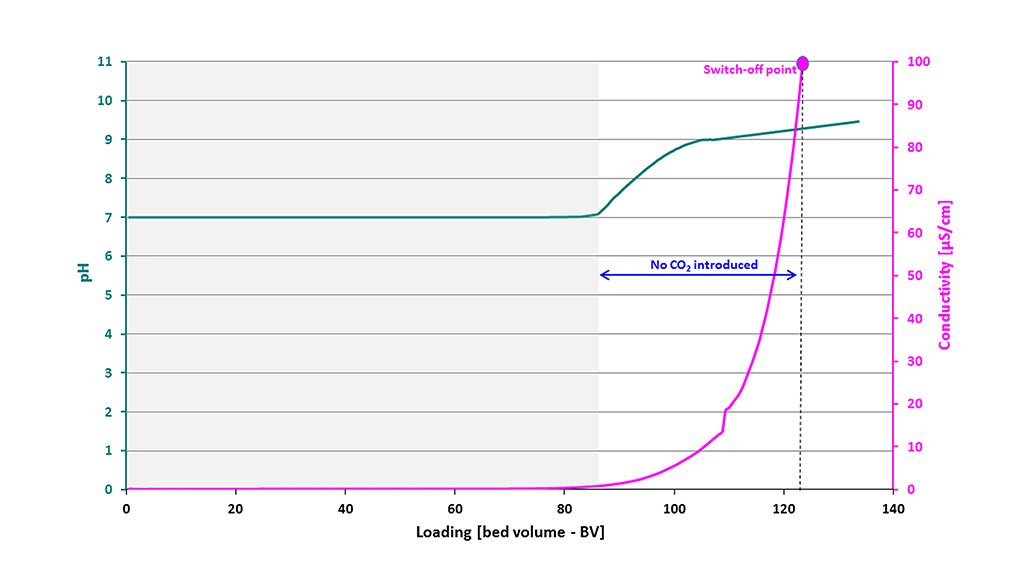
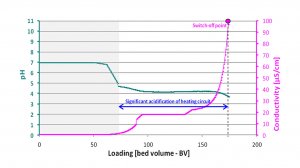
In the initial phase (Fig. 1) – up to a loading of approx. 70 bed volumes (BV) – good results are achieved (conductivity < 5 S/cm). After that, though, previously bound hydrogen carbonate is increasingly released from the now spent anion exchange resin, thereby turning the original H/OH cycle into an H/HCO3 cycle. Ultimately, after a loading of 130 BV, more strongly bound anions such as chloride, sulphate and nitrate are also released and combine with the protons to form highly aggressive mineral acids long before the conductivity increases to 100 S/cm. This value is often recommended as the switch-off point for ion exchangers.
The pH values determined at conductivities of less than 5 S/cm in the area highlighted in grey in Fig. 1 do not enable any realistic estimation of the proton concentration and thus the medium’s acidity, because this is below the minimum conductivity required by the market’s standard pH meters for a reliable measurement. The conductivity measurement, on the other hand, provides reliable information about the degree of deionisation throughout the operating period.
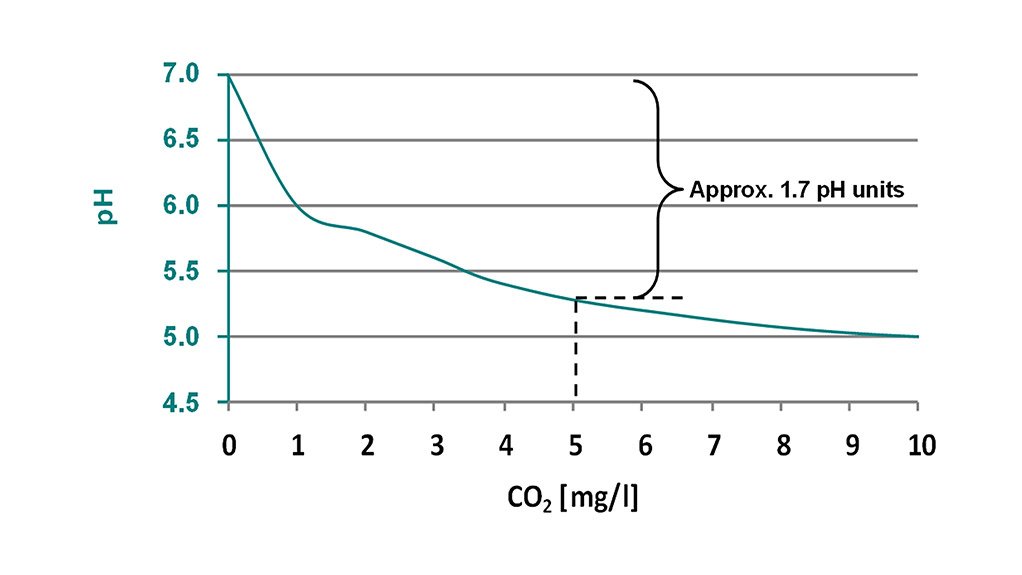
Furthermore, pH measurements in open vessels would be highly inaccurate because, for example, even tiny quantities of CO2 – which could be introduced into the sample through contact with the surrounding air – would significantly distort the measuring result. Even 5 mg of CO2, which is equivalent to around 2.5 ml of gas, dissolved in a litre of demineralised water in a precision measurement performed for control purposes produced a shift in pH of around 1.7 units into the acidic range (Fig. 2).
Only the subsequent values obtained at higher conductivities – outside the grey area in Fig. 1 – generate a realistic picture and provide evidence of significant acidification to a level of pH < 4. The standard method with a mixed bed exchanger of this kind would thus expose the relevant heating installation to a significant risk of corrosion.
Customised exchanger capacity
To take into account the fact that both the total capacity and the usable capacity of an anion exchange resin is always lower than that of a cation exchange resin, Lanxess developed the new Lewatit NM 3367 mixed bed exchanger specifically for this deionisation application. Two-thirds of this exchanger consists of a highly alkaline anion exchange resin, with a special transformation process ensuring it is loaded with over 90% OH- ions. A hydroxide loading of this kind cannot be achieved with conventional transformation/regeneration processes and we therefore do not recommend conventional regeneration.
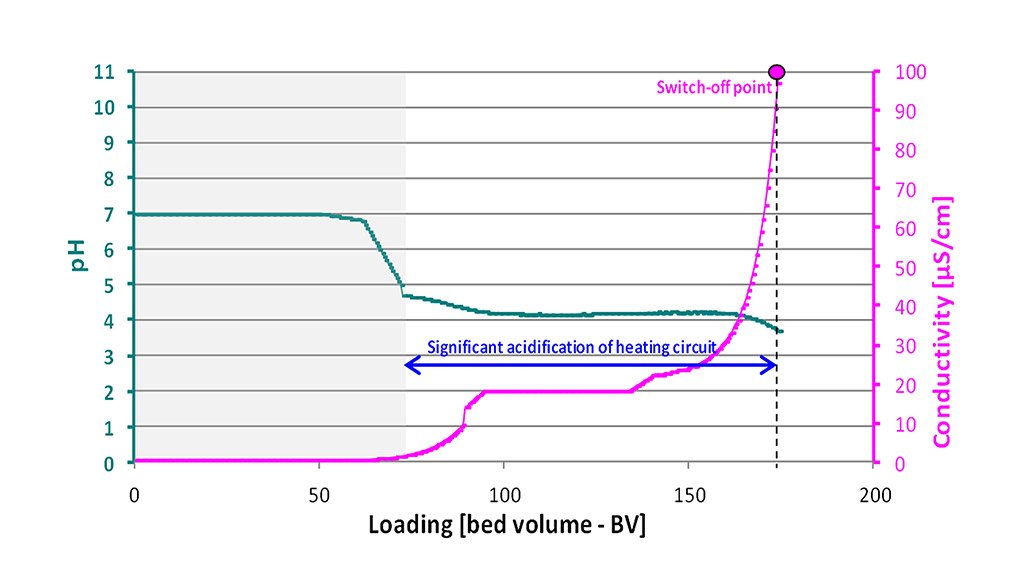
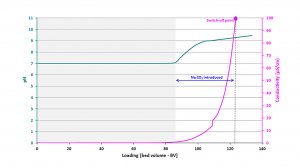
This would lead to significant performance losses if the resins were subsequently to be reused. Due to the high OH- loading, the new exchanger system only exhibits an increase in the conductivity curve after a loading of approx. 90 BV (Fig. 3, raw water with total salt content of 5.3 meq/l, carbonate hardness 2.5 meq/l). Unlike the situation in Fig. 1, however, this is not associated with a reduction in the pH, but with a gradual increase to approx. 9.5 up to the switch-off point at a conductivity of 100 S/cm and a loading of approx. 120 BV. Only after the switch-off point does the pH fall again – outside the range displayed in Fig. 3 – due to acid formation.
If aluminium components conveying water are present in the heating installation, the switch-off point would need to be brought forward to a conductivity of 5 S/cm so as not to exceed the resultant upper pH limit of 8.5. In the case in question, this corresponds to a loading of approx. 100 BV. For other raw water qualities, too, no alkaline aluminium corrosion should occur up to this conductivity limit if using this mixed bed system.
Since even small quantities of impurities can cause significant changes in the pH in fully deionised and thus unbuffered water – as shown in the above example of CO2 addition – we consider it to be necessary after initial filling with deionised water to use demineralised water for any topping up.
Impact on handling
The virtually total loading of the anion exchange resin in the Lewatit NM 3367 mixed bed system with OH- ions creates the basis for a high exchange capacity, long service lives and thus high efficiency. However, it must be ensured that the mixed bed exchanger does not lose any of its initial capacity in the logistics chain prior to its use. Our investigations reveal that factors such as the reaction with carbon dioxide from the environment result in an undesirable reduction in capacity.
Resin-bound hydrogen carbonate is generated at the expense of the anion exchange resin’s OH- loading. This hydrogen carbonate, which is released again as the exchange process advances, leads to premature formation of carbonic acid and thus to the medium’s acidification.
Our measurements have shown that the form and course of the pH and conductivity curves of exchanger material changed in this way do not differ fundamentally from the curves in Fig. 1 in the initial stages. However, the conductivity of 5 S/cm is now already exceeded after approx. 60 BV, which is associated with a lowering of the pH into the acidic range. This is equivalent to a capacity deficit of approx. 30% based on the specified capacity.
To prevent this effect, contact with the surrounding air must be restricted during storage and transportation. Our tests demonstrated that aluminium-coated foil packaging is ideal for significantly reducing CO2 diffusion through the foil. Other barrier materials or packing the resin in a vacuum also appear conceivable, but the latter is far more costly. All these processes appear suitable for ensuring that the specified capacity of the exchange resins remains unchanged during a typical storage period not exceeding two years.
Within a few days of opening, containers should be transferred to sealed, gas-tight containers – i.e. either small cartridges or larger exchanger columns – to prevent capacity losses due to a reaction with CO2 from the air. This type of handling can be supported by selecting suitable container sizes. In our opinion, containers with a capacity of 12.5 l or 25 l are ideal. They can be transferred directly and in their entirety to appropriate stationary or mobile exchanger containers.
Summary
Although softening the water used to fill and top up water heating installations is an effective means of preventing scale formation in the heating circuit, further measures are required to protect against corrosion in particular.
Full deionisation of water is one possibility, with the absence of ions and the resultant very low conductivity of the water preventing corrosion. Mixed bed ion exchange resins offer benefits when it comes to implementing such demineralisation.
A newly developed mixed bed exchanger system with a significant surplus of an anion exchange resin loaded with OH- ions to a high extent and specially tailored gas-tight packaging deliver a high exchange capacity and equally high process safety. This can reliably prevent acid-induced corrosion of the metallic parts of the heating installation up to a switch-off point at a conductivity of 100 S/cm.
Literature
- M. Hannemann, TGA-Fachplaner 2010 (3), 48-53.
- D. Ende, SBZ – Sanitär Heizung Klima 2008 (9) 50-53.
- A. Kämpf, IKZ-Fachplaner 2006, 12-15.
- Guideline VDI 2035, Part 1, Prevention of damage in water heating installations – Scale formation in domestic hot water supply installations and water heating installations, VDI-Verlag, Düsseldorf 2005, p. 10.
- Guideline VDI 2035, Part 2, Prevention of damage in water heating installations – Water-side corrosion, VDI-Verlag, Düsseldorf 2009, p. 9, 12.
Contact
Hans-Jürgen Wedemeyer
Manager, Technical Marketing
Liquid Purification Technology business unit
LANXESS Deutschland GmbH
Phone: +49 221 8885 6455
Email: hans-juergen.wedemeyer@lanxess.com
Website: www.lanxess.com or www.lewatit.com
Approx. 2,000 words / approx. 12,850 characters incl. spaces
Figures
Fig. 1 Conductivity and pH during deionisation of water with a mixed bed exchanger comprising 55% cation and 45% anion exchange resin
Fig. 2 Influence of CO2 dissolved in demineralised water on the pH
Fig. 3 Conductivity and pH during deionisation of water with Lewatit NM 3367
Article Enquiry
Email Article
Save Article
Feedback
To advertise email advertising@creamermedia.co.za or click here
Research Reports

Projects
Latest Multimedia

Latest News
Showroom
For over 30 years, Werner South Africa Pumps & Equipment (PTY) LTD has been designing, manufacturing, supplying and maintaining specialist...
VISIT SHOWROOM
Your global lifecycle technology & service partner for materials & minerals processing equipment for coal, iron ore, copper, manganese & other...
VISIT SHOWROOM

Announcements
What's On
Subscribe to improve your user experience...
Option 1 (equivalent of R125 a month):
Receive a weekly copy of Creamer Media's Engineering News & Mining Weekly magazine
(print copy for those in South Africa and e-magazine for those outside of South Africa)
Receive daily email newsletters
Access to full search results
Access archive of magazine back copies
Access to Projects in Progress
Access to ONE Research Report of your choice in PDF format
Option 2 (equivalent of R375 a month):
All benefits from Option 1
PLUS
Access to Creamer Media's Research Channel Africa for ALL Research Reports, in PDF format, on various industrial and mining sectors
including Electricity; Water; Energy Transition; Hydrogen; Roads, Rail and Ports; Coal; Gold; Platinum; Battery Metals; etc.
Already a subscriber?
Forgotten your password?
Receive weekly copy of Creamer Media's Engineering News & Mining Weekly magazine (print copy for those in South Africa and e-magazine for those outside of South Africa)
➕
Recieve daily email newsletters
➕
Access to full search results
➕
Access archive of magazine back copies
➕
Access to Projects in Progress
➕
Access to ONE Research Report of your choice in PDF format
RESEARCH CHANNEL AFRICA
R4500 (equivalent of R375 a month)
SUBSCRIBEAll benefits from Option 1
➕
Access to Creamer Media's Research Channel Africa for ALL Research Reports on various industrial and mining sectors, in PDF format, including on:
Electricity
➕
Water
➕
Energy Transition
➕
Hydrogen
➕
Roads, Rail and Ports
➕
Coal
➕
Gold
➕
Platinum
➕
Battery Metals
➕
etc.
Receive all benefits from Option 1 or Option 2 delivered to numerous people at your company
➕
Multiple User names and Passwords for simultaneous log-ins
➕
Intranet integration access to all in your organisation

