



De Ruyter calls for upscaling of IPP procurement as he questions feasibility of new coal, nuclear

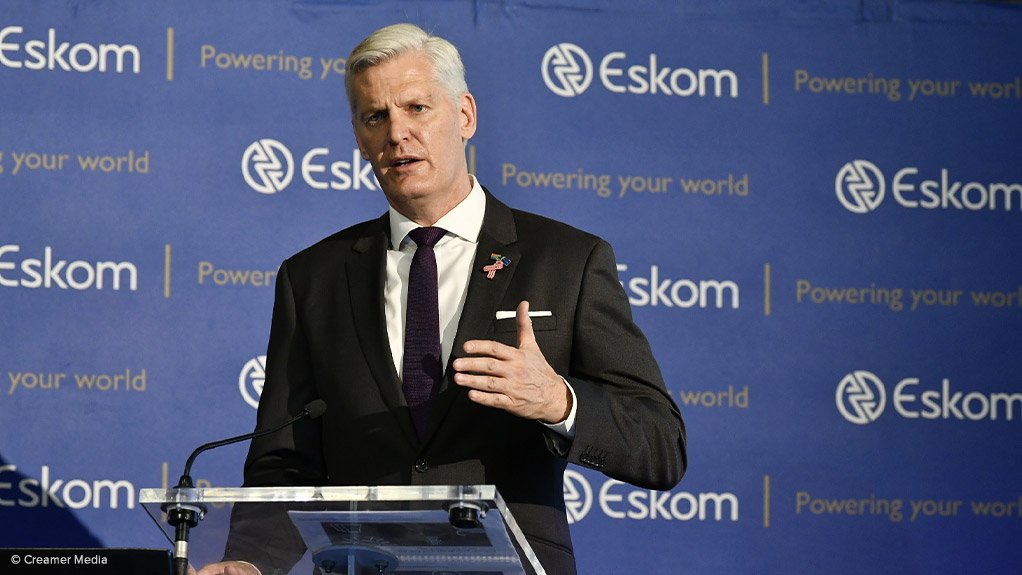


Eskom CEO Andre de Ruyter has again called on government to open the way for the procurement of more new electricity capacity in addition to the 11 800 MW outlined in a recently gazetted Ministerial determination, cautioning that the 1 500 MW of new coal included in the determination is unlikely to be built in the timeframes outlined, if at all.
Speaking to broadcaster Bruce Whitfield as part of a PSG-organised webinar, De Ruyter said that, even if the capital could be raised for new coal, the projects would struggle to secure environmental approvals and the commissioning schedule envisaged in the Integrated Resource Plan of 2019 (IRP 2019).
The IRP 2019 has allocated 750 MW of new coal for introduction into the South African system in 2023 and another 750 MW in 2027.
It emerged last month that a Marubeni-led consortium had requested to withdraw from an initial plan to build the 630-MW Thabametsi coal station, in the Limpopo province. The consortium was named in 2014 as a preferred independent power producer (IPP) bidder following government’s Coal Baseload Independent Power Producer Procurement Programme.
De Ruyter said the Ministerial determination should be welcomed, as the new capacity would be needed, regardless of whether Eskom was able to improve the reliability of its coal fleet through its so-called ‘reliability maintenance’ programme.
“But it includes about 1 500 MW of new coal. Now, even if you could get the money, or go and borrow the money in order to build a new coal plant – and that’s going to take you the better part of a decade – you then have to comply with environmental emissions. So, this is going to be a very tough ask to build 1 500 MW of additional new coal.”
He added that variable renewable energy could be financed and built, but said that more wind and solar capacity would be required than allowed for in the current determination, given the lower capacity factors of these generators relative to the coal plants that they would be replacing as a result of decommissioning.
Eskom, he said, would decommission between 8 000 MW and 12 000 MW of coal capacity over the coming ten years.
“So, we are saying that [the determination] is a fantastic first move, but give us more capacity because the country needs it.”
‘Equity in Kind’
De Ruyter indicated that Eskom would be keen to develop renewables or gas capacity of its own, but that its debt-laden balance sheet meant that it was not in a position to do so.
However, there was an opportunity to offer “equity in kind” as part of the repowering and repurposing of the first three coal plants that were scheduled for decommissioning – Grootvlei, Komati and Hendrina.
“We would love to participate in the creation of new capacity. There are some opportunities for us to participate by means of repurposing old coal-fired power stations that we can convert to natural gas, or where we can put in wind or solar and where we can contribute the infrastructure that exists at those old power stations as ‘equity in kind’ to a public–private partnership.”
He stressed, however, that the bulk of the new capacity would have to be developed by IPPs, and Eskom’s thinking had evolved to encourage such capacity rather than resisting it, as was done under what he termed Eskom’s “old style” of thinking.
“We can’t sit here and, in the national interest, make that statement [of continuing to resist], because we know that there is a train smash happening right now and we’ve got to prevent that, and we’ve got to put measures in place to enable the country to procure additional generation capacity.”
De Ruyter was more doubtful, however, about the prospects of new nuclear playing any role in closing the prevailing supply-demand gap, although he said Eskom was strongly in favour of extending the life of the existing Koeberg nuclear plant by a further 20 years, describing it as a “great asset”.
“If you start to look at the capital cost of building new nuclear and you look at the time associated with that, it will take you 12 to 15 years to bring new nuclear on line and it will probably cost you about R1.80/kWh.
“So, when you compare that to new wind, at about 70c/kWh, and you look at solar photovoltaic electricity, which is about 60c/kWh, and the fact that you can bring wind and solar on line in about 18 to 24 months, the decision kind of makes itself, even if you ignore any environmental considerations.”
He was far more keen on pursuing large-scale storage, which would allow South Africa to capture its low-cost wind and solar electricity when it was available and release it when the economy required it.
“We need to invest significantly in storage capacity and that’s going to be part of the programme going forward. Even if you add on the cost of storage, the renewable energy is still going to be more cost-competitive, both from an initial capital outlay as well as from an operating expenditure perspective.”
That said, Eskom would continue to push for higher tariffs, with De Ruyter suggesting that a cost-reflective charge would be about R1.30/kWh, as opposed to the R1.06/kWh that Eskom charges currently.
Article Enquiry
Email Article
Save Article
Feedback
To advertise email advertising@creamermedia.co.za or click here
Research Reports

Projects
Latest Multimedia
Latest News
Showroom
CMTS is a leading, well-established EC&I contractor with 37+ years of mining and industrial experience. We execute full-scope EC&I projects with...
VISIT SHOWROOM
ZF Aftermarket is the after-sales division of the world-renowned German ZF group, a global leader in mobility technology.
VISIT SHOWROOM
Announcements
What's On
Subscribe to improve your user experience...
Option 1 (equivalent of R125 a month):
Receive a weekly copy of Creamer Media's Engineering News & Mining Weekly magazine
(print copy for those in South Africa and e-magazine for those outside of South Africa)
Receive daily email newsletters
Access to full search results
Access archive of magazine back copies
Access to Projects in Progress
Access to ONE Research Report of your choice in PDF format
Option 2 (equivalent of R375 a month):
All benefits from Option 1
PLUS
Access to Creamer Media's Research Channel Africa for ALL Research Reports, in PDF format, on various industrial and mining sectors
including Electricity; Water; Energy Transition; Hydrogen; Roads, Rail and Ports; Coal; Gold; Platinum; Battery Metals; etc.
Already a subscriber?
Forgotten your password?
Receive weekly copy of Creamer Media's Engineering News & Mining Weekly magazine (print copy for those in South Africa and e-magazine for those outside of South Africa)
➕
Recieve daily email newsletters
➕
Access to full search results
➕
Access archive of magazine back copies
➕
Access to Projects in Progress
➕
Access to ONE Research Report of your choice in PDF format
RESEARCH CHANNEL AFRICA
R4500 (equivalent of R375 a month)
SUBSCRIBEAll benefits from Option 1
➕
Access to Creamer Media's Research Channel Africa for ALL Research Reports on various industrial and mining sectors, in PDF format, including on:
Electricity
➕
Water
➕
Energy Transition
➕
Hydrogen
➕
Roads, Rail and Ports
➕
Coal
➕
Gold
➕
Platinum
➕
Battery Metals
➕
etc.
Receive all benefits from Option 1 or Option 2 delivered to numerous people at your company
➕
Multiple User names and Passwords for simultaneous log-ins
➕
Intranet integration access to all in your organisation

