


Boys’ club mentality in the mining sector changing


The email Jacqui McGill received from one of her teams at a BHP Billiton coal mine in northern Australia contained great news: output delays were down 75% in a year.
That was not the only reason she let out a whoop of excitement. “I did my little yeehaw, because every single person on the email was a woman in a production role,” says McGill, asset president for two of the world’s biggest mining company’s operations in Queensland’s Bowen Basin.
“That’s the first time that had happened in my career,” McGill, an industry veteran of more than 20 years, says of the July email. “I have plenty of men in my business in senior roles, but I thought, that’s critical mass.”
Mining remains the most male-dominated business, with men holding more than 90% of executive positions. This is starting to change, however, as retiring employees help open the $1-trillion industry’s doors to female successors.
“It lags behind; it’s historically been male,” says US Labor Secretary Tom Perez. “They are missing out on great talent. They are missing out on recruiting some of the best and the brightest.”
From female-only leadership training at Canada’s Goldcorp to scholarships offered by South Africa’s Lonmin, the world’s third-largest platinum producer, mining companies are implementing initiatives aimed at guiding women into senior roles. London-based Rio Tinto Group, the second-biggest miner, has set a goal of having women make up 20% of its senior managers by 2015, from 14% last year.
In the global mining industry, women hold 8% of executive committee positions reporting directly to the CEO, according to a study by gender consulting company 20-first. This compares with 18% in the $2.9-trillion pharmaceuticals industry, the best performer in the survey.
Efforts to attract women go beyond recruiting and career development initiatives. OZ Minerals, Australia’s third-biggest copper producer, no longer makes presentations at the nation’s main mining conference.
The Diggers & Dealers Mining Forum is held annually in Kalgoorlie, a desert city known for its raucous nightlife. Some bars near the conference employ topless bartenders, known locally as skimpies.
“The entertainment provided by the town was not reflective of our values,” says former CEO Terry Burgess, who left his position on October 17.
It sends the wrong message for an industry seeking more women, according to Elizabeth Broderick, Australia’s sex discrimination commissioner. “When you participate in sexualised corporate entertainment, you are excluding women – and not only that, but potentially excluding men as well,” she says.
An ageing workforce across the mining sector means producers worldwide face a lack of sufficient candidates for management positions and should seek a more diverse range of employees, including more women, according to EY. In Canada alone, about 20% of the mining workforce will be eligible to retire by 2018, the country’s Mining Industry Human Resources Council said in a report last year.
“We’ve been fishing from the same pool for a very long time, and it is exhausted,” says Debbie Butler, a talent manager at Anglo American responsible for coal operations in Canada and Australia. “Our industry needs to focus on bringing new people into mining and this means looking beyond the traditional demographics.”
Swiss commodity producer and trader Glencore in June appointed Patrice Merrin as its first female director, ending its status as the only company on the UK’s FTSE 100 Index with an all-male board. At Brazil’s Vale, 13% of employees are women, according to its 2013 sustainability report.
Seeking to promote mining to young women, Gina Rinehart, Asia’s wealthiest woman and chairperson of Australian mining company Hancock Prospecting, this month invited students at the private girls schools where she studied, in Perth, to take up work placements at her Roy Hill iron-ore mine.
Gold producer St Barbara’s offer of additional parental leave is helping attract more women, says executive GM for people and business services Katie-Jeyn Romeyn.
Horrified Father
One of the biggest barriers to women moving into mining may be their perception of the industry, says Laura Tyler, asset president for BHP Billiton’s Cannington, mine in Australia, the world’s largest silver/lead operation.
“My father was particularly horrified when I told him I was going into mining, and I grew up on the edge of the Lancashire coalfields, in England,” says Tyler, who hires the same number of male and female graduates at the mine and began a mentorship programme to accelerate women into leadership.
Increasing numbers of women in mining is creating opportunities for new businesses.
After seeing a pregnant colleague at an Anglo American coal mine in Queensland wearing a large, ill-fitting uniform to accommodate her bump, Kym Clark last year started a business selling luminous, high-visibility work clothing for women in mining and construction, including maternity wear.
Comfortable Men
“I noticed how comfortable all the men were in their high-viz, and how uncomfortable she looked,” says Clark, a former management accountant at Anglo, who began selling uniforms in November to Glencore, BHP Billiton and other customers.
Still, mining is behind every other industry, including oil and gas, in terms of gender diversity, according to a February report by Women in Mining UK and professional services firm PwC.
Women occupy an average of 8% of board positions and 12% of management posts at mining companies with a market value of at least $500-million, according to data compiled by Bloomberg. This compares with equivalent-sized food, beverage and tobacco companies, where 13% of directors are female.
Article Enquiry
Email Article
Save Article
Feedback
To advertise email advertising@creamermedia.co.za or click here
Research Reports

Projects
Latest Multimedia
Latest News
Showroom
Established in 1933, EKATO is the world leader in agitation technology, supplying agitators for processes and applications such as chemicals and...
VISIT SHOWROOM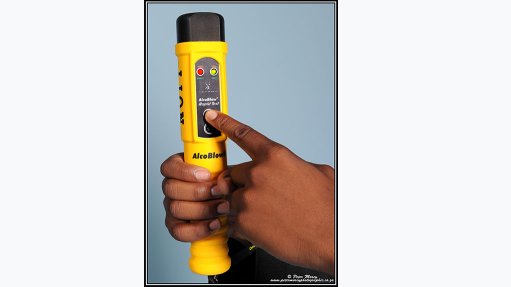
Developed to exceed the latest EN 15964 standards for police breathalysers proving that it will remain accurate and reliable for many years to come.
VISIT SHOWROOM
Announcements
What's On
Subscribe to improve your user experience...
Option 1 (equivalent of R125 a month):
Receive a weekly copy of Creamer Media's Engineering News & Mining Weekly magazine
(print copy for those in South Africa and e-magazine for those outside of South Africa)
Receive daily email newsletters
Access to full search results
Access archive of magazine back copies
Access to Projects in Progress
Access to ONE Research Report of your choice in PDF format
Option 2 (equivalent of R375 a month):
All benefits from Option 1
PLUS
Access to Creamer Media's Research Channel Africa for ALL Research Reports, in PDF format, on various industrial and mining sectors
including Electricity; Water; Energy Transition; Hydrogen; Roads, Rail and Ports; Coal; Gold; Platinum; Battery Metals; etc.
Already a subscriber?
Forgotten your password?
Receive weekly copy of Creamer Media's Engineering News & Mining Weekly magazine (print copy for those in South Africa and e-magazine for those outside of South Africa)
➕
Recieve daily email newsletters
➕
Access to full search results
➕
Access archive of magazine back copies
➕
Access to Projects in Progress
➕
Access to ONE Research Report of your choice in PDF format
RESEARCH CHANNEL AFRICA
R4500 (equivalent of R375 a month)
SUBSCRIBEAll benefits from Option 1
➕
Access to Creamer Media's Research Channel Africa for ALL Research Reports on various industrial and mining sectors, in PDF format, including on:
Electricity
➕
Water
➕
Energy Transition
➕
Hydrogen
➕
Roads, Rail and Ports
➕
Coal
➕
Gold
➕
Platinum
➕
Battery Metals
➕
etc.
Receive all benefits from Option 1 or Option 2 delivered to numerous people at your company
➕
Multiple User names and Passwords for simultaneous log-ins
➕
Intranet integration access to all in your organisation

