



Anglo CEO talks hydrogen, recycling, Scope 3, material solutions provision

Anglo American CEO Mark Cutifani interviewed by Mining Weekly’s Martin Creamer. Video: Darlene Creamer
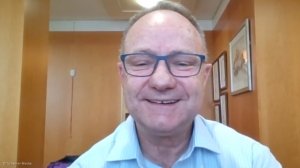


The surge of the hydrogen economy, the need to recycle, halving Scope 3 emissions through iron-ore-linked green steelmaking, assisting South Africa to create new industries, and becoming a one-stop material solutions provider were among the issues discussed by Anglo American CEO Mark Cutifani in a wide-ranging interview.
Speaking to Engineering News & Mining Weekly on Zoom, Cutifani expressed appreciation for the leadership and support that Anglo receives from the South Africa government. He described Anglo as being a strong advocate and supporter of South African “in every sense of the word”, and said the backing received for the group’s solar-linked hydrogen project in Limpopo had been “very, very good”.
Cutifani drew attention to:
- the importance of South Africa’s global leadership position in platinum group metals (PGMs) beneficiation, at a time when the world spotlight is on the catalysis role of PGMs in global decarbonisation;
- this being achieved against the background of hydrogen possibly fuelling almost 20% of the world’s energy by 2050, which would make South Africa one of the centres of the hydrogen industry on the basis of its PGMs at this stage being the best known catalysers for creating hydrogen and for turning hydrogen into water, which is basically what happens when hydrogen is used to fuel vehicles;
- the opportunity for Anglo to work with the South African government to create a coherent world-leading regulatory environment for green hydrogen, decarbonisation and climate-change mitigation, in the absence of any jurisdiction currently striking him as the coherent leader in this space, where there are industrial development and other commercial opportunities;
- the potential for green hydrogen to halve Anglo’s own Scope 3 emissions in downstream steelmaking, owing to about 45% of the company’s Scope 3 emissions being iron-ore linked, and the high quality of its iron-ore being very attractive to green steelmakers;
- the promise made to Mineral Resources and Energy Minister Gwede Mantashe that he will be the first person to sit in the driver’s seat of the world’s biggest hydrogen fuel cell truck, which the company hopes to have on the ground in Limpopo this year;
- the company retaining its technical innovation base in South Africa, where it can help to bring about new industries that could lower South African high level of unemployment;
- Anglo Platinum having 50% of the world’s non-Russian PGMs processing capacity, and the company being the PGM industry’s most significant beneficiator in that it takes material all the way to saleable products in five key steps, with the technologies applied all home-grown South African technologies;
- the need for Anglo to become a lot better in the recycling of all of its products as it plays a role in the circular economy; and
- the company’s grand vision of being a one-stop material solutions provider to the global market, where demand strength has become significantly apparent.
Engineering News & Mining Weekly (EN&MW): I’ve never before experienced such a flurry of trumpets around any sector of the economy like is happening now with the reception being given to the hydrogen economy. I was listening to the former UK Prime Minister David Cameron come over TV saying he’s going into renewable energy for fragile economies, many of them African. Then, I read about Malcolm Turnbull, another former Prime Minister, swinging into green hydrogen. It seems as though hydrogen could be pervasive, and Anglo was one of the first to join the Hydrogen Council and you got us into thinking about hydrogen, and now, suddenly, hydrogen’s just burst across the universe as a potential universal energy carrier. Where do you think it’s all going to lead?
Well, you’ve got a good memory. In 2013, we started talking hydrogen on the basis of, if you understand hydrogen molecules’ efficiency in terms of energy, it’s probably the most efficient fuel that we know of, and the good news is you need PGMs, in particular platinum, to catalyse and turn water into hydrogen, or whatever process you may have. So, yes, I was talking my own book, but the more homework I did, the more logical it seemed. Hydrogen’s been around for a long time but now we’re starting to see, with the new technologies, we’re able to harness that potential and, with the need to decarbonise, people are now understanding how they can use hydrogen, and they’re looking at renewables as the primary energy source, which is what we’re thinking about. You then create hydrogen using wind power or solar power, so there’s no carbon footprint in creating the hydrogen. Then, we can use the hydrogen to replace the diesel in a truck, and now we’ve got a carbonless energy footprint that’s quite unique. So, that really fired my imagination back in 2013, 2014, when I was trying to understand what platinum was. It’s been a great journey. We’re absolutely thrilled and excited to see that it’s starting to take off. It could go anywhere, and literally hydrogen could be fuelling almost 20% of the world’s energy by 2050 and, if that were to be the case, then South Africa would be one of the centres of the hydrogen industry on the basis that PGMs are, at this stage, the best known catalysers for creating hydrogen, and for turning hydrogen into water, which is basically what happens when we’re driving a truck.
You did another great thing by setting up, in Limpopo, the foundation for the biggest hydrogen fuel cell mining truck in the world, a 300 tonner, and that has really been great for South Africa in that it has created so many headlines around the world. How is that doing?
Very well, and I’ve got to give credit to Tony O’Neill (Anglo group director: technical and sustainability), Donovan Waller (Anglo group head of technology development), and Chris Griffith (former Anglo American Platinum CEO) when he was in platinum. They were the catalysts to bring all that thinking together. Norman Mbazima, as the chairperson of Anglo Platinum, and current CEO Natascha Viljoen are driving it as hard as they can. We’re trying to get a truck on the ground and so by, I think, July we’ll be constructing the truck, near Mogalakwena (Anglo Platinum’s PGMs mine in Limpopo). We have made the Minister a promise that he’ll be the first to sit in the driver’s seat. These are exciting times and a really important message here is that we’ve retained a technical innovation base in South Africa and for us to be a catalyst to bringing these things together and using South Africa as a base is absolutely thrilling. If we can help make that another industry for South Africa then that will be a great win for everybody, and I’ve got to say that the government’s been very supportive, the President (Cyril Ramaphosa) and all the way through his Cabinet. The Finance Minister (Tito Mboweni) has been doing a great job under very tough circumstances. We’ve had a great lot of people supporting us and it really is a privilege and a pleasure to be working with our South African colleagues.
People used to say to me that when they came to South Africa to invest in mining, the red tape was rolled out, and that when they went to mining jurisdictions in South America, the red carpet was rolled out. Is there a little more red carpet that you’re noticing in South Africa?
Being an Aussie, I’ve never really had red carpet treatment in South Africa. But what I will say is that we’ve always had a lot of friendly banter and arguments about who’s got the best rugby team and who’s got the best cricket team. From our point of view, the one thing we always know we’ll have in South Africa are honest conversations. We are always working around how to best do the job and how we can do it together, and I’ve got to give great credit to the Minister, who has really worked hard to be a partner and to help support us. At the same time, we don’t always agree on everything. He’s trying to do the best thing for South Africa, which we appreciate, but certainly the leadership and the support we get, we really do appreciate, and while I still wouldn’t say it’s red carpet, we certainly get the support and help we need and, in talking about the solar array, the renewable source, the sun, the idea of the hydrogen strategy, being able to use that energy inside our operations, the Minister has been fantastically supportive, Eskom, all the associated Ministries, the President and local communities have all been very, very good. Now, we’ve got to do a lot better with our local communities but, to be fair, we’ve generally had pretty good support, and we are strong advocates and supporters of South Africa, in every sense of the word.
EN&MW always likes to look at the mines themselves as to how they are also using the technologies that they are giving metals to, and that other people are using to clean the planet – how the mines are themselves putting into practice what green metals preach. I read about the nickel miner in Australia who’s changing his whole fleet to a fleet of electric vehicles that make use of the nickel that he mines. How extensively are your green metals preaching to you and how are you getting greener in your own organisation?
Firstly, we’re continuing to grow our copper business, our nickel business. We’ve bought into crop nutrients with this polyhalite fertiliser that we hope we can sell into South Africa to help our farmers. We have diamonds for those that you love. We’ve got a whole range of products that are looking pretty strong in today’s market. We’re a great user and adopter of technology, so the spin-offs and the benefits of that in South Africa are that we can potentially help bring new industries, and a lot of people forget that beneficiation is core to who we are, particularly in the platinum business. Today, Anglo Platinum actually has 50% of the world’s non-Russian processing capacity in the PGMs space. We take material right to metal. We actually beneficiate through five key steps to get into saleable product in metal form, and that is beneficiation in every sense of the word. We’re the most significant beneficiator in the platinum industry, and the technologies that have been applied and developed in that business, to make it as efficient as it is today, are all South African home-grown technologies, something to be very proud of. The products, the technologies we’re applying, the new digital technologies, are all being worked on to try and improve our operations to make sure that we’ve got another 100 years oflife in those operations for all South Africans.
Article Enquiry
Email Article
Save Article
Feedback
To advertise email advertising@creamermedia.co.za or click here
Research Reports

Projects
Latest Multimedia
Latest News
Showroom

Sika South Africa is a trusted partner for the nation’s infrastructure, commercial, residential, and industrial sectors.
VISIT SHOWROOM
ECG provides specialised electrical engineering services to the Mining, Utilities, Materials Handling and Industrial industries, with extensive and...
VISIT SHOWROOM

Announcements
What's On
Subscribe to improve your user experience...
Option 1 (equivalent of R125 a month):
Receive a weekly copy of Creamer Media's Engineering News & Mining Weekly magazine
(print copy for those in South Africa and e-magazine for those outside of South Africa)
Receive daily email newsletters
Access to full search results
Access archive of magazine back copies
Access to Projects in Progress
Access to ONE Research Report of your choice in PDF format
Option 2 (equivalent of R375 a month):
All benefits from Option 1
PLUS
Access to Creamer Media's Research Channel Africa for ALL Research Reports, in PDF format, on various industrial and mining sectors
including Electricity; Water; Energy Transition; Hydrogen; Roads, Rail and Ports; Coal; Gold; Platinum; Battery Metals; etc.
Already a subscriber?
Forgotten your password?
Receive weekly copy of Creamer Media's Engineering News & Mining Weekly magazine (print copy for those in South Africa and e-magazine for those outside of South Africa)
➕
Recieve daily email newsletters
➕
Access to full search results
➕
Access archive of magazine back copies
➕
Access to Projects in Progress
➕
Access to ONE Research Report of your choice in PDF format
RESEARCH CHANNEL AFRICA
R4500 (equivalent of R375 a month)
SUBSCRIBEAll benefits from Option 1
➕
Access to Creamer Media's Research Channel Africa for ALL Research Reports on various industrial and mining sectors, in PDF format, including on:
Electricity
➕
Water
➕
Energy Transition
➕
Hydrogen
➕
Roads, Rail and Ports
➕
Coal
➕
Gold
➕
Platinum
➕
Battery Metals
➕
etc.
Receive all benefits from Option 1 or Option 2 delivered to numerous people at your company
➕
Multiple User names and Passwords for simultaneous log-ins
➕
Intranet integration access to all in your organisation

