



Amplats weighs in on palladium to platinum substitution

Amplats CEO Chris Griffith responds to Mining Weekly’s Martin Creamer. Video Editing: Nicholas Boyd. Photographs: Donna Slater. Video: Kutlwano Matlala; Editing: Nicholas Boyd.
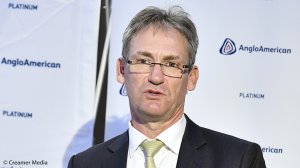


The platinum industry could very easily experience an original-equipment manufacturer (OEM) switching from palladium to platinum in the short term, platinum-group metals (PGMs) are unlikely to be used in battery electric vehicles (BEVs) soon and communities are sharing considerably in the latest dividend windfall of Anglo American Platinum (Amplats).
Outgoing Amplats CEO Chris Griffith made these points in response to questions put by Engineering News & Mining Weekly on the current slowness in the switch from palladium to platinum by the automotive industry, the chances of PGMs being used any time soon in BEVs, and not only in fuel cell electric vehicles (FCEVs), and the extent to which communities will share in Amplats’ latest large dividend windfall.
A cash dividend of R11.2-billion was declared for the second half of 2019, taking the total dividend for the year to R14.2-billion.
Engineering News & Mining Weekly put it to Griffith that past platinum and palladium alternating took place far more quickly and with seeming ease compared to the slow, undecisive situation currently.
But Griffith countered that there had always been a need to go through a process before actual substitution of one PGM for another took place.
The industry, he said, could find that substitution had been introduced to temper prices.
In 2019, the palladium price gained 48%, setting numerous price records along the way, and the rhodium price rose 73%, while the platinum price fell 1% and the rand basket price rose by 38%. That pushed Amplats’ revenue up 33% to $100-billion. Palladium ended the year by contributing 40% to the total and platinum’s contribution fell to 29%.
“It wouldn’t be unexpected to see an OEM come out and say: ‘We have a big solution and a substitution for palladium and it’s called platinum’. We know that,” he said.
But, with the regulatory focus on real-world driving tests, far tighter carbon dioxide emissions and the impact of the Volkswagen emissions scandal, there was a far greater likelihood of OEMs being ultracautious before switching applications.
“That’s why it won’t perhaps be done as quickly as in the past. To get the right emission levels, OEMs have to spend more time coming up with the right technical solutions – but don’t be surprised if you get an OEM saying it has a substitution for palladium and rhodium. In all likelihood, that substitution is going to be platinum, because the fact is they’re actually very, very good metals. They do the job that they’re required to do,” he said.
On the progress of the Lion Battery Technology joint venture to accelerate the development of next-generation battery technology using platinum and palladium, he said it was too early to say whether PGMs would play a role in BEVs.
JSE-listed Amplats and TSX-listed Platinum Group Metals last year launched Lion, which subsequently entered into an agreement with Florida International University to further advance a research programme that uses platinum and palladium to unlock the potential of lithium air and lithium sulphur battery chemistries to increase their discharge capacities and cyclability.
Griffith said he expected most of Amplats’ work to continue to be focused on FCEVs, where there was considerably more potential for PGMs to be part of the hydrogen economy solution than for the metals to be part of the BEVs.
“But the fact is that PGMs do such amazing things in so many applications that we don’t even know where some of the solutions of the future will come from, so who says that PGMs can’t be a really cost-effective solution for batteries, and that’s why we’ve assumed that option. “But, if you asked us to hedge our bets, I think it would be better to expect a greater uptake in the green economy and for platinum to be associated with hydrogen fuel cells,” he said.
He said the second-half dividend allocation to communities would be R260-million, of which R157-million would go towards repaying loans and just over R100-million to the communities themselves.
Article Enquiry
Email Article
Save Article
Feedback
To advertise email advertising@creamermedia.co.za or click here
Research Reports

Projects
Latest Multimedia

Latest News
Showroom

SmartMine IoT has been developed with the mining industry in mind, to provides our customers with powerful business intelligence and data modelling...
VISIT SHOWROOM
Developed to exceed the latest EN 15964 standards for police breathalysers proving that it will remain accurate and reliable for many years to come.
VISIT SHOWROOM

Press Office
Announcements
What's On
Subscribe to improve your user experience...
Option 1 (equivalent of R125 a month):
Receive a weekly copy of Creamer Media's Engineering News & Mining Weekly magazine
(print copy for those in South Africa and e-magazine for those outside of South Africa)
Receive daily email newsletters
Access to full search results
Access archive of magazine back copies
Access to Projects in Progress
Access to ONE Research Report of your choice in PDF format
Option 2 (equivalent of R375 a month):
All benefits from Option 1
PLUS
Access to Creamer Media's Research Channel Africa for ALL Research Reports, in PDF format, on various industrial and mining sectors
including Electricity; Water; Energy Transition; Hydrogen; Roads, Rail and Ports; Coal; Gold; Platinum; Battery Metals; etc.
Already a subscriber?
Forgotten your password?
Receive weekly copy of Creamer Media's Engineering News & Mining Weekly magazine (print copy for those in South Africa and e-magazine for those outside of South Africa)
➕
Recieve daily email newsletters
➕
Access to full search results
➕
Access archive of magazine back copies
➕
Access to Projects in Progress
➕
Access to ONE Research Report of your choice in PDF format
RESEARCH CHANNEL AFRICA
R4500 (equivalent of R375 a month)
SUBSCRIBEAll benefits from Option 1
➕
Access to Creamer Media's Research Channel Africa for ALL Research Reports on various industrial and mining sectors, in PDF format, including on:
Electricity
➕
Water
➕
Energy Transition
➕
Hydrogen
➕
Roads, Rail and Ports
➕
Coal
➕
Gold
➕
Platinum
➕
Battery Metals
➕
etc.
Receive all benefits from Option 1 or Option 2 delivered to numerous people at your company
➕
Multiple User names and Passwords for simultaneous log-ins
➕
Intranet integration access to all in your organisation

