



Amended Act a ‘second revolution’ for competition law in South Africa

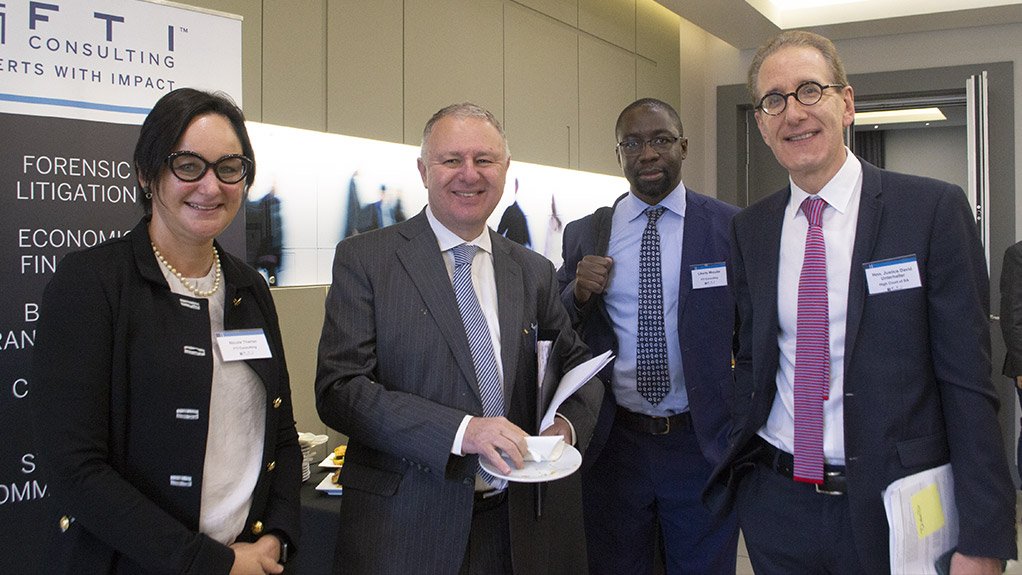
THUMBS UP Nicola Theron, Norman Manoim, Liberty Mncube and Justice David Unterhalter



The Competition Amendment Act, which was signed into law by President Cyril Ramaphosa in February, represents a “second revolution” for competition law in South Africa and will require practitioners to enter territory that is unchartered globally, Justice David Unterhalter argues.
Speaking during a recent panel discussion on the evolution of competition law and economics in South Africa over the past 21 years, Unterhalter described the amendments as conceptually “adventurous” and said lawyers and economists would have to come to terms with the changes so that they could be operationalised in actual cases.
Government argues that the amendments have strengthened the hand of the competition authorities to address economic concentration and to promote economic transformation. It also states that the Act provides firms and investors with greater clarity on prohibited practices and what constitutes abuse of dominance.
“This is the second revolution of competition law in our country – everyone had to come to terms, in the first phase, with concepts that were pretty well understood in other jurisdictions [but] novel in ours.
“We are now entering a terrain that is pretty much unknown in other jurisdictions and we are going to have to fashion these concepts, apply them, understand them, operationalise them and make them manageable within our jurisdiction,” Unterhalter, who was involved in numerous competition matters prior to being appointed to the High Court in 2017, argued.
Competition Tribunal chairperson Norman Manoim concurred, adding that the amendments represented a “major philosophical shift” for which there was no precedent internationally.
“So, we are pioneers,” he added, at the event in Sandton, organised by FTI Consulting.
The amendments, Manoim explained, went well beyond the traditional framework of prohibiting exclusionary acts by dominant firms by stating that such firms had a “positive duty” to include a certain category of entrants in the market. “You have a positive duty, if you have buyer power, to not use that buyer power in a way that discriminates against the small firm or historically disadvantaged individuals.”
Unterhalter said the South African “experiment” was likely to be examined closely by other countries in light of the current uncertainties facing antitrust law globally.
“In truth, a good deal of what lies behind our amendment is to deal with questions of distributive justice, rather than how to make our economy the most efficient economy it can be.”
Nevertheless, the changes could still have resonance in some of the big debates taking place internationally on antitrust law, which risked becoming a “redundant sideshow” in light of the digital-economy-led changes sweeping the international economic landscape.
Manoim cautioned that the language in the Act was challenging to follow, which could make “literal interpretations” difficult and result in economists, rather than lawyers, playing a more central role in defining the economic problems that needed resolving. He also saw the Competition Commission playing a key role in sifting through cases that should be addressed through the Act.
FTI Consulting MD Liberty Mncube, who was Competition Commission chief economist between 2014 and 2019, said an evolution towards the use of more advanced economic analysis was under way, which was mainly in response to the Competition Tribunal and the Competition Appeal Court becoming increasingly insistent on basing their determinations on solid economic evidence.
Some of the econometric models produced, particularly in adversarial cases, had not always proved valuable in helping to contextualise the economic problem at hand, nor had they assisted the authorities in reaching a rational conclusion.
The tribunal had, thus, begun experimenting with the so-called ‘hot tub’ legal method of allowed for testimony to be provided concurrently by the economic experts in a way that allowed both the economists and the tribunal panel to interrogate their arguments without the testimony being mediated through a lawyer.
Manoim indicated that the tribunal was likely to continue to experiment with the method under the new framework provided by the amended legislation.
“My parting message is that we have had sections that have alarmed people before, and we have learnt to live with them. I think we will learn to live with the [amendments] as well,” Manoim concluded.
Article Enquiry
Email Article
Save Article
Feedback
To advertise email advertising@creamermedia.co.za or click here
Research Reports

Projects


Latest Multimedia


Latest News


Showroom

From batteries for boats and jet skis, to batteries for cars and quad bikes, SABAT Batteries has positioned itself as the lifestyle battery of...
VISIT SHOWROOM
Rittal is a world leading provider of top-quality integrated systems for enclosures, power distribution, climate control, IT infrastructure and...
VISIT SHOWROOM


Announcements
What's On
Subscribe to improve your user experience...
Option 1 (equivalent of R125 a month):
Receive a weekly copy of Creamer Media's Engineering News & Mining Weekly magazine
(print copy for those in South Africa and e-magazine for those outside of South Africa)
Receive daily email newsletters
Access to full search results
Access archive of magazine back copies
Access to Projects in Progress
Access to ONE Research Report of your choice in PDF format
Option 2 (equivalent of R375 a month):
All benefits from Option 1
PLUS
Access to Creamer Media's Research Channel Africa for ALL Research Reports, in PDF format, on various industrial and mining sectors
including Electricity; Water; Energy Transition; Hydrogen; Roads, Rail and Ports; Coal; Gold; Platinum; Battery Metals; etc.
Already a subscriber?
Forgotten your password?
Receive weekly copy of Creamer Media's Engineering News & Mining Weekly magazine (print copy for those in South Africa and e-magazine for those outside of South Africa)
➕
Recieve daily email newsletters
➕
Access to full search results
➕
Access archive of magazine back copies
➕
Access to Projects in Progress
➕
Access to ONE Research Report of your choice in PDF format
RESEARCH CHANNEL AFRICA
R4500 (equivalent of R375 a month)
SUBSCRIBEAll benefits from Option 1
➕
Access to Creamer Media's Research Channel Africa for ALL Research Reports on various industrial and mining sectors, in PDF format, including on:
Electricity
➕
Water
➕
Energy Transition
➕
Hydrogen
➕
Roads, Rail and Ports
➕
Coal
➕
Gold
➕
Platinum
➕
Battery Metals
➕
etc.
Receive all benefits from Option 1 or Option 2 delivered to numerous people at your company
➕
Multiple User names and Passwords for simultaneous log-ins
➕
Intranet integration access to all in your organisation

